

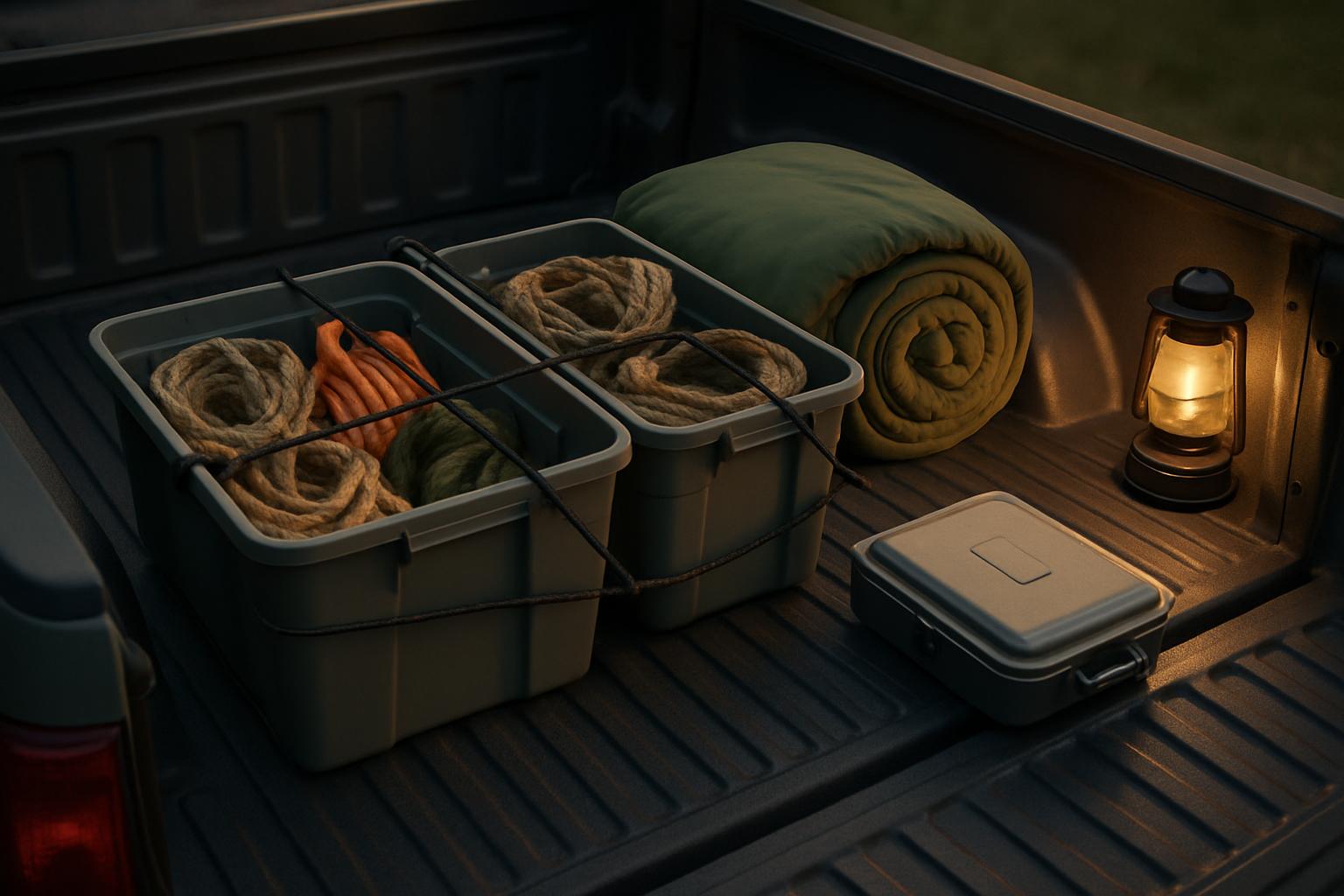
You’re standing at the tailgate with four bags, two bins, a camp chair, and a cooler that weighs forty pounds empty, and you are about to make the same mistake most truck owners make at this exact moment. You’re going to load the heavy things last because they’re awkward to stack on top of, and that means they’re going to ride behind the rear axle for the next eight hundred miles. The truck will handle it. Your steering will not.
Packing a truck bed for a road trip is not a Tetris problem. It’s a weight distribution problem that looks like a Tetris problem. Get the sequencing wrong and you will feel it in the steering, in the braking distance, and in how much the rear end wanders when a semi passes you on a wet interstate. Get it right and the truck behaves like a truck, not a shopping cart with a V8.
There are four decisions you make every time you load a bed. Most people skip three of them.
Checkpoint 1: Where Does the Heavy Gear Go?
The rear overhang on a standard half-ton truck extends roughly 18 to 24 inches past the rear axle centerline. Anything you stack in the last third of the bed is riding on the wrong side of that fulcrum. It pushes the rear down and lightens the front axle. At highway speed, that configuration does not steer the same way it does in your driveway.
Heavy items belong in the front third of the bed, against the cab wall, or directly over the rear axle. That means the full cooler, the water storage, the tool bags, the cast-iron cookware, and anything else that makes you grunt when you lift it. Load those first, before anything else goes in, because once the bins and bags are stacked they will not come back out until you make camp.
I packed a Colorado’s bed for a 10-day overlanding loop in Wyoming and loaded the water containers last because they were the most awkward shape to carry. They went in last. They ended up behind the axle. By the time I hit I-25 north of Cheyenne, the rear end was squirrely in crosswinds in a way I had not expected from a truck I had driven plenty of times before. I pulled over and rearranged at a rest stop. The drive changed immediately.
Most half-ton pickups have a payload rating between 1,500 and 2,200 pounds depending on configuration, according to manufacturer specifications from Ford and Chevrolet. That is not the number to chase. The number to manage is front-to-rear distribution. A 600-pound load distributed evenly behaves better than a 300-pound load stacked in the tailgate corner.
Checkpoint 2: What Actually Needs to Stay Dry?
The answer is smaller than your instinct suggests. Clothing bins with lids, hard-shell cases, and dry bags are already weatherproof. A tonneau cover or cargo net does not change what is inside them. What actually needs protection is anything in soft luggage: duffel bags, backpacks, open-top bags, and sleeping bags rolled in fleece stuff sacks. Those will absorb rain through sustained highway driving even under a closed tonneau if the bed rails are not sealed.
Sort your load into two categories before a strap touches anything. Category one is gear that can get wet without consequence: firewood, wet camp shoes, a folded tarp, a mesh bag of camp dishes. Category two is gear that cannot: sleeping bags, electronics, changes of clothing, paper maps, food that is not in hard coolers. Everything in category two goes into a hard bin, a dry bag, or a waterproof duffel before it goes in the bed. Not once you’re at the campsite. Before you leave the driveway.
A cargo net alone does not waterproof. A tarp bungeed over the bed does not waterproof, particularly above 55 mph. The protection has to be at the container level. This is the piece most guides skip.
Checkpoint 3: How You Secure It Changes What Survives
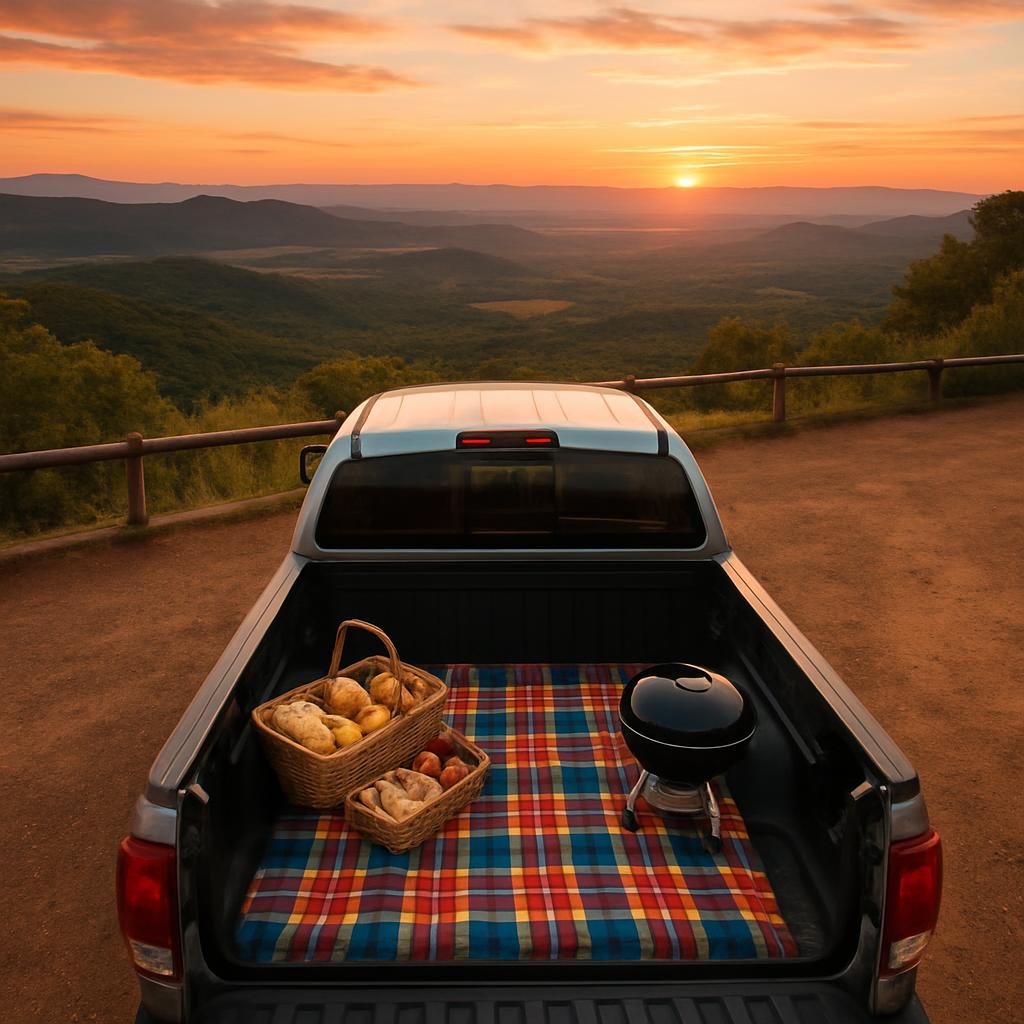
One ratchet strap running diagonally across the bed is not a securing strategy. It is a gesture. A full load needs four anchor points minimum, two per cargo group, and the straps need to be doing different jobs.
Ratchet straps are for heavy, dense items: full cooler, water containers, a toolbox, anything that would slide three feet forward under hard braking. Cam buckle straps are for medium-weight items where over-tightening crushes or warps the contents. Sleeping pads, soft bags. Don’t confuse the two.
Cargo nets are for the top layer of light items that would become road hazards at speed: camp chairs, dry bags, a stuff sack of puffy layers. The net keeps them from clearing the bed walls on a hard stop. It does not keep them dry, and it does not do much for awkwardly shaped items that can work their way through the mesh over two hundred miles of highway.
Do not use bungee cords as primary retention for anything over five pounds. Bungees stretch. Under sustained highway vibration, they lose tension progressively. What started as a tight strap is a loose one by the time you have been on the road three hours. I have watched a camp chair clear a truck bed on I-70 and it is a genuinely dangerous moment that costs about five minutes of attention to prevent.
The tie-down cleats on most modern half-tons are rated for several hundred pounds each. Use them. Run straps to opposing cleats for cross-tension rather than parallel cleats on the same side rail. Cross-tensioning resists both lateral shifting and longitudinal sliding, which are the two failure modes that actually happen.
Checkpoint 4: Can You Reach What You Need Without Unpacking Everything?
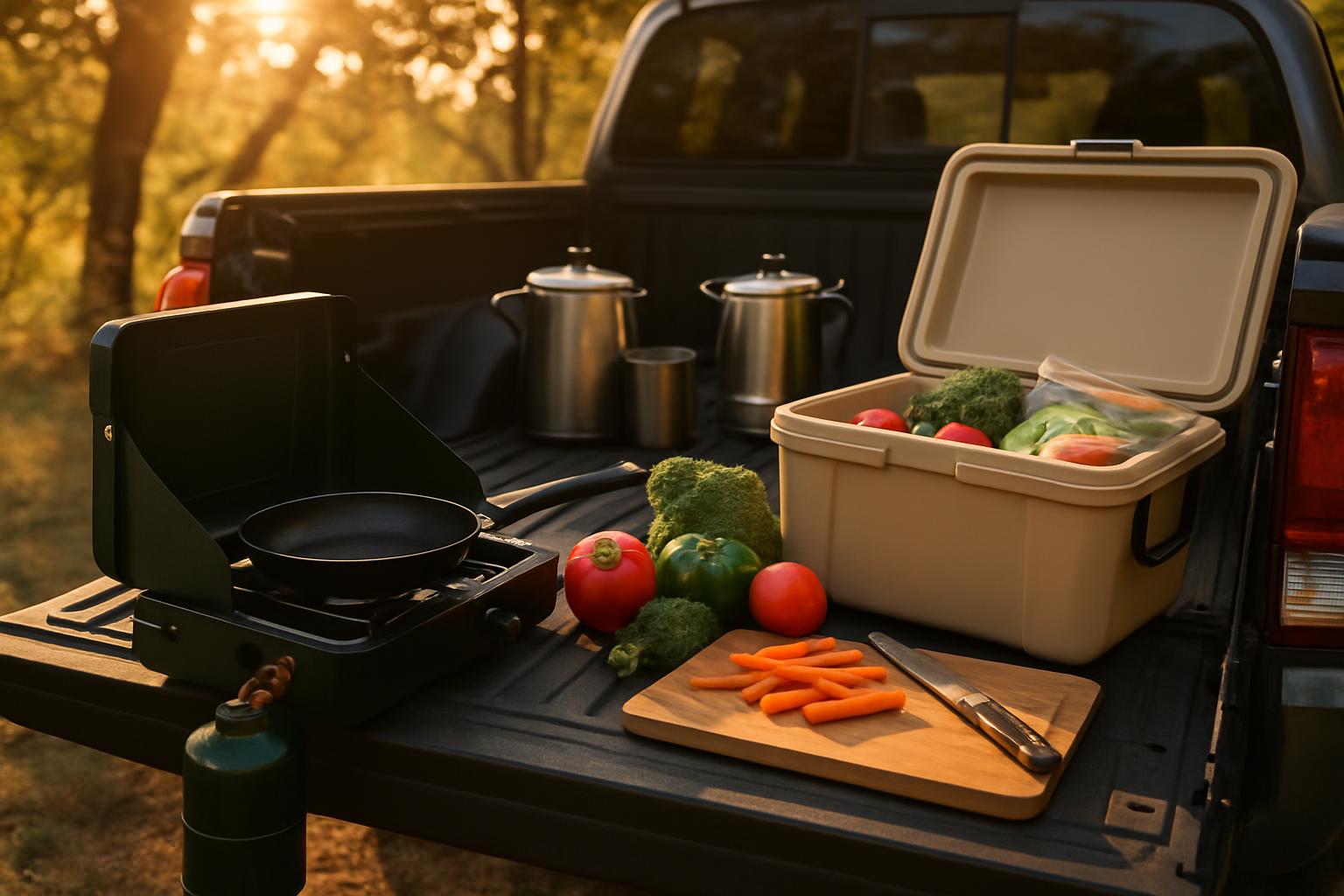
Load in reverse trip order. The gear you need at the first stop goes in last. The gear you will not touch until you make camp goes in first. It is not how most people load. Check the bed of any truck in a campground parking lot.
Map out your first day before you start packing. You are going to stop for lunch. You need the cooler accessible without moving three bins. You may stop at a trailhead before you reach the campsite. You need the daypack on top, not under the folded tent. You might need rain gear in the first hour if the forecast is uncertain.
Tall items and long items set the limits. A four-person tent in its bag is typically four to five feet long and goes along one side rail, parallel to the truck’s centerline. Everything else organizes around it. Do not try to cross-stack long items unless you have a bed extender, because they migrate against each other on curves and create pressure points on softer bags below.
This is where short-bed trucks create a real constraint. There is no organizational solution to a 5-foot bed when you are carrying 10 days of gear for two people. You will run out of horizontal space. The hard call is deciding what goes in the cab, what goes on a rooftop carrier if you have one, and what stays home.
The Loading Sequence Decision Matrix
The table below shows how to make the four cargo decisions for a standard road trip load in a half-ton or midsize truck.
| Cargo Type | Placement Zone | Securing Method | Weatherproofing Required |
|---|---|---|---|
| Heavy/dense (full cooler, water, tools) | Front third, against cab wall | Two ratchet straps, cross-tensioned | Optional: already hard-sided |
| Medium gear (clothing bins, food boxes) | Center of bed, over rear axle | Cam buckle straps | Yes for soft bags: bin or dry bag |
| Light loose gear (chairs, puffy layers) | Top layer, rear section | Cargo net | Light rain only: net will not seal |
| Long items (tent bags, poles, sleeping pads) | One side rail, parallel to centerline | One ratchet strap plus side contact | Depends on material |
| Wet or dirty gear (firewood, waders, wet shoes) | Rear, tailgate side | One ratchet strap or cargo net | Not required |
One note on this matrix: it assumes a covered bed or a tonneau. If you are running an open bed in wet weather, every soft item in the middle and rear zones needs its own waterproof container regardless of the net or straps above it. The matrix handles placement and securing. Your containers handle the weather. If you skip that second part, you will find out why around mile 300 when the rain starts.
AAA has tracked highway debris as a serious road hazard for years. The source of most of it is not blown tires or falling rocks. It is gear that left truck beds because one bungee cord was doing a ratchet strap’s job.
One Thing to Do Before You Back Out of the Driveway
Put the heaviest items in first, against the cab wall, directly over or forward of the rear axle. That single step changes how the truck steers, brakes, and responds in crosswinds more than any other loading decision. Everything else in the matrix follows from it. The cooler goes in before the bags. The water containers go in before the bins. Get that sequence right and the rest of the load falls into place around it.
References
AAA Road Trip Resources
EPA Fuel Economy Data
Ford Trucks Payload and Towing
Chevrolet Trucks Specifications
IIHS Vehicle Safety Ratings