

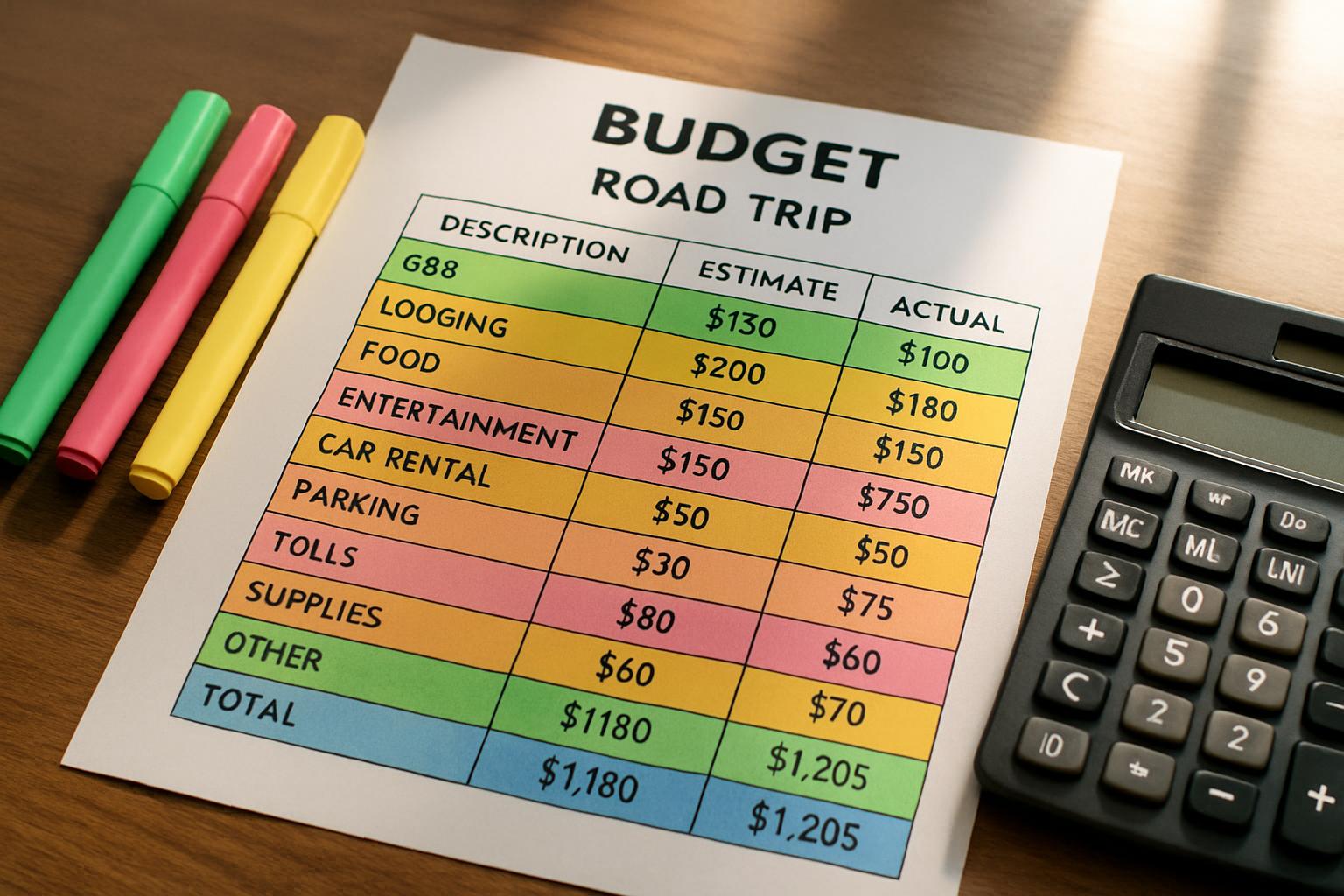
The radiator hose on the 2016 Suburban let go at noon in July, somewhere outside Barstow, with the temperature sitting at 107 degrees and the nearest town twenty minutes back. I had a budget. Four days of BLM camping, meals from a cooler, gas stops calculated in a notebook the night before. I was, by every measure of conventional road trip advice, doing everything right.
The tow to the nearest shop with the right part was 67 miles. AAA covered the haul. Nobody covered the four hours in a waiting room, or the $340 repair bill, or the motel I hadn’t planned on because I was supposed to be 200 miles north by dark. In two hours, the trip I’d spent a week planning had a $500 hole in it. The savings from four nights of free camping was roughly $280.
Every road trip has two budgets: the one you build in a spreadsheet, and the one the road charges you. This article is about not showing up with only the first one funded.
Fuel: The Line Item You’re Already Managing (and Not the Dangerous One)
Fuel gets the most attention in road trip planning because it is the most visible. You watch the price board at every exit, calculate miles per gallon before you leave, and arrive with a number you feel good about. According to AAA’s 2025 Your Driving Costs study, average fuel costs for a midsize sedan run roughly 13 to 15 cents per mile. On a 2,000-mile trip, that is around $260 to $300.
That math is correct. It is also almost never what surprises people at the end of the trip.
Fuel is manageable because you can see it coming. The gauge drops, you stop, you fill. No ambush. The categories that blow road trip budgets are the ones that arrive without warning: mechanical failures, campsites that listed $18 but charged $33 after booking fees, detours that add 80 miles, or the grocery town that closes at 6pm on Sundays.
Budget for fuel first. Then take every other category with the same seriousness. Most people do not.
Where the Money Actually Goes
You’re somewhere east of Flagstaff on day three and the plan is already behind. The campsite took longer to find than expected. You stopped for coffee. Now you are doing math on whether to push the miles or accept that tomorrow gets compressed. That is a normal road trip day. Your budget should expect it.
Food is the first category that runs away. At home, you cook. On the road, you cook until you are tired and it is 9pm and the campsite has no flat surface. AAA data shows Americans traveling by car average $142 per person per day on road trips, and food is a major driver of overage against initial budgets. A family of four that plans $40 per day for food typically lands at $65 to $80 by the third night. That gap compounds fast.
Convenience spending is the second category, invisible until you add it up: ice bags every other day, the phone cable that snaps on day four, the $18 cooler seal you stop to replace at a gas station. None of these appear in any budget template. All of them show up in your bank account.
Mechanical failure is the one nobody budgets for. A tow from AAA typically runs $100 to $300 for members depending on distance. A small-town shop with limited parts means waiting, which means unplanned lodging and meals. The Mojave does not negotiate. Neither does a grinding noise that starts on a Saturday afternoon, 40 miles past the last shop you saw.
Lodging: The Gap Between the App Price and the Checkout Screen
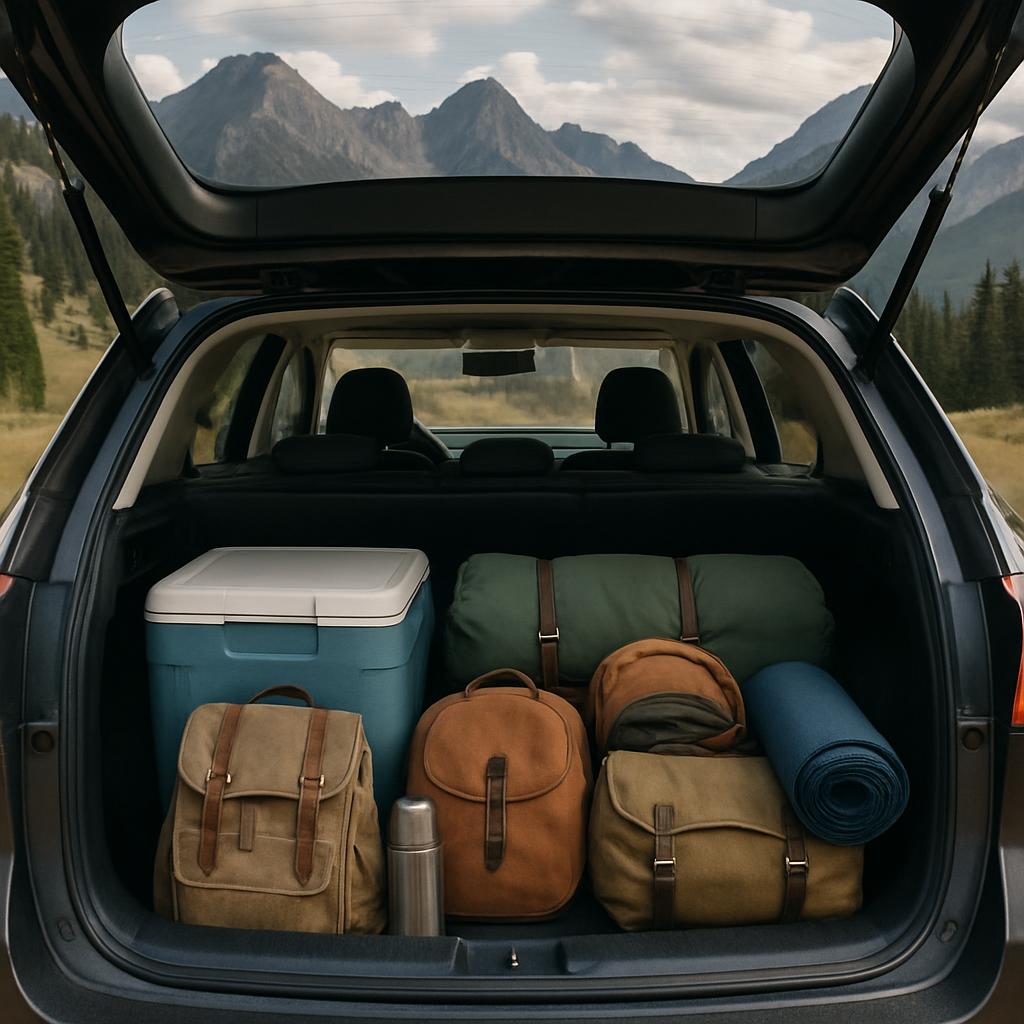
Free camping saves real money. It also sometimes means driving 40 minutes off the highway to a dispersed site with no water and no signal, and then 40 minutes back in the morning. Do that math against your fuel cost and your schedule before you call it free.
You have booked a federal recreation campsite for $18 a night. Then the reservation fee hits: $10. Then there is a day-use fee for the surrounding area you missed in the listing: $5. The $18 site cost you $33. Over a 10-night trip, that $15-per-night gap adds $150 that nobody planned for.
Motel pricing has gotten harder to predict. A room showing $79 at 3pm can show $119 by 7pm the same day. In gateway towns near national parks, Moab, Glacier, the areas around Zion, weekend rates run 40 to 70 percent above weekday rates per AAA data. Booking in advance locks in a rate and limits flexibility. Not booking leaves you exposed to surge pricing when you are tired and out of better options.
Neither is wrong. But decide which one you are using before the trip starts. The mistake is assuming the flexible approach will hold on the nights it matters most.
Vehicles and the Hidden Cost of the Wrong One
The vehicle choice is where budget road trippers make their most expensive mistake. It usually does not look like a mistake until mile 400.
A body-on-frame truck gives you payload, towing capacity, and access to roads that stop a sedan cold. It also gives you 14 to 18 mpg on the highway depending on load and conditions. A RAV4 Hybrid or CR-V Hybrid returns 36 to 40 mpg on the same roads. On a 3,000-mile trip, the fuel difference between a 16-mpg Silverado and a 38-mpg RAV4 Hybrid, at roughly $3.20 per gallon per AAA’s 2025 tracking, runs about $280. Real money. Not a reason to take the wrong vehicle.

If you are driving highway miles between campgrounds with a soft-sided cooler and two duffel bags, the Silverado is doing nothing for you except costing more per mile. If you are going off-pavement with real gear, the truck is the right tool and the fuel cost is the price of access. Those are two different trips with two different answers.
The EPA’s fuel economy data at fueleconomy.gov lets you enter a vehicle and calculate fuel cost for a specific mileage. Use it before you decide which vehicle to take.
The Float: The Only Number That Makes the Rest of the Plan Hold
The most useful thing I can tell you about road trip budgeting in 2026: set aside 15 to 20 percent of your total planned budget as a float before you book anything. Not in a savings account. As actual budgeted trip money you expect to either spend or not spend. If you spend none of it, the trip came in under. If you spend all of it, the trip came in on budget. The outcome to avoid is day 8 of a 14-day trip with $200 left and a brake noise that started yesterday.
Here is what that looks like:
| Trip Type | Vehicle | Planned Budget | Typical Overage | Recommended Float |
|---|---|---|---|---|
| 3-day weekend, solo, 900 miles | 2026 Toyota Camry | $320 | $65-90 | $60 |
| 7-day regional, couple, 2,000 miles | 2026 Honda CR-V Hybrid | $1,150 | $175-250 | $210 |
| 14-day cross-country, family of 4, 4,500 miles | 2026 Chevy Suburban | $3,400 | $480-680 | $600 |
Sources: AAA 2025 Your Driving Costs; EPA fueleconomy.gov 2025 data; overage estimates based on AAA-reported traveler cost averages.
The $320 solo weekend figure assumes free BLM or dispersed camping, all meals self-prepared, and no paid attractions. Gas at 32 mpg and $3.50/gallon accounts for roughly $100 of that budget. A single paid campsite and two restaurant meals add $80–120. The 14-day Suburban figure assumes 10+ campsite nights, most meals from a cooler, and no major paid attractions. Fuel at 15 mpg accounts for roughly $1,050. Budget-hotel nights or restaurant meals push that real number to $4,500–5,500.
The float does not require a separate account. It requires that you write it into the budget before you start booking. Road trips are variable-cost trips where the range of outcomes is wide. Plan for the range, not the best case.
Building the float changes every booking decision. If you have $200 of headroom, you take the $18 campsite with confidence instead of the $30 backup. You keep the AAA membership instead of dropping it. You do not, on day six, do math on whether a grinding noise is serious. You already covered it.
The Planning Mistake That Sounds Like Good Advice
Most road trip budget guides tell you to plan each category around the cheapest available option and add a buffer on top. That is the wrong model.
The cheapest campsite often means 20 miles off route at the end of a long day. The cheapest gas station often means a 12-mile round-trip detour. You save $12 and spend an hour plus fuel. By day four, those small inefficiencies compound into a trip that feels behind before anything has actually gone wrong.
Find the site or room that is on-route, even if it costs $10 more. Budget around on-route fuel stops. Time costs are real costs on a road trip. They just do not show up as a line item until you are already spending them.
If your budget is $1,100 for two people over seven days, that trip is possible. You will be in a tent most nights, buying groceries instead of sitting down to dinner, watching every fuel stop. But you will make it, if you plan for exactly that and not for a vague figure that “should work out around $1,400.”
The Part Arrived the Next Morning
The shop in Victorville called at 9am. The part had come in. The Suburban was ready by noon. I was back on the road by 12:30, two and a half days behind schedule and $500 lighter than I had been when I left home.
That trip ended 11 percent over budget. Not because I planned badly. Because a $23 radiator hose set off a chain of costs that totaled $500, and I had nothing built in to absorb it. The float I did not have was exactly $500. The thing I am going to build into every trip budget from here forward is the number that covers the afternoon the road decides to rewrite the plan.
Plan the route. Book the campsites. Run the fuel numbers. Do all of it. Then add 15 to 20 percent on top, and call it what it is: the budget for the trip the road is actually going to give you.
References
AAA Road Trip and Driving Cost Data
EPA Fuel Economy Data
EPA Fuel Economy Vehicle Search Tool