

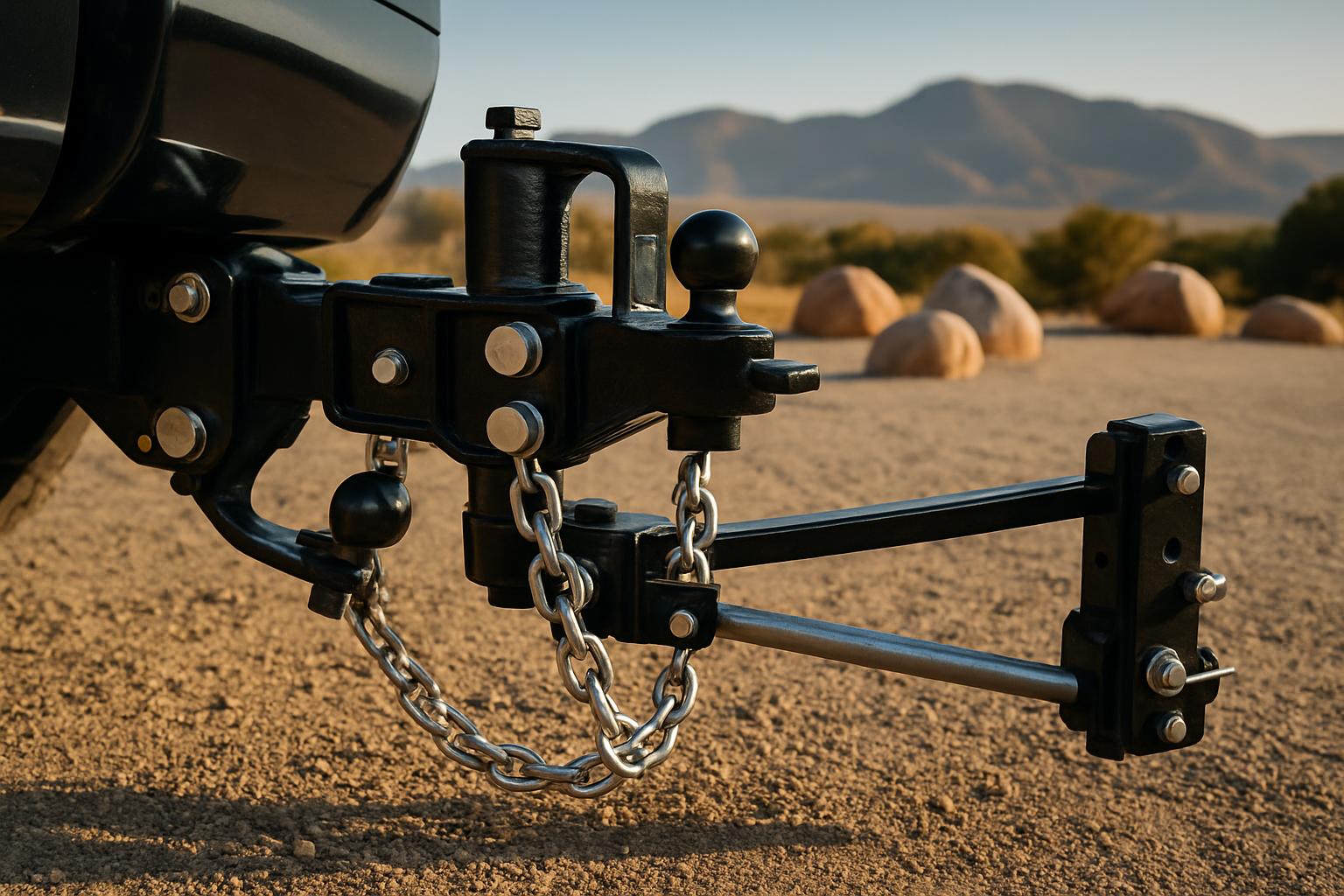
You’re in a campground parking lot in southern Utah, watching a late-model half-ton pickup sag at the rear hitch. The owner isn’t worried. The window sticker says 10,000 pounds, and the trailer’s weight certificate says 9,200. By the numbers, everything checks out.
Except the truck has four adults, a full bed of camping gear, a 120-quart cooler wedged against the cab, and a nearly full tank. Nobody ran that math. Nobody does. And that’s why the rear suspension on a technically legal tow rig sometimes looks exactly like that.
The tow rating on the door sticker is real. It is also the maximum the vehicle can handle under conditions that almost never exist on an actual trip: one driver, no passengers, empty cargo areas, sea level, mild grade. The number that governs your real trip is always smaller, and the gap between that number and the sticker is the part that catches people.
The Number on the Sticker Is a Ceiling, Not a Plan
Most current tow ratings are developed according to SAE J2807, the industry standard that major manufacturers adopted starting around 2013. The standard is legitimate. The rated figure reflects what the vehicle can tow under controlled test conditions with a properly equipped setup. What it does not reflect is the weight of you, your co-pilot, your kids, your dogs, or any cargo already in the bed or cabin.
The governing math runs through two numbers: the Gross Vehicle Weight Rating and the payload capacity. The Gross Vehicle Weight Rating is the maximum total weight of the vehicle, including passengers, fuel, cargo, and the tongue weight of the trailer. Payload capacity is the difference between the Gross Vehicle Weight Rating and the vehicle’s curb weight. Every passenger, every bag, every full water container you put in the truck comes out of that payload budget. Tongue weight, which is the downward force the trailer coupler exerts on the hitch ball, also comes directly out of it.
When your payload budget runs out, you’ve hit the limit. Not the tow limit. The truck limit. You can be well under your rated tow capacity and still be overloaded if you’ve spent the payload on people and gear. The door placard, not the brochure, is the number that governs.
I have no patience for towing specs cited without payload disclosure. The headline number in the brochure assumes the right axle ratio, the right tow package, an empty cab, and a light right foot on flat ground. Most salespeople won’t volunteer that information. You have to ask, and you have to know what question to ask.
The Math Nobody Does Before Leaving the Driveway
Take a common towing setup: a 2025 Ford F-150 SuperCrew with the 3.5-liter EcoBoost and the Max Trailer Tow Package. Ford rates it at up to 13,000 pounds. That figure is accurate. It is also not what you have available on a family camping weekend.
The base payload for that specific configuration typically runs around 1,440 pounds, depending on build. Subtract two adults at a combined 340 pounds. Subtract two kids and a car seat at around 140 pounds. Subtract a full 26-gallon tank of fuel, roughly 174 pounds. Add a bed loaded with camping gear: tent, sleeping bags, cooler, firewood, a portable generator, and recovery equipment. Call it 300 pounds conservatively. You’re now at roughly 954 pounds of payload consumed before the trailer is attached.
That leaves you approximately 486 pounds of payload for tongue weight.
A travel trailer with a loaded weight of 8,000 pounds typically carries 10 to 15 percent of that weight at the tongue: 800 to 1,200 pounds. You do not have 800 pounds left. You are not in a legal or safe towing situation with that trailer, regardless of what the tow rating says. The truck’s suspension already told you that, if you looked.
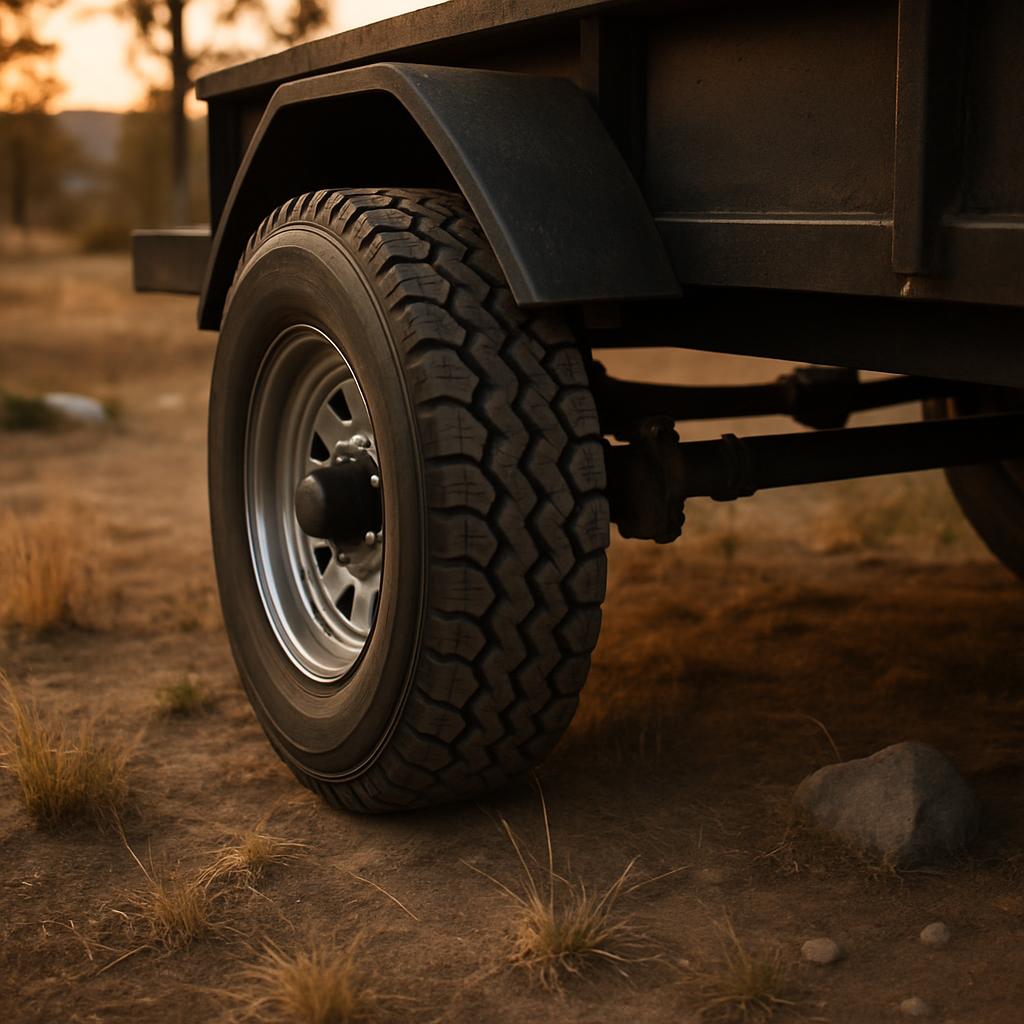
The table below shows how quickly the gap opens between the advertised maximum and what’s actually available after accounting for two adults and a full fuel load. These figures are approximate, drawn from manufacturer-published specifications, and vary by trim and configuration. The payload numbers shown reflect common real-world configurations, not the maximum possible payload for each model.
| Vehicle | Advertised Max Tow | Payload (approx.) | After 2 Adults + Full Fuel | Payload Left for Tongue Weight |
|---|---|---|---|---|
| 2025 Ford F-150 3.5L EcoBoost (Max Tow) | 13,000 lb | ~1,440 lb | ~926 lb remaining | ~926 lb |
| 2025 Ram 1500 5.7L HEMI (Max Tow) | 12,750 lb | ~1,765 lb | ~1,251 lb remaining | ~1,251 lb |
| 2025 Chevy Silverado 1500 6.2L (Max Tow) | 13,300 lb | ~2,280 lb | ~1,779 lb remaining | ~1,779 lb |
| 2025 Toyota Tundra 3.5L TTV6 (Max Tow) | 12,000 lb | ~1,795 lb | ~1,307 lb remaining | ~1,307 lb |
The Silverado’s headroom looks generous on paper. It is. Load three kids, a week of gear, and a fully stocked bed and you’re looking at something closer to 900 pounds available for tongue weight. A medium-sized travel trailer’s tongue alone runs 700 to 1,050 pounds. Do that math before you feel smug about the payload spec.
Tongue Weight Takes Its Cut First
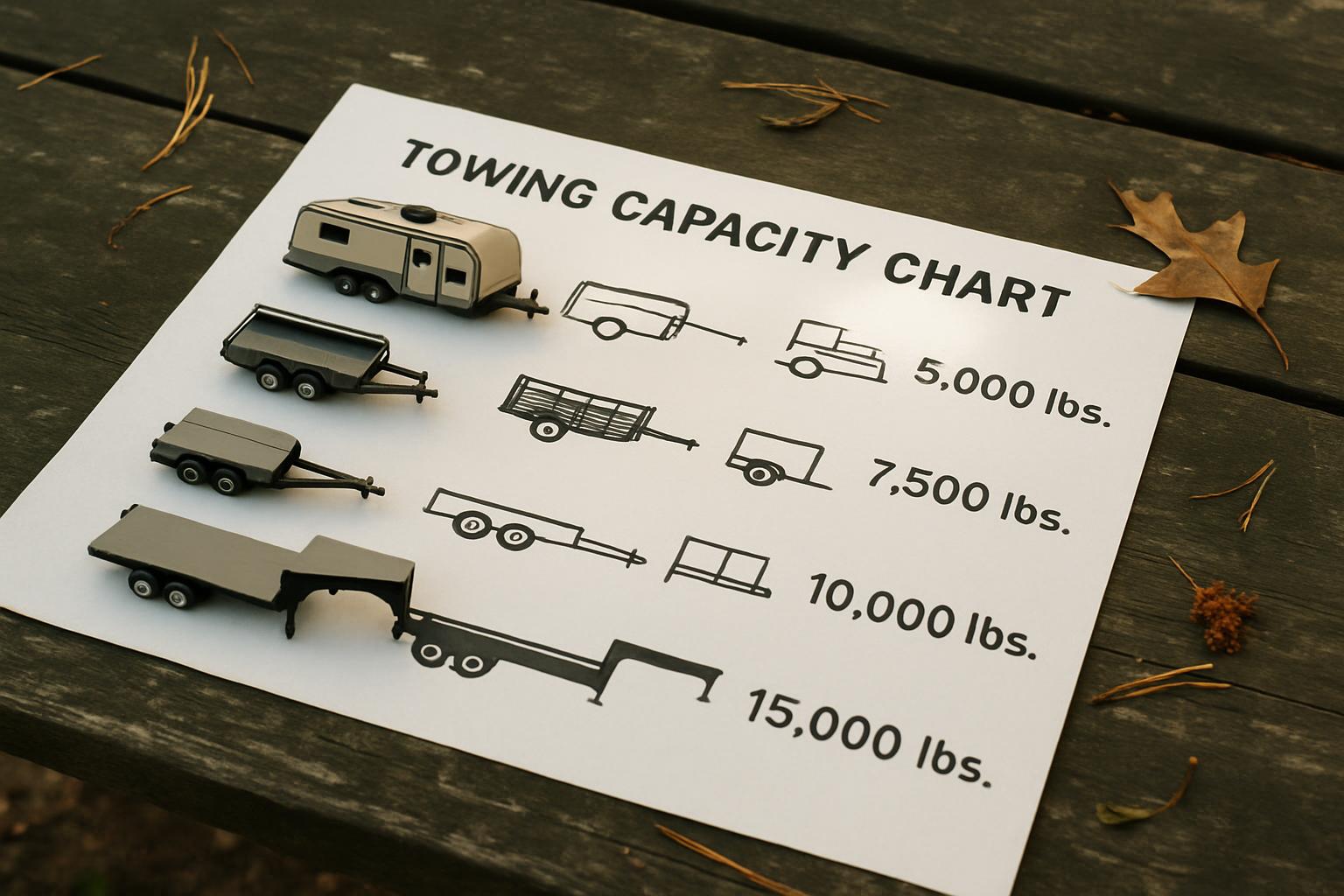
Tongue weight is the specific load the trailer coupler places on the hitch ball. Standard guidance from trailer manufacturers and SAE J2807 is that it should fall between 10 and 15 percent of the total loaded trailer weight. For a 7,000-pound trailer, that is 700 to 1,050 pounds pressing down on the rear axle of your tow vehicle.
That weight counts against payload. It does not get a separate budget because it arrives at the hitch instead of in the bed. It is cargo. It lives inside the same payload envelope as your passengers and your cooler.
I drove a Silverado with the max-tow package on a test loop with a 9,000-pound boat trailer in the Smoky Mountains. The truck handled the grade. The rear suspension was compressed, the front end was noticeably lighter, and the braking on the downhill sections required considerably more planning than the spec sheet prepared me for. That boat trailer carried about 1,100 pounds of tongue weight. The Silverado had a payload rating of roughly 1,900 pounds in that configuration. On paper, the numbers worked. On that mountain road, they worked barely. Add two people and a weekend bag and the margin is gone.
Weight-distribution hitches spread the load across the front axle and restore some steering feel. They are real and useful. They do not add a single pound of payload capacity. The arithmetic does not care what your hitch cost.
What Happens When the Grade Goes Up
Somewhere past mile 40 on the climb into the Rockies, the Blue Ridge, or the Sierra Nevada, the rated tow capacity becomes an abstraction. The real question is whether your engine, transmission, and brakes can manage that weight on a 6-percent grade at 5,000 feet above sea level.
Altitude reduces engine output because thinner air delivers less oxygen for combustion. A naturally aspirated V8 can lose 3 to 4 percent of its power output for every 1,000 feet of elevation gain, according to AAA. Turbocharged engines compensate better. But not fully. At 7,000 feet of elevation, a realistic elevation for mountain passes in Colorado, Utah, or Wyoming, a naturally aspirated engine is running on roughly 20 to 25 percent less air than it gets at sea level. The tow rating was established at sea level.
If you’re at 80 percent of your rated tow capacity on a mountain pass, you are not operating with comfortable margin. You are near the edge of the test conditions, in conditions harder than the test conditions. Your transmission temperature gauge will confirm it. At elevation, the cushion that feels theoretical on a flat highway becomes very practical on a downgrade where your brakes are doing the work your engine can’t.
The practical rule: if your working tow capacity after payload deductions is 6,000 pounds, plan your trailer around 5,000. The 1,000-pound cushion is not timidity. It is the gap between the trip you planned and the grade you didn’t know was coming.
Start with Your Working Number, Then Find a Trailer
Most buyers run this process backwards, and the industry does nothing to discourage it. A vehicle with a 13,000-pound tow rating is a more compelling ad than “check your door placard first.” They find the trailer or boat they want, look at the weight, then shop for a vehicle with a tow rating above it. That method skips payload, tongue weight, and every deduction that turns the headline figure into the real one.
The sequence that works: calculate your working tow capacity before you shop for a trailer. Pull the payload rating off your specific vehicle’s door placard, not the model’s maximum published number. Those two figures are often different. Subtract passengers at realistic weights, gear you actually plan to carry, and a full fuel load. What remains is your tongue weight budget. Multiply that budget by roughly seven to determine a conservative maximum trailer weight, using the 15-percent tongue-weight assumption. That is the trailer weight you can tow with margin intact.
If that number falls short of the trailer you want, two paths exist. One is a heavier-rated vehicle. The other, less obvious and often the better answer, is a lighter trailer. Aluminum-framed travel trailers can weigh 1,500 to 2,000 pounds less than comparable steel-framed units at the same floor length. That weight difference closes a lot of gaps and costs nothing beyond a change of spec sheet.
There is a third outcome the math occasionally produces: the working number is low enough that neither a different hitch setup nor a lighter trailer closes the gap. If you drive a midsize SUV with a payload rating under 1,200 pounds and you want to tow a 26-foot travel trailer with any gear or passengers aboard, the math does not work. That is not a failure of planning. It is a real constraint, and it is better to find it in a driveway than on a mountain pass.
The Trip You’re Actually Planning
Back in southern Utah, the man with the sagging F-150 figured it out around mile 20 on the highway. He called me that evening from a pullout south of Kanab. The rear-end squat was bad enough that the truck was pulling to the right at 55 miles per hour, and he was not comfortable pushing it further. He had not exceeded the rated tow capacity. He had blown through his payload rating by close to 400 pounds.
The window sticker tow number is what the vehicle can pull on its best day, in its lightest configuration, on flat pavement at sea level. Your trip is not that. It has people in it. It has gear. It probably has a grade.
Run the actual numbers before you hitch up. The door placard has the payload rating. The tongue weight is 10 to 15 percent of your loaded trailer weight. The arithmetic takes about three minutes. Almost nobody in that campground parking lot had spent those three minutes, and one of them spent the rest of the afternoon on the shoulder of US-89 waiting for a tow.
References
EPA Fuel Economy Data
AAA Homepage
Ford Trucks
Ram Trucks
Chevrolet
SAE International