

Last April, a customer came into my bay with a Civic that had already been to two other shops. She had spent $340 on a throttle body cleaning and a new set of spark plugs. Car still hesitated at highway speed. Both shops had pulled the same P0300 misfire code and done the same generic repair. Neither one had loaded the fuel trim data. Clogged injector on cylinder 3. Forty-dollar diagnostic session, $180 injector service. Done.
The other shops weren’t crooks. They were guessing. That’s the real problem with most advice about finding a trustworthy mechanic: it helps you avoid being overcharged for the wrong repair, when the actual risk is paying for the wrong repair at any price.
The Quote Problem Nobody Talks About
Three quotes is the standard recommendation. Get three, pick the middle one, feel smart about it.
Here’s the thing: quotes only compare price. They don’t compare accuracy.
If the first shop diagnosed your car incorrectly, three more quotes on that diagnosis just give you a range of prices for the wrong job. You’ll pay the cheapest wrong price and call yourself a savvy consumer.
This matters most on intermittent problems. Transmission shudder that comes and goes. Hesitation that only shows up above 65 mph. A check engine light that cleared itself. These don’t throw obvious codes. They require a technician who can read live data, not just retrieve fault codes and match them to a parts list. Shops that can do that work will usually tell you upfront what the data showed. Shops that can’t will give you a confident quote with no reasoning behind it.
What a Good Diagnosis Actually Looks Like
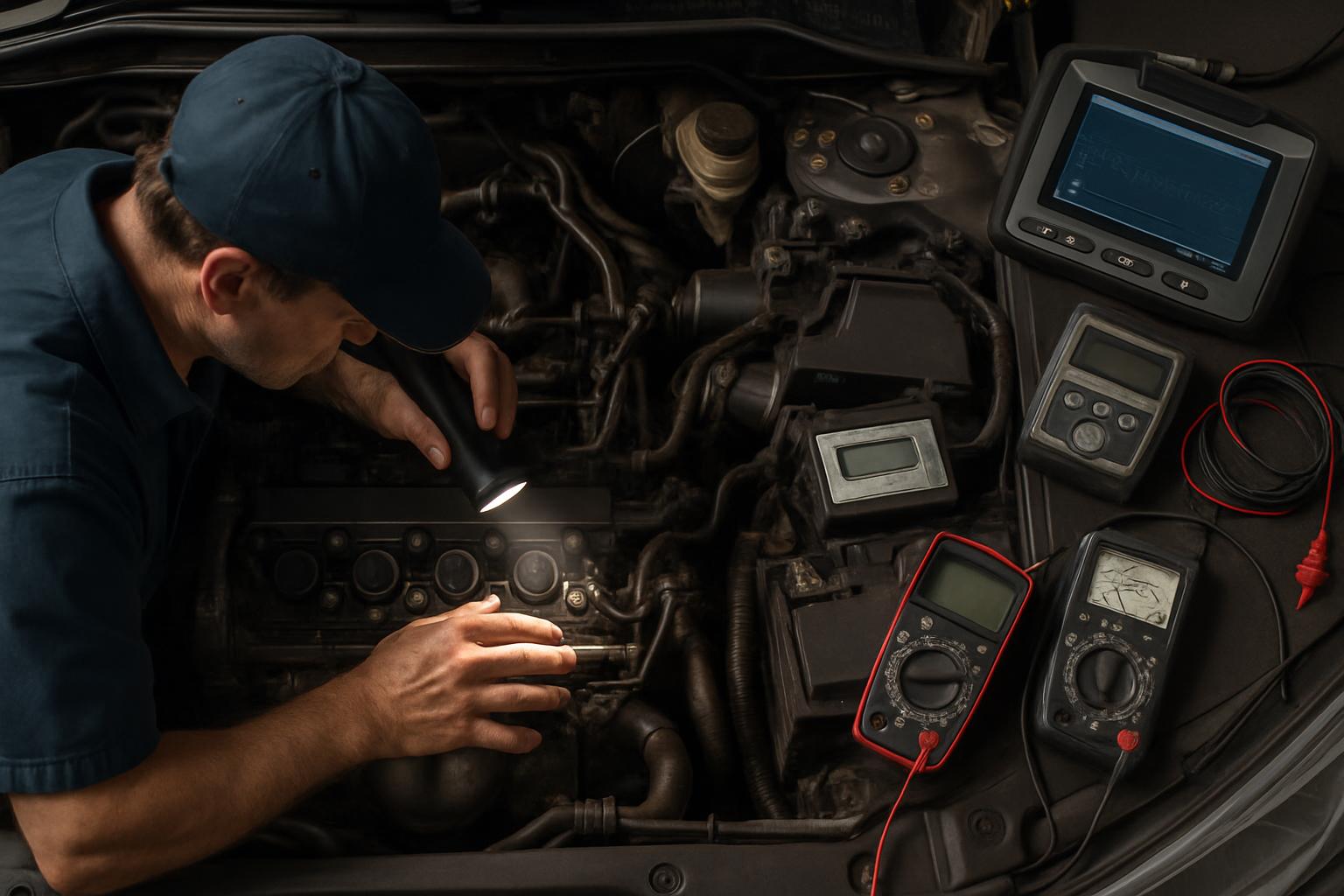
A real diagnostic session takes 45 minutes to an hour. The technician connects a scan tool, reads live data streams while the engine runs, and often drives the car to reproduce the symptom under load. That session costs money. Typically $90 to $150 at an independent shop.
Shops advertising free diagnostics are usually doing a quick code pull. Not a diagnosis. The starting point for one. There’s a difference, and it matters when your symptom is something the code doesn’t fully explain.
I had a policy when I was on the floor: print the data, show the customer. Fuel trim readings, misfire counts by cylinder, injector pulse width. Most owners had no idea what any of it meant, and that was fine. The point was transparency. If a shop won’t show you the actual data behind their recommendation, you’re being asked to trust the conclusion without seeing the reasoning. That’s the wrong way to spend money.
Red Flags That Show Up Before You Hand Over the Keys
The first phone call to a shop tells you something.
Ask what they charge for a diagnostic. A shop that says “free” when you describe a drivability complaint is signaling one of two things: they don’t do real diagnostics, or they’re rolling the cost into whatever repair they recommend. Either way, someone is paying for the diagnostic work, and it’s going to be you.
Last summer a 2019 Equinox got towed in after the owner had already been quoted $650 for an alternator replacement, over the phone, before anyone had looked at the car. Spent 30 minutes on it. Corroded battery terminal. $25 repair. The other shop had guessed.
The second red flag is upsell pressure before the diagnosis is done. I’ve been in enough service bays to know that the recommended-services list at some shops comes out before the technician has touched the car. The service advisor at a franchise shop I was at last March handed a customer a $420 upsell packet eight minutes after the car pulled in. The tech hadn’t moved it off the drive yet. Cabin air filter, fuel injector cleaning, transmission flush. Some of that is real maintenance. When it shows up on a ticket for a car that came in about a brake squeal, it isn’t maintenance. It’s revenue.
A shop worth the relationship will show you what they found, explain the data, and separate any additional recommendations from the primary repair. If those things get bundled together before you’ve agreed to anything, slow down.
Questions Worth Asking
Two questions. That’s all you need.
First: “Can you show me what the scan tool actually read, not just the fault code?” A shop that knows its business says yes without hesitation. One that doesn’t will bluff, pivot, or get defensive. The response tells you what you need to know.
Second: “If this repair doesn’t fix it, what’s next?” Good technicians think past the parts list. They’ve already considered what else produces that symptom. A shop that has an answer has thought it through. A shop that looks confused at the question hasn’t gotten that far yet.
What Fair Pricing Looks Like in 2026
RepairPal and AAA both publish regional labor rate benchmarks. For most metro areas, an independent shop runs $110 to $150 per hour for general repairs. Dealership rates typically come in at $170 to $220 per hour for the same labor. Specialty shops, import brands, transmission specialists, can run higher.
The hourly rate isn’t what makes a job expensive. Labor hours do. A water pump replacement on a transversely mounted four-cylinder might be quoted at 2.5 hours at one shop and 3.5 at another. Both can be accurate depending on the car and access. Ask for the time estimate and ask why.
The table below uses common repairs on three broadly comparable vehicles to show what market-rate work looks like in 2026. Estimates are based on RepairPal regional data and AAA maintenance benchmarks.
| Repair | 2022 Honda Civic (2.0L) | 2021 Toyota Camry (2.5L) | 2020 Ford F-150 (5.0L V8) |
|---|---|---|---|
| Brake pad and rotor replacement (front) | $290-$380 | $310-$400 | $380-$480 |
| Serpentine belt replacement | $120-$180 | $130-$190 | $150-$210 |
| Spark plug replacement (full set) | $130-$180 | $160-$220 | $280-$380 |
| Coolant flush | $90-$130 | $90-$130 | $100-$140 |
| Transmission fluid service | $150-$200 | $150-$210 | $180-$260 |
Pricing based on RepairPal regional estimates and AAA maintenance cost benchmarks. Confirm with your shop before authorizing work.
If a quote for a Civic front brake job comes in at $580, ask what’s in the number. Maybe the rotors are worn past spec and the price is legitimate. Maybe they’re not worn at all and the shop is adding them by default. You need to know which repair you’re actually authorizing before the car goes on the lift.
How to Read the Estimate
A written estimate should list parts and labor separately. Parts should show the brand name or part number. Labor should be listed as a time estimate in hours, not just a dollar total.
If the estimate reads “brake service: $440” with nothing else, that’s a number, not an estimate. Ask for the itemized version before you sign anything. A shop that pushes back on that request is answering a question you hadn’t finished asking yet.
In my experience, the shops that consistently get complex diagnoses right are the ones with ASE Master Technicians on staff. They have the training and the diagnostic equipment. The franchise chains move faster and sell more add-ons. Different priorities. The independent tech who has worked the same brands for fifteen years has pattern-matched thousands of failures you’re not going to find in a diagnostic tree. When the problem isn’t reading off the code sheet, that familiarity is what finds it.
One hard limit on all of this: none of it applies if the car is under manufacturer warranty. Take it to the dealer. Independent work during the warranty period can complicate a claim in ways that a $150 savings on a fluid service doesn’t come close to covering.
Find a shop before you need one. Bring a car that’s running well, ask for a basic checkup, and watch how the conversation goes when there’s no repair on the table. The quality of a shop is clearest when nothing is wrong.
References
AAA Homepage
RepairPal
Consumer Reports Cars
J.D. Power Homepage
CarMD Vehicle Health Index