

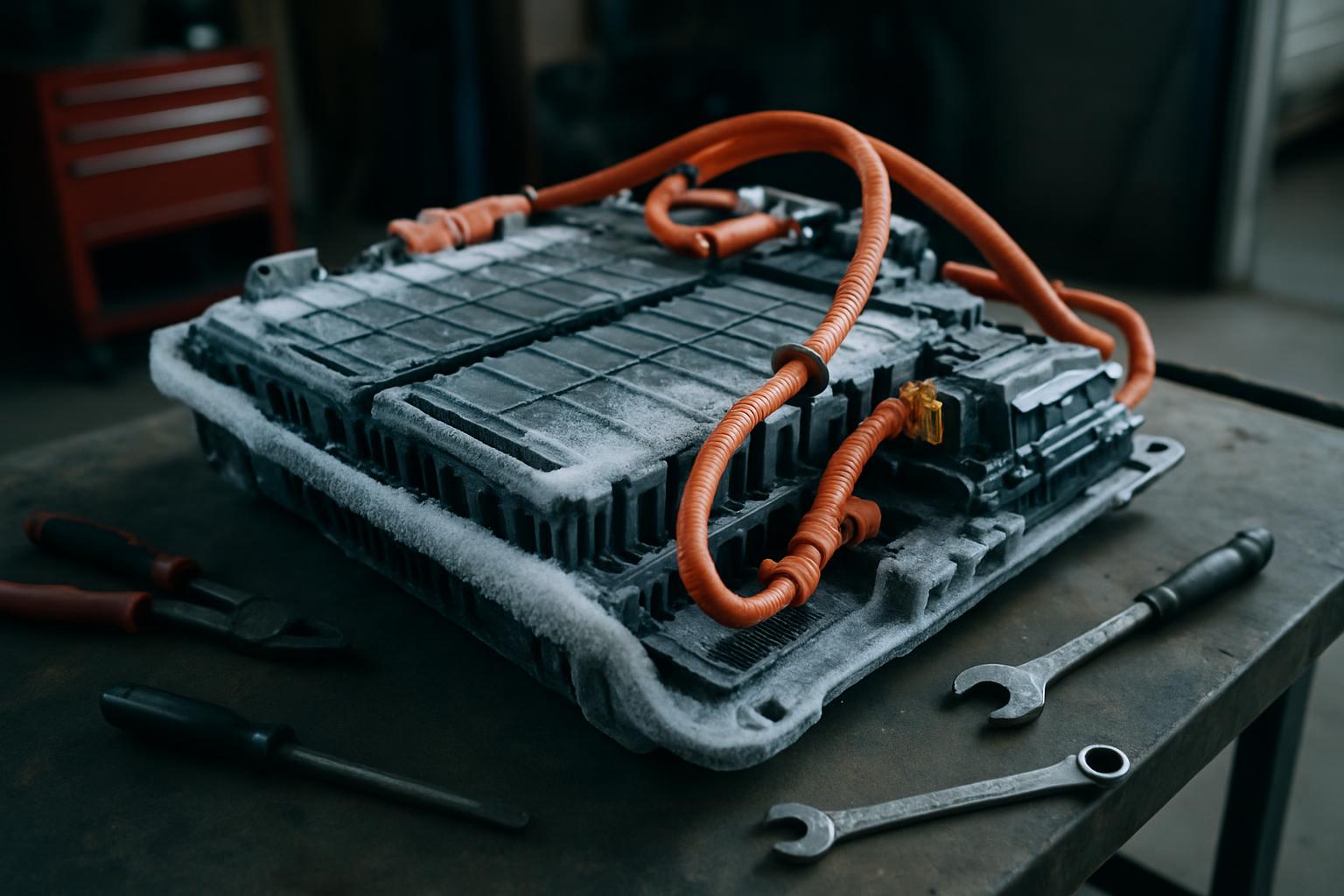
At 20 degrees Fahrenheit with cabin heat running, a battery-electric vehicle can lose up to 41 percent of its EPA-rated range, according to AAA testing. That figure does not come from a fringe scenario. It describes a moderately cold winter morning in Chicago, Denver, or Minneapolis: the kind of day that arrives reliably from November through February across most of the country.
Most EV owners know winter affects range. What most do not know is why, at the level of the battery itself. The common assumption is that cold temperatures drain the battery faster. The actual mechanism is different, and understanding it changes how you manage your car in winter.
The Chemistry Behind the Drop
Lithium-ion cells do not discharge faster in the cold. They become electrochemically sluggish.
At low temperatures, the lithium ions that carry charge between the anode and cathode slow down as electrolyte viscosity increases. Internal resistance rises. The battery can hold most of its stored energy, but it cannot release that energy at the same rate it does at 70°F. That is why cold-weather range loss is often recoverable: warm the battery, and much of the lost range comes back. It is not a degradation event. It is a physics constraint.
The practical consequence is a car that reads 200 miles of remaining range in your garage but delivers something closer to 130 on the interstate in January. The electrons are there. The battery just cannot move them fast enough to sustain highway speeds with full climate control running.
Cabin Heat Is the Bigger Problem
Here is the number that gets underreported: internal combustion engines generate waste heat as a byproduct of operation. EVs do not. The resistive heating element or heat pump that warms your cabin draws directly from the traction battery. In a gasoline car, you are using energy that would otherwise be wasted anyway. In an EV, cabin heat competes with propulsion for the same battery reserve.
NREL research on real-world EV energy use found that climate control can account for 30 to 40 percent of total energy consumption in cold conditions. That is not a minor footnote. It is the dominant reason a 300-mile EPA range vehicle delivers 180 miles on a cold day with occupants inside.
Heat pumps, which are now standard or available on most new EVs, reduce this penalty significantly. A heat pump moves heat from outside air rather than generating it from scratch, operating at roughly three to four times the efficiency of resistive heating at temperatures above about 15°F. Below that threshold, most heat pump systems fall back to resistive heating anyway because there is not enough ambient heat to extract.
I learned this boundary condition the hard way. When I was still doing cell-level testing, we ran discharge cycles at -20°C and -10°C back to back. The capacity drop between those two temperatures was sharper than almost any published range table shows. That data does not make it into press releases.
How Much Range Loss to Actually Expect
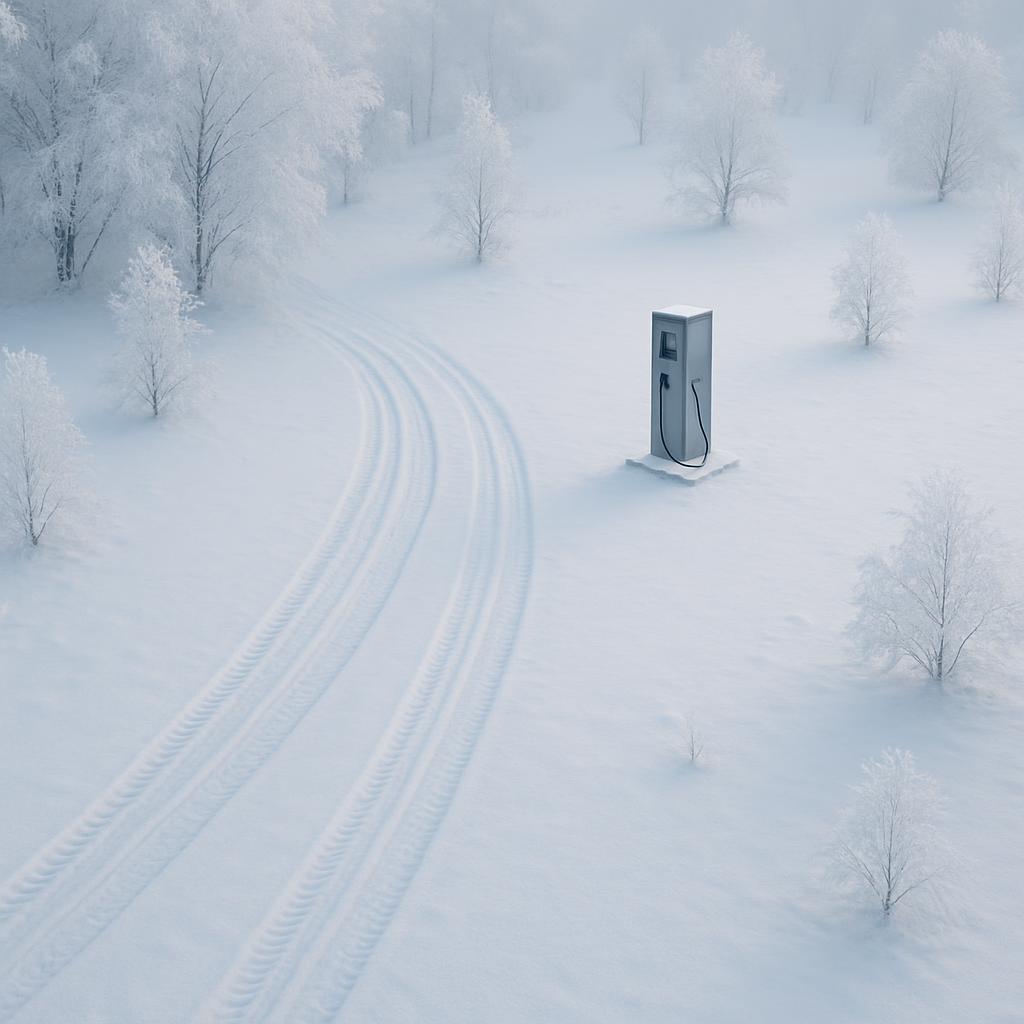
The range penalty is not uniform across vehicles or temperatures. Pack chemistry, battery thermal management design, vehicle size, and whether a heat pump is included all affect the outcome. The table below reflects documented real-world testing data for a sample of popular EVs.
| Vehicle | EPA Range (mi) | Estimated Range at 20°F, Heat On (mi) | Approx. Loss |
|---|---|---|---|
| Tesla Model 3 Long Range RWD | 358 | ~230 | ~36% |
| Chevrolet Equinox EV (Standard Range) | 319 | ~215 | ~33% |
| Ford Mustang Mach-E Standard Range | 230 | ~145 | ~37% |
| Rivian R1T (Dual-Motor Standard Pack) | 314 | ~200 | ~36% |
| Hyundai Ioniq 6 Long Range RWD | 361 | ~240 | ~34% |
Sources: AAA EV range testing, NREL fleet analysis, manufacturer real-world data. Cold-weather figures represent estimates based on published testing protocols at approximately 20°F ambient with climate control active.
The 33 to 37 percent band is consistent enough to treat as a planning baseline. If your daily commute is 90 miles, a 300-mile EPA vehicle gets you there and back comfortably in July. In January, the math changes.
Battery Thermal Management: Not All Systems Are Equal
Every modern EV includes a battery thermal management system, but the quality and approach vary considerably. This is where the engineering gap between vehicles shows up most clearly in real-world winter performance.
Liquid-cooled systems, now standard on most mainstream EVs, can both cool the battery in summer and pre-warm it in winter. Pre-conditioning the battery while still plugged in is the single most effective thing an owner can do to reduce cold-weather range loss. A battery brought to operating temperature before departure draws its pre-conditioning energy from the grid rather than the traction pack. Most current EVs can be scheduled to pre-condition through the companion app before you leave home. Most owners do not use it.
Air-cooled systems, which appear in some older Nissan Leaf models and a small number of budget EVs, have no active thermal management. Cold weather hits those packs harder, and the loss is less recoverable during the drive.
That distinction should be on your checklist when comparing vehicles, not buried in a spec sheet footnote. Two vehicles with similar EPA ranges can behave very differently in January depending entirely on how aggressively the thermal management system maintains pack temperature during the drive.
Charging in the Cold
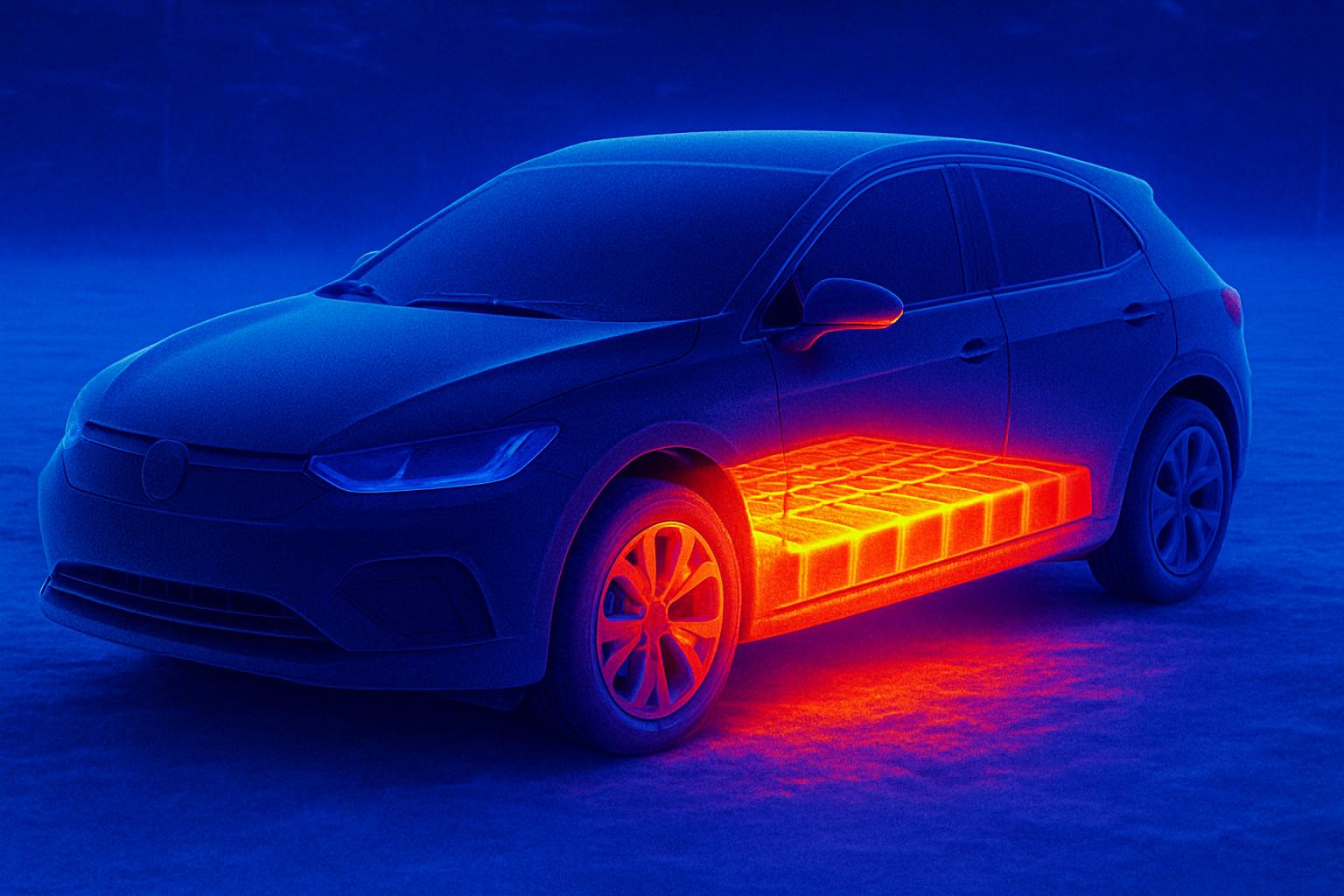
Cold weather affects charging, not just range. A lithium-ion cell that is at 20°F cannot accept charge as quickly as one at 70°F, for the same reason it cannot release energy as quickly: ion mobility is limited by temperature.
DC fast charging at reduced temperatures typically begins at a significantly lower rate and stays there until the battery management system brings the pack to an acceptable temperature. On a Supercharger or Electrify America station, a charge session that normally takes 25 minutes may take 45 minutes in winter if the battery has not been pre-conditioned.
I have plugged into a DC fast charger rated at 150 kW that delivered 61 kW for the first 20 minutes because the prior session had not let the charger thermal cycle properly. That was an infrastructure problem, not a vehicle problem. In winter, both problems can compound simultaneously. A cold battery at a thermally stressed charger produces a slower session than the spec sheets suggest is possible.
The solution is the same as for range: use navigation-based battery pre-conditioning if your vehicle supports it. Systems that route to a fast charger and begin warming the battery 20 to 30 minutes before arrival can recover most of the charging speed penalty. Tesla, Hyundai, and Kia implement this well. Ford’s implementation on the Mach-E has been inconsistent depending on software version.
What You Can Actually Do
The range table above should anchor your winter planning. Assume 35 percent less than EPA range on a cold day with heat running. That is conservative enough to cover most scenarios without leaving you stranded.
Beyond pre-conditioning, a few adjustments matter. Parking in a garage keeps the battery warmer overnight, which shrinks both the range penalty and the warm-up time before departure. Seat heaters and steering wheel heaters consume far less energy than blowing heated air through the cabin; use them aggressively and turn the fan down, and the efficiency gain is real, not marginal. The aerodynamics math is starker: dropping from 75 to 65 mph on the highway can recover 10 to 15 percent of cold-weather range because drag scales with the square of speed.
The EPA range number on the window sticker is not a winter range number. It was never designed to be. It is a controlled-temperature test cycle result. The DOE’s own guidance acknowledges that real-world range can vary significantly from the rated figure based on temperature, speed, and accessory use. Treating the sticker figure as a floor rather than an expected value is not pessimism. It is accurate.
What the Data Confirms, and What Remains Variable
What the data confirms: a 35 percent cold-weather range reduction is a reliable planning baseline for most modern battery-electric vehicles at 20°F with climate control active. Battery pre-conditioning is the highest-leverage intervention available to owners, and it costs nothing beyond the habit of using the scheduler. Heat pump-equipped vehicles perform meaningfully better than resistive-heating systems in the 15 to 40°F range that defines most US winter driving.
What remains variable: pack chemistry improvements are moving quickly. Newer LFP (lithium iron phosphate) cells, used in standard-range Tesla variants and some Chinese-market EVs, behave differently in cold conditions than NMC (nickel manganese cobalt) chemistry, and the tradeoffs are not simple to summarize in a range table. Owners buying EVs in 2025 and beyond should look specifically at cold-weather range data from real-world sources, not EPA figures alone. The gap between the sticker and January is not closing as fast as the press releases suggest.
References
AAA Electric Vehicle Range Testing
DOE EV Resources: Fuel Economy and Range
NREL Homepage: EV Energy Use Research
EPA Fuel Economy Data
DOE Charging Station Locator