

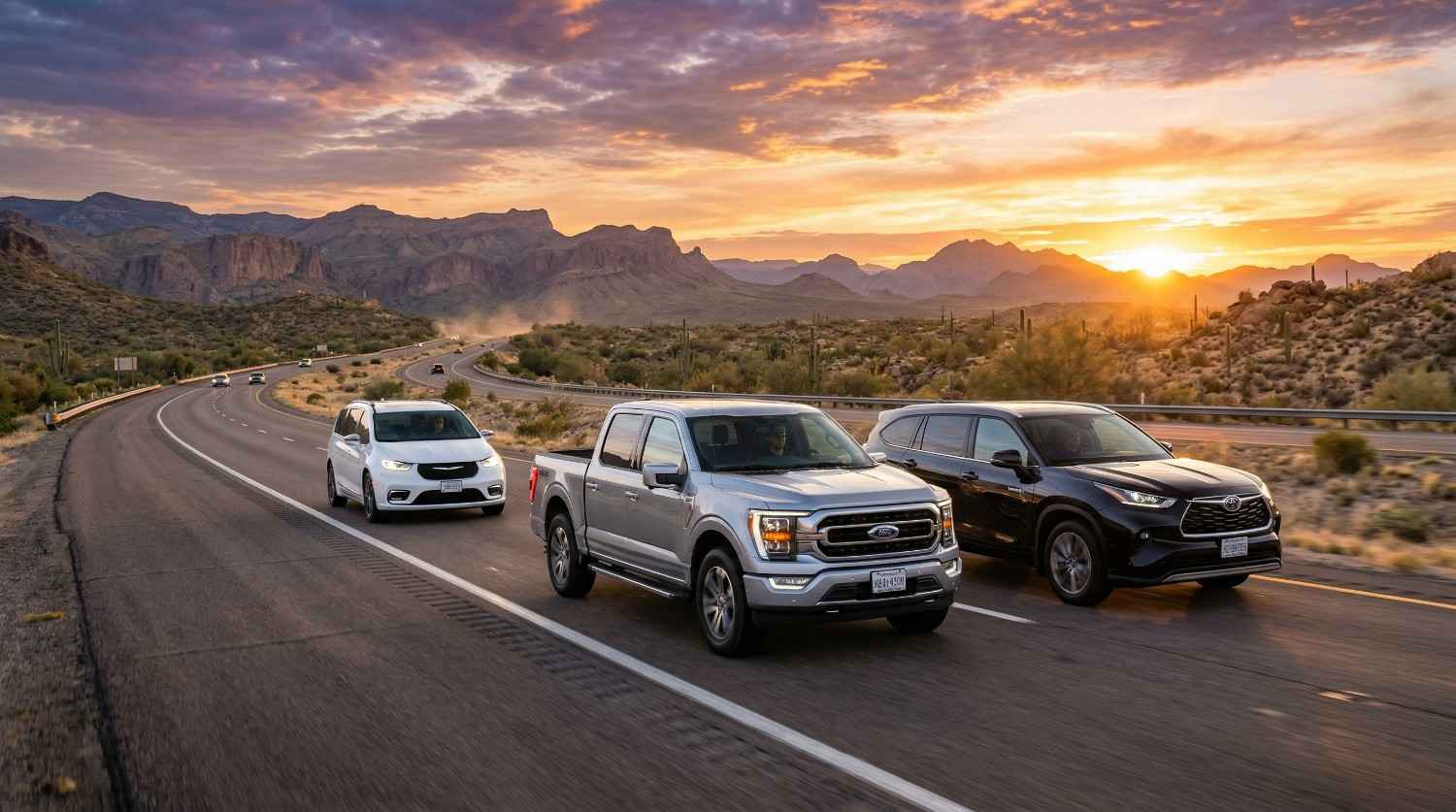
You’re three hours into a 1,200-mile drive, somewhere between Amarillo and Albuquerque, and the decision you made months ago starts to matter. Not in theory, but in your lower back, your fuel stops, and your packing choices. I’ve done that stretch in all three: a half-ton pickup, a midsize SUV, and a converted van. Each felt like the right choice—until it didn’t.
This breakdown looks at what actually changes over long distances: fuel costs based on EPA Fuel Economy Data, cargo flexibility, ride comfort, and real ownership considerations pulled from Edmunds’ 2026 True Cost to Own and 2026 IIHS Safety Ratings. We’ll anchor this with specific 2026 models—the Ford F-150, Toyota Highlander Hybrid, and Chrysler Pacifica—so you can picture how this plays out on an actual trip.
The Real Question Isn’t Size — It’s Use Case
A full-size truck like the 2026 Ford F-150 gives you unmatched payload and towing—up to 13,500 pounds depending on configuration. But unless you’re hauling a trailer, most of that capability sits unused while you’re paying for it at the pump. Long-distance travel magnifies these inefficiencies.
According to EPA Fuel Economy Data, the F-150 with a 2.7L EcoBoost engine returns about 20 mpg combined. Compare that to the 2026 Toyota Highlander Hybrid at roughly 35 mpg combined. Over a 3,000-mile road trip, with AAA reporting 2026 fuel prices averaging $5.84 in coastal regions, that is the difference between roughly $500 and $875 in fuel.
How the Numbers Stack Up for 2026
| Vehicle Type | Model (2026) | EPA MPG (Combined) | Max Cargo (cu ft) |
| Truck | Ford F-150 (2.7L) | 20 mpg | ~62 (bed+cabin) |
| SUV | Highlander Hybrid | 35 mpg | 84.3 |
| Van | Chrysler Pacifica | 30 mpg (Hybrid) | 140.5 |
Why Vans Keep Winning Road Trips
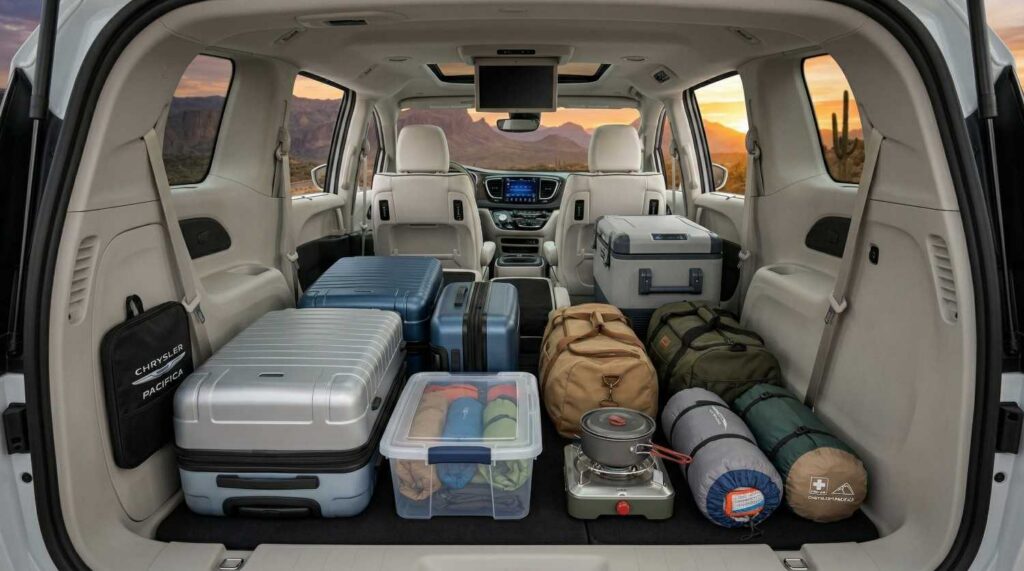
The Chrysler Pacifica’s Stow ‘n Go seating remains the gold standard for long-distance practicality, turning the interior into a flat cargo bay in minutes without removing seats. Long wheelbases—like the Pacifica’s—smooth out highway imperfections, reducing the “head toss” and fatigue that passengers often feel in shorter vehicles.
However, ground clearance is limited. If your route includes unpaved trailheads, a van can feel out of place quickly. We explicitly advise against using a minivan for routes involving known “soft-road” terrain, as the low breakover angle makes high-centering a constant risk.
SUVs: The 2026 Middle Ground
The 2026 Toyota Highlander Hybrid is a balanced choice, offering solid fuel economy and standard all-wheel drive on many trims. In our assessment, it is easier to live with day-to-day in cities than a full-size truck.
According to the 2026 J.D. Power Vehicle Dependability Study, midsize SUVs continue to show strong reliability trends, though software-defined features remain a common area for service calls. While safe, the Highlander’s third row is tight; if you are traveling with more than four adults, the cabin will feel cramped before you reach the first state line.
Trucks: The Cost of Capability
If your trip involves towing a boat or an overland trailer, a truck like the F-150 isn’t optional—it is necessary. However, rear-seat ride quality in half-ton trucks is often stiff due to the suspension being tuned for heavy loads. We explicitly advise against using a half-ton truck for a pure highway passenger road trip; the efficiency penalty and choppy ride for rear passengers are hard to justify without a trailer.
Long-Term Ownership and Depreciation
Ownership costs go beyond the pump. According to the 2026 AAA Driving Costs Study, large pickups cost an average of 98.54 cents per mile to operate, while medium SUVs cost significantly less at 83.89 cents per mile.
Using Edmunds’ 2026 True Cost to Own, we see that trucks often carry higher insurance premiums and maintenance costs, such as $500+ for sets of larger all-terrain tires. For 2026, the Highlander Hybrid remains a value leader, balancing high resale value with low operating costs.
Conclusion: Matching Vehicle to Journey
For most long-distance travelers, a midsize SUV like the Toyota Highlander Hybrid strikes the cleanest balance of efficiency and comfort. If you prioritize interior space above all else, the Chrysler Pacifica is the smartest recommendation for paved routes.
Before you decide, check the 2026 IIHS Safety Ratings for your chosen trim and run your expected mileage through EPA Fuel Economy Data. Choosing the right tool for the trip starts with running real numbers, not just following the brochure.
References
- J.D. Power 2026 Vehicle Dependability Study Results
- 2026 Ford F-150 Towing & Payload Guide
- 2026 AAA Driving Costs Study
- 2026 IIHS Safety Rankings & Ratings
- AAA Fuel Price Data March 2026
- Edmunds’ 2026 True Cost to Own Data
- EPA Fuel Economy Data & Trends (2026)
Disclaimer: The information provided in this article is for educational and informational purposes only. It does not constitute professional advice. Readers should conduct their own research and consult with qualified professionals before making any decisions.