


I pulled into a gas station outside Moab on a Tuesday afternoon in mid-July, watching the pump tick past $80 for the second time that day. Not in some giant truck. A packed 2022 Honda CR-V, two adults, seventy pounds of dog in the back. That trip cost more than I planned, not because anything went wrong, but because I hadn’t mapped where the money was actually going before we left.
Road trips feel cheaper than flying. That impression is sometimes accurate and sometimes a myth your wallet pays for later. In 2026, with AAA data showing average regular unleaded prices between $3.20 and $3.80 per gallon depending on region and season, a 2,000-mile round trip burns through $250 to $400 in fuel alone before you’ve paid for a single night of lodging. That’s the starting number. It’s rarely where the spending ends.
This article breaks down every major cost on a North American road trip in 2026, puts real numbers on each one, and shows you which cuts are worth making and which ones just make the trip worse.
Fuel Is the Anchor. Everything Else Floats Around It.
You’re somewhere past Amarillo on I-40, the gauge sitting at a quarter tank, and the next town with gas is 40 miles out. At that point, fuel stops being a budget line item and becomes a logistics problem.
Before you leave, take your vehicle’s highway MPG from EPA’s fueleconomy.gov, multiply it by roughly 0.85 to get a realistic real-world figure (highway ratings typically run 10 to 15 percent optimistic when you factor in AC, hills, and a loaded vehicle), then divide your total route mileage by that adjusted number. That gives you gallons. Multiply by the regional average for your trip window.
On a 1,500-mile trip in a midsize SUV averaging around 26 real-world highway mpg, you’re looking at roughly 58 gallons. At $3.50 per gallon, that comes to about $203. In a full-size pickup getting 18 mpg highway, the same route burns 83 gallons and costs around $290. The spread between vehicles matters more than most people acknowledge when you’re covering real distance.
Gas prices also vary by region, sometimes by a lot. According to AAA’s pricing data, California, Hawaii, and the Pacific Northwest consistently run $0.50 to $0.80 per gallon above the national average. If your route passes through those states, topping up in Nevada before crossing into California isn’t paranoia. It’s just math.
Lodging: The Cost That Catches People Off Guard
Three nights of budget motel rooms along US-1 in Florida can run $90 to $160 per night depending on season, even at mid-tier chains. That’s $270 to $480 for lodging alone on a long weekend trip. Most people don’t budget that honestly until they’re looking at it on a credit card statement.
The right answer depends on your vehicle and your sleeping preferences. If you’re driving something with a flat cargo floor, like a Toyota RAV4, Subaru Outback, or any van or pickup with a bed shell, car camping eliminates lodging costs entirely on nights when you’re in rural areas or national forests. Dispersed camping on Bureau of Land Management land costs nothing. A $30 annual America the Beautiful pass covers entrance fees at all national parks and most federal recreation sites. If you’re making multiple park stops, that pass pays for itself at the second gate.
Developed campground fees at state and national park sites run $25 to $45 per night, meaningfully lower than motel rates. But free they aren’t.
One honest limitation here: if your trip falls during peak summer season at destinations like Yellowstone, Glacier, or the Smokies, campsite reservations fill months out at Recreation.gov. Showing up in July without a reservation and expecting a spot isn’t a strategy. It’s a gamble that usually loses.
The Budget Killers Nobody Plans For
I’ve seen more road trip budgets wrecked by this category than any other. The miscellaneous column.
Food on the road adds up fast if you’re eating every meal at a sit-down spot. A reasonable estimate for one adult covering three meals daily runs $35 to $60 when you factor in tips and the gas station impulse buys that happen regardless. For two people, that’s $70 to $120 per day. On a ten-day trip at the midpoint of that range, you’re looking at $950 in food for two. That’s a real number.
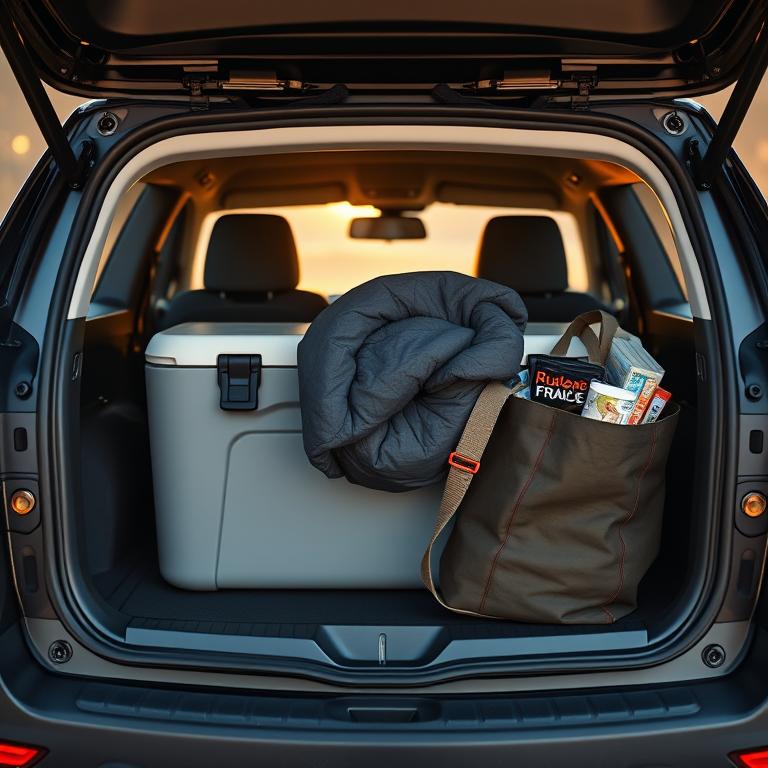
A 48-quart cooler stocked before departure with groceries, cold cuts, fruit, and drinks can cut food spending by 40 to 50 percent on days when you’re not stopping in a town with a worthwhile lunch option anyway. Pack the cooler. Unglamorous, completely worth it.
Tolls are the other surprise. Drive from Charlotte to Boston on I-95 and you’ll pass through toll systems in North Carolina, Virginia, Maryland, Delaware, New Jersey, and New York. Without an E-ZPass transponder, cash rates can run 20 to 40 percent higher than the transponder rate at many plazas. Getting an E-ZPass before the trip is a free win.
Vehicle prep is what people skip and later regret. Tires running 5 PSI underinflated don’t just hurt fuel economy slightly. A sidewall bulge you ignored before departure can become a flat tire 40 miles from the nearest town in rural Nevada, and that roadside service call restructures your budget fast. Spend 20 minutes on tires, oil, and coolant before you go. It costs nothing and beats any alternative.
A Real Budget for a 2,000-Mile Trip
Here’s what a realistic five-day, 2,000-mile road trip may cost for two adults in 2026, split across two scenarios:
| Cost Category | Unoptimized | Budget-Optimized |
|---|---|---|
| Fuel (midsize SUV, approx. 28 mpg highway) | $280 | $250 (planned fill-ups, route strategy) |
| Lodging (3 nights) | $390 (budget motel, avg $130/night) | $75 (2 nights free camping, 1 motel) |
| Food (5 days, 2 adults) | $500 (mostly restaurants) | $260 (groceries and selective dining) |
| Tolls | $80 (no transponder) | $55 (E-ZPass or equivalent) |
| Vehicle prep and incidentals | $60 | $40 |
| Estimated Total | $1,310 | $680 |
That gap of roughly $630 for the exact same trip isn’t about suffering through it. It’s about front-loading decisions before you leave the driveway. The biggest wins come from lodging and food. Fuel is less negotiable than people expect, especially on the outbound leg when your route is fixed and you’re just passing whatever stations exist.
One thing this article cannot fully account for: if you’re traveling with young children, car camping in a compact vehicle looks different than it does for two adults. The food savings are real regardless, but lodging flexibility shrinks when small kids are in the car. Your situation there may genuinely vary.
Where Cutting Costs Too Deep Goes Wrong
Past midnight on I-80 in Nevada, with the next rest area 35 miles out and your eyes starting to blur, the $80 you saved by skipping the motel does not feel like a good trade. AAA’s research on drowsy driving associates 20 or more hours without sleep with impairment comparable to a 0.08 blood alcohol level. That’s not a scare tactic. It’s a documented threshold. Drive until you need to stop.
Skipping roadside assistance coverage is another false economy. A tow from a remote location without coverage can run $200 to $400 or more. AAA membership starts at around $70 per year. If you don’t already have it through your insurer or credit card, check before you leave.
And resist the pull of the $49-per-night motel without checking recent reviews. The cheapest room in a small town sometimes costs more in lost sleep than the $75 option two exits down.
Route Planning as a Budget Tool
Most people pick a route and accept whatever it costs. That’s leaving money on the table.
If your destination has any flexibility within 50 to 100 miles, routing around high-toll corridors or states with consistently elevated gas prices produces real savings. Planning fuel stops proactively also means you’re never forced into a high-priced isolated highway exit because the tank ran low. That’s a tax on poor planning, and it compounds on long routes.
I’ve driven US-2 across the northern tier twice. The stretch from Havre, Montana, to Minot, North Dakota, has fuel stops spaced far enough apart that planning isn’t optional. You need to know your real-world tank range before you get out there, because the route makes that decision for you if you don’t.
For families in larger vehicles, the fuel math shifts further. A three-row SUV getting 22 mpg highway on a 2,000-mile trip burns about 91 gallons. At $3.60 per gallon, that’s $327 in fuel before any other variable. Add a 400-mile detour for a must-see park, and you’re at $375. These numbers are worth running before you commit to the itinerary.
The Bottom Line on Road Trip Costs in 2026
For a solo traveler or a couple in a fuel-efficient vehicle, a well-planned 2,000-mile road trip can land in the $600 to $800 range in 2026. For families or anyone in a larger vehicle with lodging constraints, $1,200 to $1,600 is a more honest target.
The two moves with the highest return relative to effort: stock a cooler before you leave, and book your campgrounds or lodging well in advance. Everything else is incremental from there.
One real limitation of this article: fuel prices in 2026 remain genuinely variable. The figures here draw from AAA’s 2025 national average data, and regional swings of $0.60 to $1.00 per gallon are possible depending on season and location. Check AAA’s current pricing data the week before your trip, not this article, when you’re building your actual fuel number.
The road is still out there. You just need to know what it actually costs before you pull out of the driveway.
References
- AAA Driving Costs and Road Trip Data
- EPA Fuel Economy Data
- EPA Vehicle Search Tool
- IIHS Vehicle Safety Ratings
- Honda
- Toyota
Disclaimer: The information provided in this article is for educational and informational purposes only. It does not constitute professional advice. Readers should conduct their own research and consult with qualified professionals before making any decisions.