

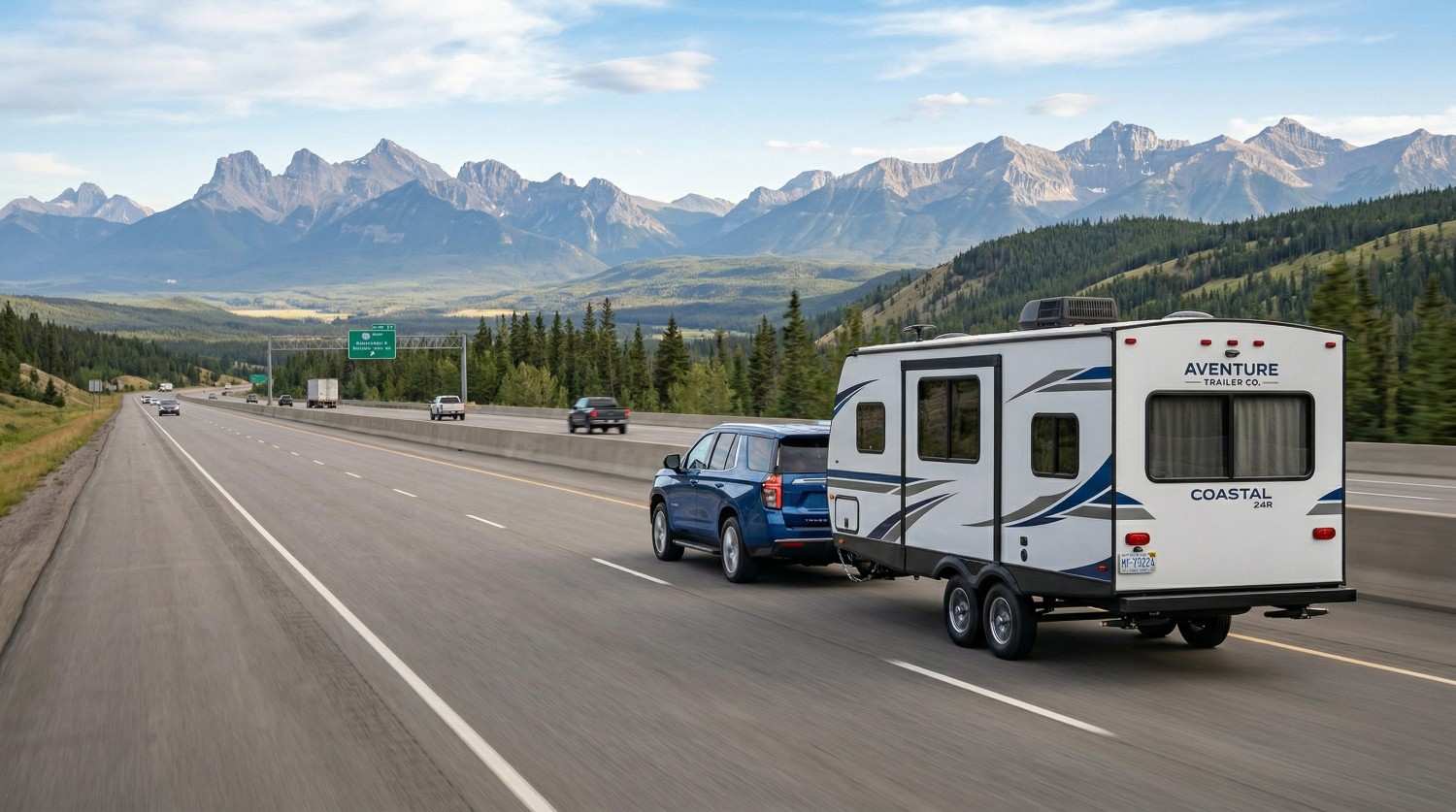
You’re standing in a dealership lot, staring at a spec sheet that says “Max Tow: 13,500 lbs.” The salesperson nods confidently. It sounds like a green light. It isn’t. That number only tells part of the story, and sometimes the least useful part. I’ve watched people hook up a trailer well within that headline rating and still end up with sagging suspensions, overheated transmissions, and a white-knuckle drive home.
By the end of this, you’ll know how towing capacity ratings actually work in the U.S., what numbers matter more than the one in bold, and how vehicles like the Ford F-150, Toyota Tacoma, and Chevrolet Tahoe compare when you run the full math. We’ll pull from SAE J2807 standards, manufacturer specs, and tools like Edmunds’ True Cost to Own to make it practical.
That Big Towing Number? It’s a Marketing Ceiling
Manufacturers follow SAE J2807 standards to calculate towing capacity. This standard defines the exact procedures for calculating the Trailer Weight Rating (TWR) and Gross Combined Weight Rating (GCWR) to ensure consistent comparisons between brands.
However, that headline number assumes a very specific setup: typically a base-trim vehicle with a single driver and minimal cargo. In my experience, this is where people get tripped up. They shop based on “max tow” instead of how they’ll actually use the vehicle with kids, gear, and a full tank of fuel.
The Numbers That Actually Matter
Pay close attention to these four critical limits:
- GVWR (Gross Vehicle Weight Rating): The maximum allowed weight of your vehicle, including passengers, fuel, cargo, and the trailer’s tongue weight.
- GCWR (Gross Combined Weight Rating): The total weight of both the vehicle and the trailer combined.
- Payload: This is the quiet limiter. It is the maximum weight you can add to the truck, including your family and the weight pushing down on the hitch.
- Tongue Weight: The downward force exerted by the trailer on the hitch. For safety, this should be 10–15% of the total trailer weight.
2026 Real-World Capability Comparison
Let’s compare three popular U.S. tow vehicles using the latest 2026 specifications. Note how the configuration dramatically shifts the limits.
| Vehicle (2026) | Max Tow Rating | Max Payload Capacity | Required Configuration |
| Ford F-150 (3.5L EcoBoost) | 13,500 lbs | 2,440 lbs | SuperCrew, 4×4, Max Tow Pkg |
| Toyota Tacoma (i-FORCE Gas) | 6,500 lbs | 1,705 lbs | Properly equipped SR5/TRD |
| Chevrolet Tahoe (5.3L V8) | 8,400 lbs | 1,834 lbs | LS Trim, 4×2, Max Trailering Pkg |
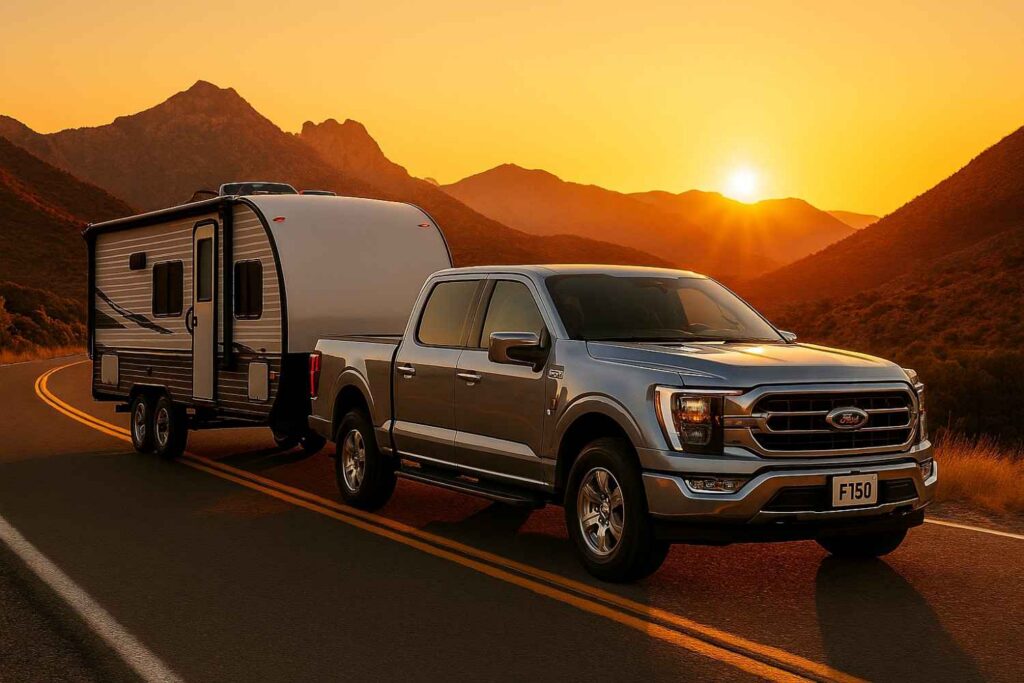
On paper, all three can pull a camper. But when you load them with four adults (~600 lbs), luggage (~200 lbs), and a 700-pound tongue weight, the Tacoma and Tahoe approach their payload ceilings quickly. The F-150, when equipped with the Max Tow/Haul package, provides a significantly larger safety margin.
Why Payload Limits Usually Decide Everything
Trailer tongue weight counts directly against your payload. If your truck has a payload of 1,700 pounds and your trailer’s tongue weight is 850 pounds, you have used half your capacity before anyone sits inside.
According to the NHTSA Standing General Order on Crash Reporting, improper loading and instability are key areas of investigation for real-world crash safety. In our assessment, exceeding payload leads to vague steering and increased stopping distances that no amount of horsepower can fix.
Trim Levels and “Phantom” Weight
A common mistake is assuming every F-150 or Tahoe tows the same. Adding a panoramic sunroof, 22-inch wheels, or power-running boards adds physical weight to the chassis. Every pound of luxury is a pound stolen from your payload capacity.
We explicitly advise against using “light-duty” base trims for trailers exceeding 6,000 pounds without verifying the specific door jamb sticker. A high-trim Limited or Platinum model often has hundreds of pounds less payload than a base XL or LS model because of those heavy options.
The Rise of the Electric Towing Equation
In 2026, we are seeing more electric and hybrid trucks. The 2026 Ford PowerBoost Hybrid offers 11,600 lbs of towing and 570 lb-ft of torque. While powerful, the heavy battery packs reduce its max payload to 1,740 lbs. If you are towing with a hybrid, you must be even more disciplined about what you pack in the truck bed.
Long-Term Maintenance and TCO
Towing is hard on a vehicle. According to Edmunds’ 2026 True Cost to Own data, vehicles used for regular heavy towing see accelerated maintenance costs. For a typical AWD SUV, maintenance can jump to over $2,700 in the fourth year of ownership as brakes and transmission fluids require more frequent service.
Conclusion: Margin Is Your Best Friend
If you are towing heavy and often, a full-size truck with the Max Tow package is the clear choice. Not because of the power, but because of the stability provided by the frame and payload margin. For occasional towing with moderate loads, a full-size SUV like the Tahoe balances comfort with capability, provided you respect the 8,400-lb ceiling.
Check your EPA Fuel Economy Data to plan your stops, as towing often cuts your MPG by 40–50%. Verify your vehicle’s safety margin through the 2026 IIHS Safety Ratings and 2026 NHTSA Safety Ratings. If your calculated load is within 10% of your maximum, give yourself a bigger buffer. It’s better to have more truck than you need than less.
References
- 2026 Ford RV & Trailer Towing Guide (SAE J2807)
- 2026 Ford F-150 Towing & Payload Charts
- 2026 Toyota Tacoma Towing Specs
- 2026 Chevrolet Tahoe Performance Review
- NHTSA Standing General Order on Crash Reporting 2026
- Edmunds’ 2026 Honda Passport True Cost to Own
Disclaimer: The information provided in this article is for educational and informational purposes only. It does not constitute professional advice. Readers should conduct their own research and consult with qualified professionals before making any decisions.