

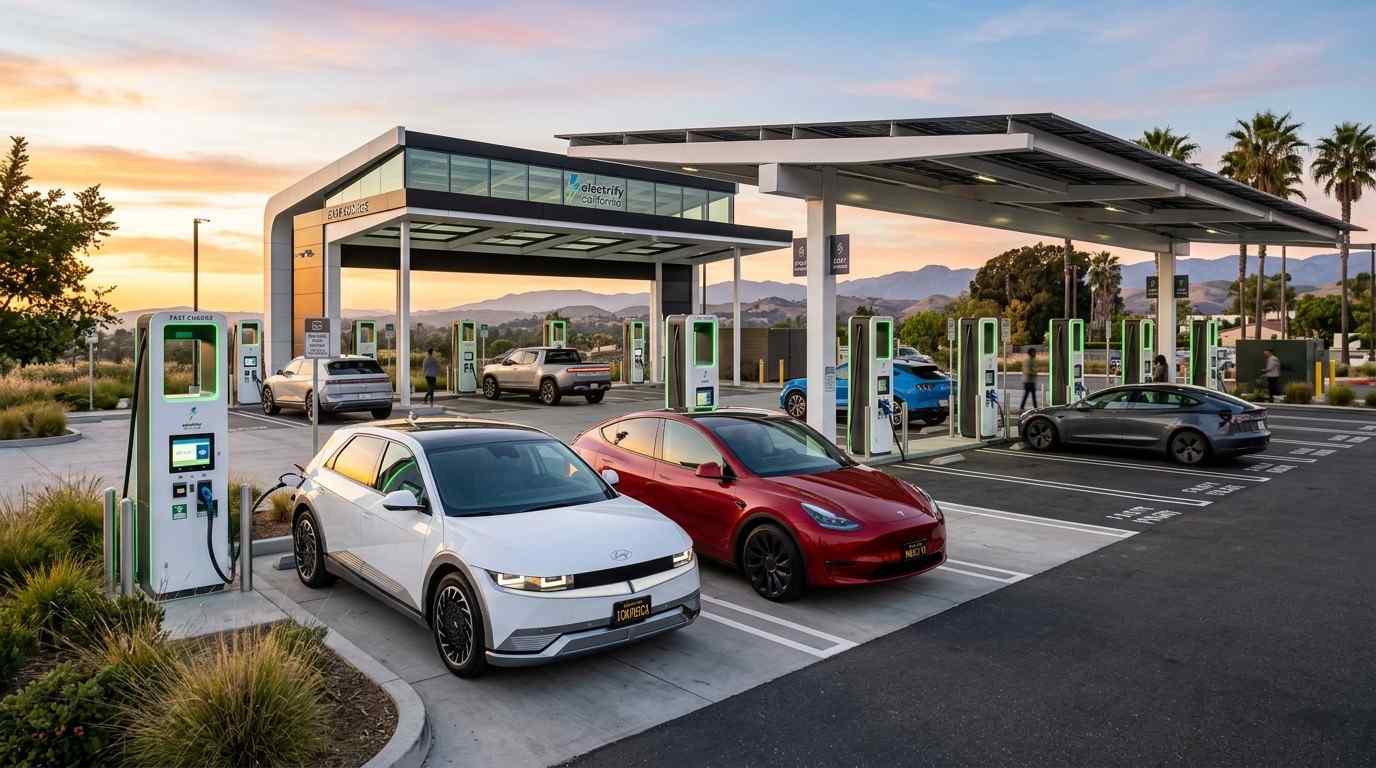
In early 2024, I waited 42 minutes for a fast charger outside Sacramento that was technically “available.” It wasn’t broken—it just wouldn’t start a session. That kind of experience used to define public charging. It’s less common now. By 2026, the U.S. public charging network has crossed a threshold: more stations, better uptime, and—finally—some consistency. But it’s not fixed. Not even close.
Here’s what’s actually improved, where the friction still lives, and what it means for you if you’re relying on public charging in the U.S. today. The numbers come from the 2026 DOE Alternative Fuels Data Center report, NREL deployment tracking, and real-world charging data—not press releases.
There Are More Chargers — But Density Matters More Than Count
The U.S. officially crossed 200,000 public charging ports in late 2025, according to the 2026 DOE Alternative Fuels Data Center report. While that sounds impressive, raw numbers don’t tell the full story. What actually improved in 2026 is charger density along travel routes, specifically interstate corridors and high-traffic suburban zones. This is where reliability starts to feel real rather than theoretical.
The shift between 2024 and 2026 focused on clustering fast chargers where people actually drive, rather than just expanding total station count. In practice, this means fewer single-point failures. If one charger is down, there are usually several more available at the same site. That alone reduces range anxiety more than any increase in EPA range numbers. Still, progress remains uneven. Rural states lag behind, and even in 2026, if you’re driving across parts of Wyoming or West Texas, planning remains a necessity.
Fast Charging Speeds: The Gap Between “Rated” and Real
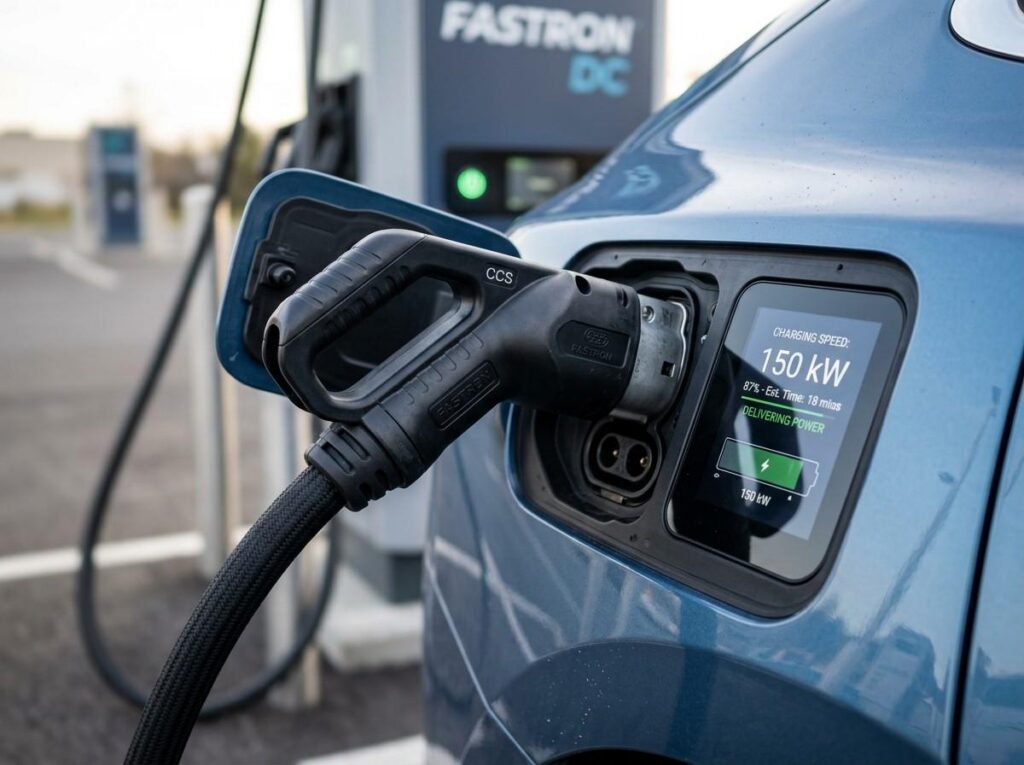
You’ve seen the numbers—250 kW, 350 kW. They sound fast, and sometimes they are. But the reality is that most EVs rarely hold peak charging speeds for long. According to the 2026 NREL EV Efficiency Study, many vehicles average closer to 100–180 kW across a full fast-charging session, even if they briefly spike higher.
Think of charging speed like pouring water into a glass. You can start fast, but as it fills, you must slow down to avoid overflow. This is a fundamental battery protection mechanism.
| Vehicle (2025–2026) | Peak DC Fast Charging | Real-World Average (10–80%) | Time (10–80%) |
| Hyundai Ioniq 5 | ~235 kW | ~140–160 kW | ~18 minutes |
| Tesla Model Y | ~250 kW | ~120–140 kW | ~25 minutes |
| Ford Mustang Mach-E | ~150 kW | ~90–110 kW | ~32 minutes |
| Chevy Equinox EV | ~150 kW | ~85–100 kW | ~35 minutes |
Data is aligned with 2026 EPA Fuel Economy estimates and manufacturer disclosures; real-world averages reflect independent testing trends and 2026 NREL engineering analysis. While charging is faster in 2026, an 18–25 minute stop is now the standard for newer EVs—a timeframe suitable for a quick coffee break.
Reliability Is Better — But Not Uniform Yet
Let’s be blunt: reliability used to be the biggest problem, and in some regions, it still is. A 2026 J.D. Power public charging study found that roughly 1 in 5 users still experience issues during charging sessions, including failed starts or slow speeds. While that isn’t perfect, it’s a significant improvement from earlier years when failure rates were nearly double, especially outside of dedicated networks.
Most stations now support “plug and charge,” payment systems are more consistent, and real-time availability data is more accurate. However, some networks still struggle with maintenance. In my experience, reliability now depends heavily on the network operator. Tesla’s Supercharger network still leads on consistency, while Electrify America and EVgo have improved but maintain a level of variability that requires checking an app before you arrive.
The Tesla Factor: Opening the Network
The single biggest shift in 2026 is Tesla opening parts of its Supercharger network to non-Tesla vehicles. Combined with the industry shift toward the North American Charging Standard (NACS), this move has reshaped the entire charging experience. More EVs can now use the most reliable network in the country, which matters more than adding thousands of new chargers elsewhere because reliability beats quantity.
In our assessment, access to Tesla’s network is the most meaningful improvement for non-Tesla EV owners in 2026. It reduces trip planning stress in a way no spec sheet ever could. While not all stations are open and adapter compatibility can vary, the direction is clear: a more unified charging standard is finally emerging.
The NEVI Program and Maintenance Backlogs
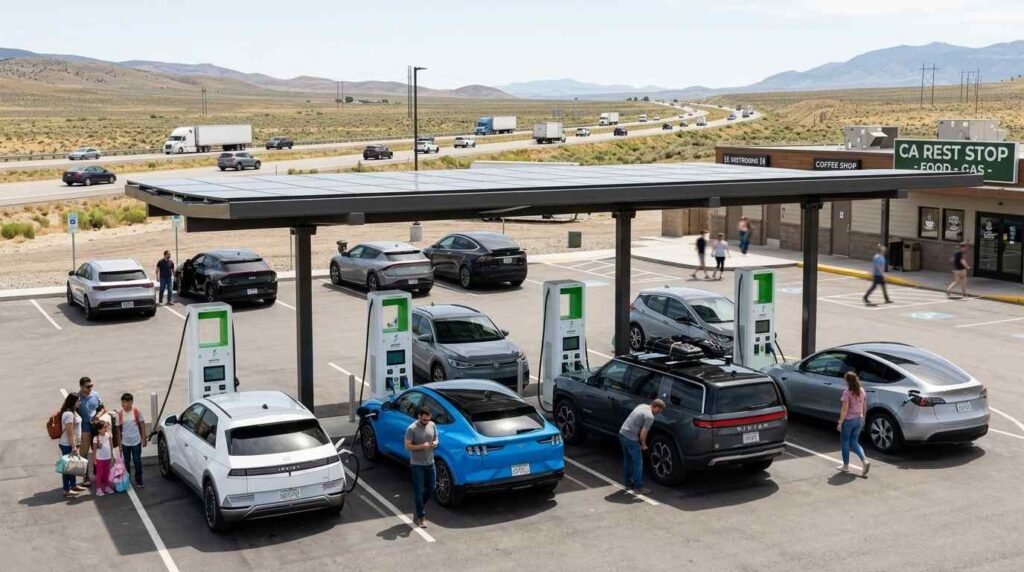
A major contributor to the current 2026 infrastructure is the National Electric Vehicle Infrastructure (NEVI) formula program. This federal initiative has successfully funded thousands of new ports along high-priority corridors. However, a lingering issue is the maintenance backlog. According to the 2026 DOE EV Resources report, while new installations are at an all-time high, the industry still lacks enough trained technicians to keep up with repairs in rural areas.
This means that while the “map” looks full, you might still encounter “ghost chargers”—stations that appear online in an app but are physically damaged or throttled. In our assessment, this is the next major hurdle for the industry to clear to reach 100% reliability.
Costs and Grid Limitations
Public fast charging prices have climbed significantly. In many states, DC fast charging now ranges from $0.30 to $0.60 per kWh. According to the 2026 Edmunds True Cost to Own calculator, this can put the cost of driving an EV on par with a gasoline car getting 35 mpg for long trips. Home charging remains the primary cost-saving benefit of EV ownership, often equivalent to paying under $1.50 per gallon of gasoline.
Furthermore, deployment delays are increasingly tied to grid interconnection. Adding a 350 kW charger requires massive power delivery that many local utilities struggle to provide on short timelines. This is why some “planned” charging sites take years to go live even after the hardware is on-site.
Conclusion: Who the 2026 Charging Network Actually Works For
If you mostly charge at home and use public chargers for road trips, the 2026 network works better than it ever has. In our assessment, it is now good enough that infrastructure should not stop most buyers from considering an EV. For urban drivers in well-supported regions, the experience is nearly seamless.
However, if you rely on public charging daily and live outside major coastal hubs, it remains complicated. Reliability and cost can still be inconsistent. Your best next step is to run your own numbers on fueleconomy.gov, check specific charging locations along your route using the DOE 2026 Station Locator, and compare long-term ownership costs via Edmunds. Those steps will provide more clarity than any brochure ever could.
References
- EPA Fuel Economy Data (2026 Edition)
- DOE EV Resources and Infrastructure Report (2026)
- DOE Alternative Fuels Data Center: Station Locator
- NREL EV Efficiency and Grid Interconnection Study (2026)
- J.D. Power 2026 Public Charging Satisfaction Study
- Edmunds True Cost to Own Calculator
Disclaimer
The information provided in this article is for educational and informational purposes only and does not constitute professional automotive or financial advice. Readers should conduct their own research and consult with qualified professionals before making any purchase or infrastructure decisions.