


You’re standing at the service counter. The advisor taps a pen against a printed “Dealer Recommended” menu and notes that you’re “due for multiple critical services”—coolant exchange, transmission flush, and a throttle body cleaning—totaling $780. Meanwhile, your owner’s manual, tucked away in the glovebox, suggests a simple oil change and tire rotation.
That gap between the manufacturer’s requirements and the shop’s suggestions is where most drivers lose hundreds of dollars annually. By the end of this guide, you’ll know how to read your manufacturer’s maintenance schedule like a seasoned technician. You will understand which services actually matter at specific mileage intervals and how to spot the difference between required maintenance and high-margin “recommended” add-ons.
We have grounded these insights in data from official 2026 manufacturer service guides, the J.D. Power 2025 Vehicle Dependability Study, and Consumer Reports reliability metrics.
The First Mistake: Treating “Recommended” Like “Required”
When you open your owner’s manual to the maintenance section, you will typically find a bifurcated list of items. Understanding the nuance between these two categories is the single most effective way to protect your wallet:
- Required (Scheduled) Maintenance: These are the non-negotiable actions the manufacturer dictates to keep the warranty intact and the vehicle operating within its design parameters.
- Inspect / Replace If Necessary: These items are condition-based. They require a physical evaluation by a technician to determine if a part has reached the end of its functional life.
Required maintenance items, such as oil changes, brake fluid flushes, and spark plug replacements, are time- or mileage-sensitive. If you skip these, mechanical components may wear prematurely. In contrast, “Inspect” items—such as suspension bushings, drive belts, or radiator hoses—should stay on the vehicle if they show no signs of cracking, leaking, or excessive play.
Up-selling often begins when a service advisor treats an “Inspect” item as a “Replace” item based solely on the odometer. If a shop pushes a replacement without providing photographic evidence of wear or a measurement (like brake pad thickness in millimeters), they are selling a product, not performing a service.
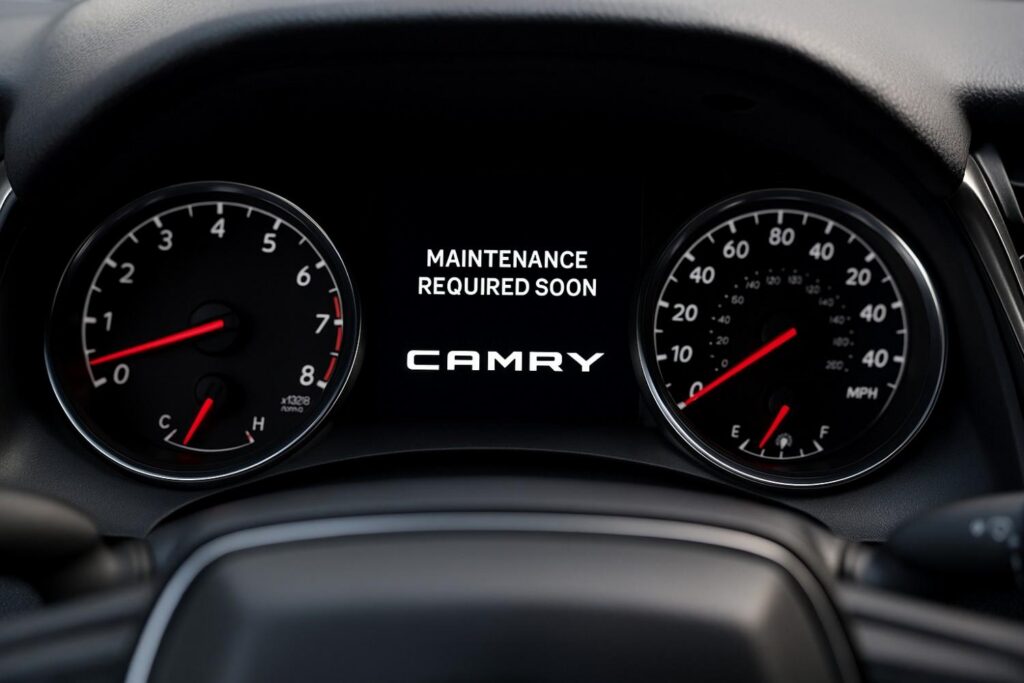
What the Manufacturer Actually Tells You
Using the 2023–2026 Toyota Camry 2.5L as a baseline—one of the most common vehicles in the J.D. Power 2025 Vehicle Dependability Study—we can see what the factory actually demands.
2026 Scheduled Maintenance Baseline (Toyota Camry 2.5L)
| Mileage | Required Maintenance | Verifiable National Average Cost |
| 5,000 | Tire rotation, fluid level check | $35.00 |
| 10,000 | Synthetic Oil + Filter change | $95.00 |
| 30,000 | Engine air filter, Cabin filter, Brake inspection | $145.00 |
| 60,000 | Brake fluid replacement, Drive belt inspection | $160.00 |
| 100,000 | Engine coolant replacement (first interval) | $195.00 |
| 120,000 | Iridium Spark Plug replacement | $320.00 |
This schedule omits several “common” services. There is no mention of a transmission flush at 30,000 miles, nor is there a requirement for fuel system cleaning or “engine de-sludging.” These omissions are intentional. Modern engineering has extended the life of fluids and components significantly compared to vehicles from twenty years ago.
According to data from Consumer Reports, sticking strictly to the manufacturer’s schedule—rather than “Dealership Value Packages”—correlates with lower long-term ownership costs. Those who purchase bundled dealer packages often pay for 30% more service than the car requires.
Why Shops Recommend Extra Services
It is important to acknowledge that some recommendations are legitimate. Driving conditions dictate the frequency of service. If you use your vehicle for towing, operate in extreme temperatures (above 100°F or below 0°F), or spend 80% of your time in stop-and-go traffic, you fall under the “Severe Service” schedule. This often halves the interval for oil changes and transmission services.
However, a secondary motivation exists. Most automotive service departments operate on a “flat-rate” pay system. Technicians and advisors are often incentivized to sell “preventative” fluid exchanges because they require very little labor time but carry high profit margins. An oil change might be a “loss leader” to get you in the door, while a $200 fuel induction service is where the shop finds its profit.
The Three Most Common Upsells Analyzed
1. Transmission Fluid Flushes
Typical Upsell: Every 30,000 miles.
The Reality: Most modern Toyota, Honda, and Ford transmissions use synthetic fluids designed for 60,000 to 100,000 miles. Some are even labeled as “Lifetime Fluid,” though many mechanics suggest a drain-and-fill (not a high-pressure flush) at 60,000 miles for longevity.
Our Assessment: If your car is under 60,000 miles and the manual doesn’t require it, decline the service unless you are towing heavy loads.
2. Fuel Injector and Induction Cleaning
Typical Upsell: Every 15,000 miles.
The Reality: Modern Top Tier™ gasoline already contains detergents that prevent carbon buildup on injectors. Unless you are experiencing a rough idle or a “Check Engine” light for a lean condition, this service provides negligible benefits.
Our Assessment: This is almost always a profit-generator for the shop rather than a necessity for the car.
3. Nitrogen Tire Fill
Typical Upsell: $50–$100 at the time of tire purchase or service.
The Reality: The air we breathe is already 78% nitrogen. While pure nitrogen migrates through tire rubber slightly slower, the benefit to the average commuter is statistically insignificant.
Our Assessment: Check your tire pressures monthly for free instead.
How to Cross-Check Before You Approve
To take control of the conversation, you must come prepared with your specific vehicle’s data. Do not rely on a generic poster on the wall of the waiting room.
- Use Digital Tools: Before your appointment, check Kelley Blue Book’s Service Advisor to see the fair market price for your specific mileage interval.
- Ask the “Condition” Question: If an advisor suggests a service not in your manual, ask: “What is the specific physical condition of the fluid or part that necessitates this today?”
- The “Manufacturer” Litmus Test: Ask: “Is this service required by the manufacturer to maintain my warranty, or is this a dealership recommendation?”
Simple, direct questions shift the dynamic. It signals to the advisor that you are an informed owner who understands the vehicle’s actual needs.
When It Is Actually Smart to Spend More
While this guide focuses on avoiding unnecessary costs, there are specific scenarios where “over-maintaining” is a sound investment. If you plan to keep your vehicle for 200,000 miles or more, being proactive with fluid changes (specifically transmission and coolant) can prevent catastrophic failures later in the vehicle’s life.
Furthermore, if you live in a “salt belt” state where roads are treated in winter, supplemental underbody washes and brake caliper lubrications are wise investments that manufacturers often overlook in their generic schedules. In these cases, the extra spend is a hedge against corrosion rather than a response to a mileage counter.
The Bottom Line
Reading your service schedule like a technician saves you from the “fear-based” selling tactics often found in the industry. By following the factory-required intervals, treating “inspect” items as condition-based, and using third-party cost estimators, you can maintain your car’s reliability without the $300 “service package” markups.
Next time you are at the counter, keep your manual open. Your car—and your bank account—will be better for it.
References
- J.D. Power 2025 Vehicle Dependability Study
- Consumer Reports: Car Maintenance and Repair Guide
- EPA/DOE Fuel Economy and Maintenance Data
- Kelley Blue Book Service Cost Estimator
- Toyota 2026 Model Year Maintenance Guides
Disclaimer: The information provided in this article is for educational and informational purposes only. It does not constitute professional automotive or financial advice. Readers should conduct their own research and consult with qualified, certified professionals before making any maintenance decisions.