

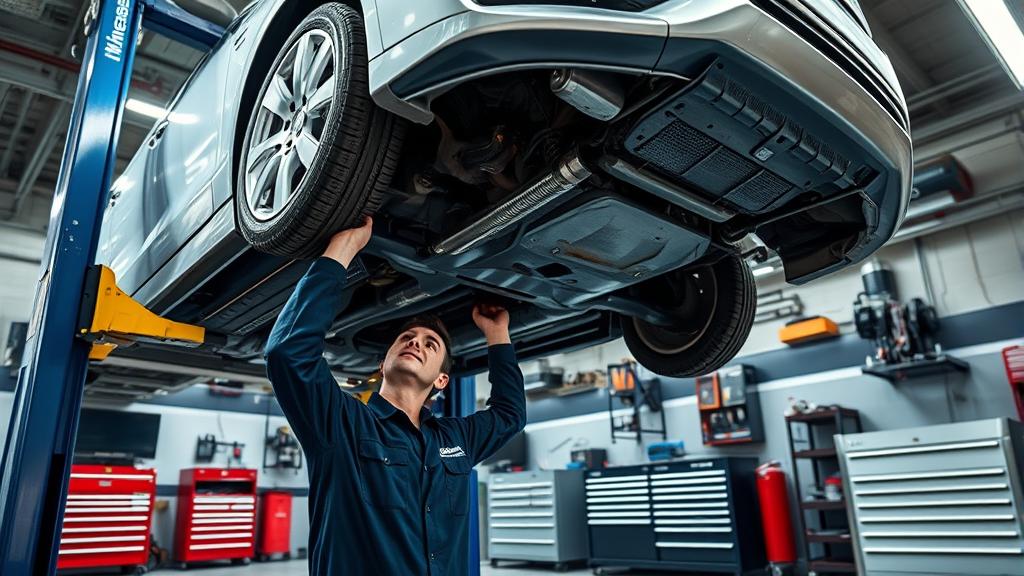
A customer brought her 2019 Honda CR-V in for a timing belt replacement. The shop told her she needed one. Honda CR-Vs don’t have a timing belt. They use a timing chain, which doesn’t need scheduled replacement at all. She paid $850 for a job that should not have been sold.
That kind of thing is not rare. According to AAA, American drivers pay an estimated $5.5 billion in unnecessary or faulty auto repairs each year. The problem isn’t finding a shop that can fix your car. Most shops are technically capable. The problem is finding one that won’t charge you for work your car doesn’t need.
The good news is that a trustworthy shop is identifiable. It just takes a little work before you actually need one.
The Walk-Through You Should Do Before You Need Them
Visit a shop when nothing is broken. A pre-need visit lets you evaluate the place without the pressure of a dead car and a repair bill hanging over the conversation.
Look at the floor. Not for cleanliness, but for organization. Tools thrown across benches, old parts sitting around lifts, no labeling on fluid containers: these are signs of a shop where things go wrong and nobody notices. An organized bay is usually run by someone who runs a tight process.
Check the wall for ASE certifications. ASE (Automotive Service Excellence) is the industry benchmark for technician qualification. Certified techs have passed a standardized test in a specific repair area, whether that is brakes, engine performance, or transmission. Certification is not a guarantee of honesty, but it at least tells you the person working on your car met a measurable standard.
Ask if they specialize. A general shop handles oil changes, brakes, and most routine work without a problem. But if you drive a European import or a diesel pickup, a shop that does two BMW jobs a month and mostly works on domestic sedans is not set up for your car’s quirks.
Red Flags to Watch For
The estimate comes back in under five minutes. That is a red flag. A real quote for anything beyond an oil change requires a physical inspection. If someone prices your brake job without checking rotor thickness, pad depth, or caliper condition, they are either guessing or padding.
They call back with a bigger number after you’ve already approved the work. One unexpected add-on is sometimes legitimate. A shop that discovers three new critical problems every single time on every car it touches is running a pattern. Ask for the old parts back whenever anything gets replaced. A shop doing honest work hands them over without any drama.
Vague invoices are another one. A line item should read: “Front brake pads, Wagner ThermoQuiet, $48 parts plus 1.2 hrs labor at $95/hr, total $162.” Not “brake service, $260.” If you cannot parse what you paid for, you cannot compare prices, catch a duplicate charge, or confirm the work happened.
Pressure to decide right now is a sales tactic. Most repairs can wait 24 hours for a second opinion. The exceptions are narrow: a brake caliper frozen in the open position, a coolant leak bad enough to make the car undrivable. A shop telling you the car will be undrivable by tomorrow on a leaking valve cover gasket is manufacturing urgency. Walk out.

Questions That Good Shops Answer Directly
Ask to see the worn part before it gets replaced. If the shop is doing honest work, the part is already out. This is a normal request, and how they respond to it tells you more than any review online.
Ask what the hourly labor rate is and whether the estimate uses flat-rate or actual time. Flat-rate pricing sets a fixed book time per repair regardless of how long it actually takes. The industry runs on flat-rate and that is fine. Knowing which applies to your job helps you read the invoice accurately.
Ask whether parts are OEM or aftermarket. For most routine repairs, quality aftermarket parts perform just as well as original equipment. For oxygen sensors, certain brake components, and some suspension parts on European vehicles, the brand gap matters more. A shop that defaults to the cheapest available part without mentioning it is leaving you out of the decision.
If this car came into my bay and the estimate came back at $900 for a power steering pump on a 2017 Corolla, the first thing I would ask the service writer is whether they checked a remanufactured unit from Toyota. Those typically run $340 to $420 installed. The $900 number is not impossible, but it needs an explanation.
Ask whether they will give you a written estimate before any work begins. Most states require shops to provide one if you ask. A shop that hesitates on this is not worth your time.
What Fair Pricing Looks Like in 2026
Labor rates vary by region and shop type, but the spread follows a consistent pattern. According to AAA, dealership labor typically runs $150 to $180 per hour. Independent shops usually charge $85 to $120. Chain service centers like Firestone or Midas tend to fall in the $60 to $95 range for straightforward jobs.
That gap does not make dealerships automatically wrong. For in-warranty repairs, recall work, or diagnosis on a recent model year, dealers have factory-trained technicians and proprietary scan tools. A 2023 vehicle with an active powertrain warranty belongs at the dealer. A 2016 F-150 with 95,000 miles and a leaking valve cover gasket does not.
Rough benchmarks for common jobs at an independent shop in 2026, based on CarMD repair data and AAA benchmarks:
- Oil change (full synthetic): $70 to $100 for most passenger vehicles
- Front brake pad replacement: $150 to $250, parts and labor
- Battery replacement: $180 to $280 installed, varies by group size
- Coolant flush: $80 to $120
- Serpentine belt replacement: $120 to $200
- Front struts, per side: $250 to $450, varies significantly by vehicle
- Timing belt with water pump: $600 to $1,100 where applicable
If a quote runs 30 to 40 percent above these ranges and the shop cannot explain why, get a second opinion.
Using Online Tools Before You Commit
CarMD and RepairPal both offer repair cost estimators searchable by vehicle and zip code. Neither is perfectly calibrated to your specific market, but they give you a reasonable range before you walk in. If a shop’s quote sits well outside that window, you have a number to ask about rather than just a feeling.
Consumer Reports publishes annual survey data on shop satisfaction by type. Independent shops consistently score higher than dealerships on perceived value and trust for out-of-warranty vehicles. Chain service centers score lower on complex repair confidence. In my experience matching that data to what I hear from owners, the pattern holds.
J.D. Power’s annual customer service satisfaction surveys consistently show that independent shops outperform dealer service centers on owner-perceived value, even when the dealer receives higher scores on facility quality. The gap narrows when warranty work is involved. For out-of-warranty vehicles, the independent advantage on perceived value is consistent year over year.
Google reviews are useful if you read them the right way. Skip the three-star middle ground and go directly to the one-star reviews. Every shop has unhappy customers. You are not looking for complaints about wait time or a missed phone call. You are looking for patterns: multiple mentions of being charged for work the car didn’t need, returned “old parts” that turned out to be the original clean parts, or estimates that doubled after drop-off.
The Bottom Line
A trustworthy mechanic in 2026 is not hard to find. They are just not obviously labeled.
Visit the shop before you need it. Ask the questions above. Get every estimate in writing. Cross-check the numbers against CarMD or RepairPal for your zip code. That takes about 20 minutes and can realistically save you several hundred dollars on a single repair job.
One thing this article cannot account for: regional price variation is larger than these benchmarks suggest. Labor in the Boston or San Francisco metro areas typically runs 30 to 50 percent higher than in smaller markets for identical work. The ranges here are national midpoints. Run your vehicle and location through CarMD before treating any of these figures as a local ceiling.
And if a quote comes in above 50 percent of what the car is worth on Kelley Blue Book, the repair-versus-replace math has shifted. That is a separate calculation worth doing before you approve anything major.
References
Disclaimer: The information provided in this article is for educational and informational purposes only. It does not constitute professional advice. Readers should conduct their own research and consult with qualified professionals before making any decisions.