

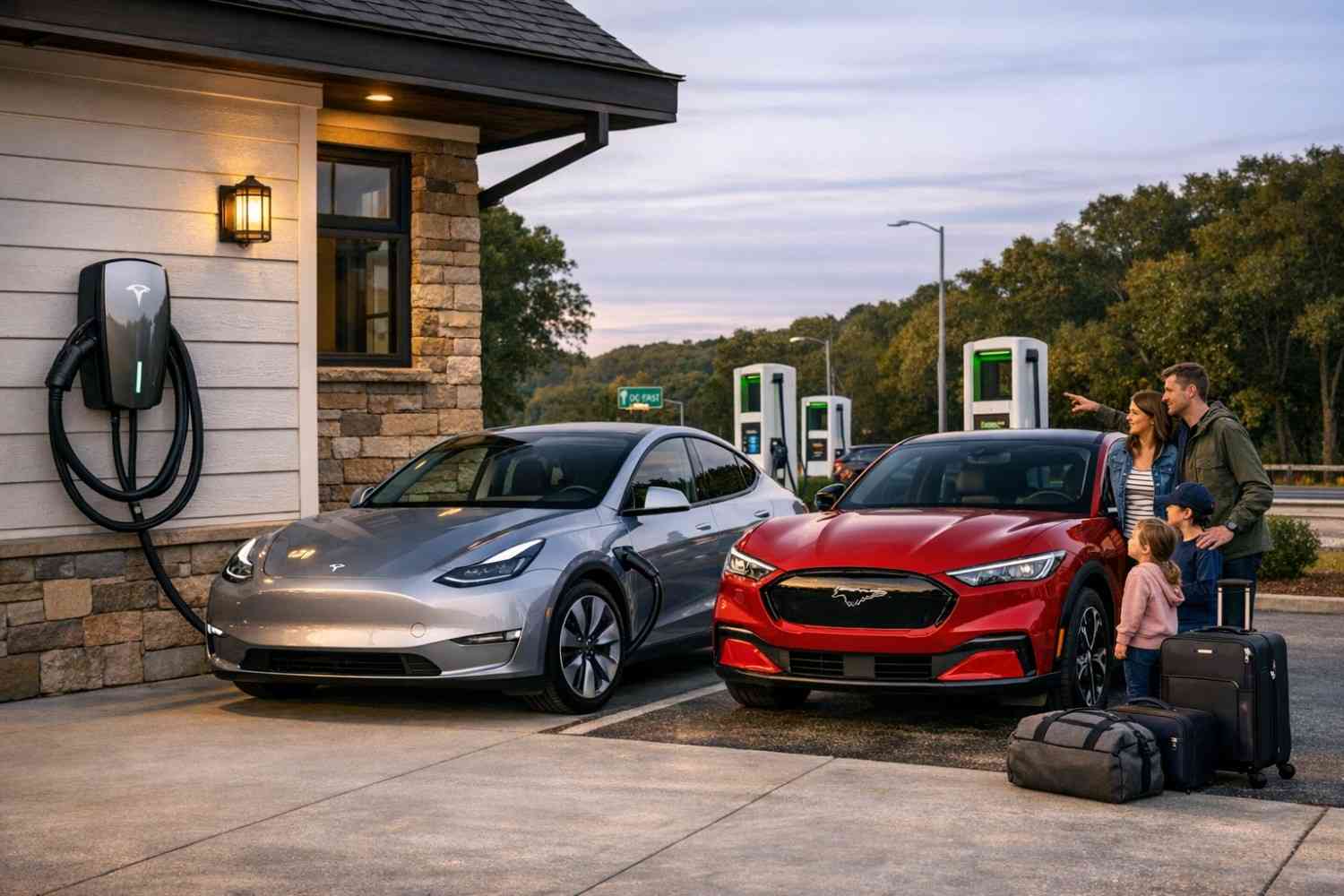
You get home with 40 miles left, plug into a standard wall outlet, and wake up… still not full. That’s the moment most new EV owners realize charging type matters more than battery size. This isn’t about voltage charts or connector names; it is about how often you think about charging, how long you wait, and whether your EV feels effortless or mildly annoying to live with.
By the end of this, you’ll know exactly where each charging level fits, how fast they actually are in real conditions, and what kind of setup makes daily driving painless. The differences in speed and cost are much bigger than most people expect, and they directly dictate your vehicle’s usability.
The Numbers That Actually Change Your Routine
Before getting into scenarios, here’s the numerical reality most buyers should start with. According to the U.S. Department of Energy’s EV resources, Level 2 is the most common home and public charging setup, while DC fast charging makes up a smaller but critical share of road trip infrastructure.
| Charging Type | Power Output | Miles Added Per Hour | Typical Use Case | Equipment |
| Level 1 | 1.4–1.9 kW | 3–5 miles/hour | Backup/home trickle | Standard 120V outlet |
| Level 2 | 6–11.5 kW | 20–40 miles/hour | Daily home charging | 240V charger |
| DC Fast | 50–350 kW | 100–1,000+ miles/hour* | Road trips/public top-up | Commercial stations |
| *Peak rates only achieved briefly under ideal temperature and battery conditions. |
This standard data split matters because your car might theoretically support 250 kW charging, but your daily life probably doesn’t require it. The optimal solution is usually the one that adds the most convenience, not just the most speed.
Level 1 Charging: The “It Works… Barely” Option
You can charge anywhere there’s a wall outlet. That is the appeal. Level 1 charging pulls about 1.4 kW from a standard 120-volt outlet. Think of it like filling a bathtub with a dripping faucet it gets there eventually, but only if you leave it completely alone for a very long time.
A typical EV with a 60 kWh battery (like a Chevy Bolt or Nissan Leaf) can take over 40 hours to go from empty to full using this method. Even a simple 50-mile top-up can require 10–12 hours. Data from EPA’s fueleconomy.gov shows most modern EVs consume around 25–35 kWh per 100 miles, which makes the math quite unforgiving at this low power level.
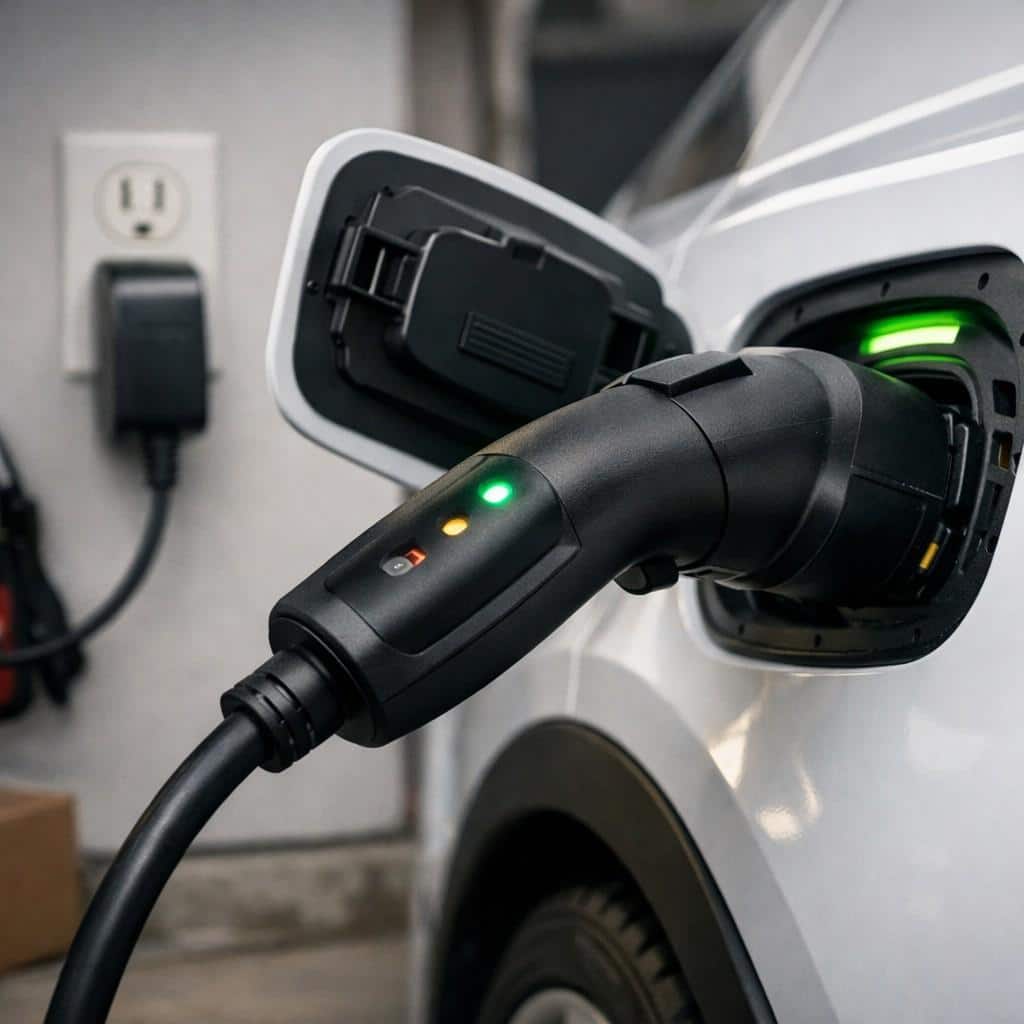
So what does this mean for you Practically? If you drive under 30–40 miles a day and plug in every single night, Level 1 can technically keep up, barely. But if you miss a single night, take an unexpected longer trip, or experience cold weather, you will start falling behind your weekly needs with no fast way to recover.
In our assessment, Level 1 is best treated strictly as a backup or temporary solution something useful in a pinch, not a setup to rely on long-term unless your daily driving patterns are extremely minimal and predictable. Using it as a primary option often results in significant “range anxiety” that home charging should solve.
Level 2 Charging: The One That Actually Fits Daily Life
This is where EV ownership starts to feel easy. Level 2 chargers run on 240 volts the same kind of circuit your heavy appliances use and deliver 6 to 11.5 kW depending on the circuit’s amperage. That translates to roughly 25–35 miles of range per hour for most EVs, which is enough to fully recharge even a large battery overnight while you sleep.
Say you drive 40 miles in a day; you can plug in at 8 PM and by midnight you are already back to full without any planning or waiting. According to U.S. Department of Energy (DOE) data, most EV owners who install home charging opt for Level 2 because it aligns perfectly with how people actually live and use their vehicles.
There is a distinct cost, though. Installing a Level 2 charger typically runs between $500 and $2,000 depending on your home’s existing electrical capacity and the complexity of the installation. But the federal EV tax credit may cover 30% of home charging equipment and installation costs (up to $1,000).
In our view, if you have a dedicated parking space and the ability to install Level 2 at home, you should absolutely do so. It removes 90% of the friction people often associate with EV ownership, making the vehicle simpler than a gas car. However, one serious limitation must be called out: if you live in an apartment without guaranteed plug access, or if you rely heavily on street parking, Level 2 access can be inconsistent, which significantly changes the daily ownership equation.
DC Fast Charging: Impressive, But Not Your Daily Habit
The headline numbers sound incredible: speeds up to 350 kW, capable of adding 200 miles in minutes. DC fast chargers bypass the vehicle’s restrictive onboard charger and feed power directly into the battery pack. On advanced vehicles like the Hyundai Ioniq 5 or Tesla Model Y, you can go from 10% to 80% state of charge in roughly 20–30 minutes under ideal conditions.
That capability is genuinely impressive for travel. But here is the part that gets glossed over in marketing: charging speed is not constant; it tapers. Think of it like pouring water quickly into a glass — you must slow down as you approach the top to avoid splashing or damage. So while you might see 250 kW briefly, your average charging speed over a 30-minute session will be much lower.
What does that mean in real life? DC fast charging is specifically designed for road trips and occasional top-ups when your home routine breaks. It is not how most people charge daily, and according to DOE infrastructure data, the vast majority of all charging sessions still occur at home or work, not at these public fast-charging plazas.
Infrastructure Reality: Capability vs. Availability
Here is where things get less ideal for the user. Your car might support 250 kW peak charging, but the public station you manage to find might max out at 50 kW or 150 kW. The national Alternative Fuels Data Center (AFDC) shows that while the U.S. has over 70,000 public charging stations as of 2026, only a fraction are high-speed DC fast chargers.
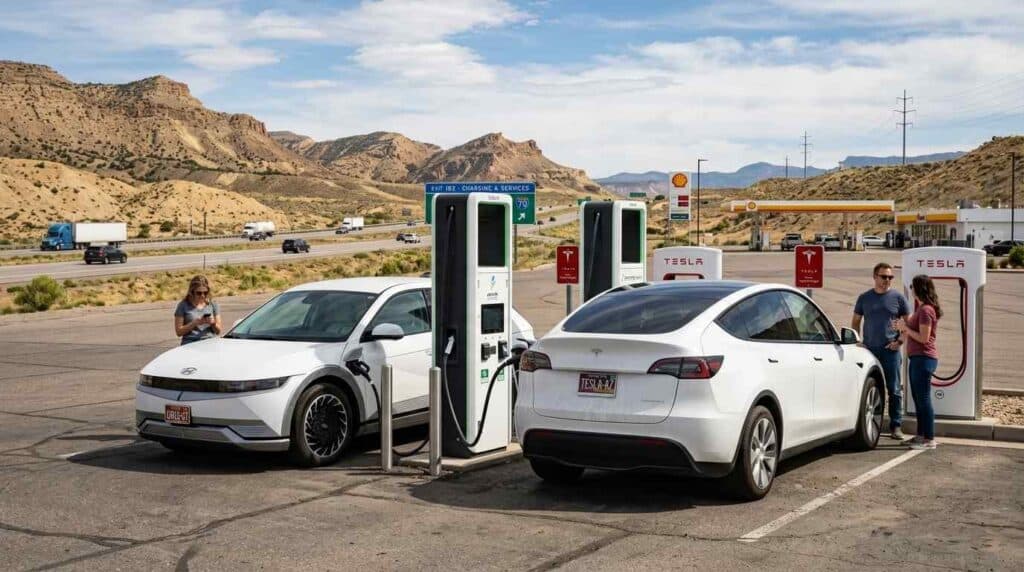
Furthermore, network reliability varies wildly. In dense urban areas, you will usually find multiple viable options, but in rural regions, significant gaps still exist. If you’re relying heavily on public charging, your experience depends entirely on this local infrastructure rather than your car’s theoretical performance. This is why some buyers feel EVs are inconvenient while others find them effortless. Before committing, I would strongly advise new buyers to consult DOE station locator maps to visualize exactly what public fast-charging coverage looks like along their most frequent long-distance routes.
Conclusion: The Setup That Actually Works
If you drive a typical daily commute and have the option to install home charging, Level 2 is the indisputable choice. It provides the seamless experience of waking up to a full “tank” every day. DC fast charging is an exceptional asset for long-distance travel, and the ongoing infrastructure expansion is making EV road trips increasingly realistic for all drivers.
Level 1 only makes sense if your driving is absolutely minimal. When deciding how to set up your own charging, start by checking your specific daily mileage and vehicle consumption estimates on EPA’s fueleconomy.gov, then run ownership cost estimates using the Edmunds’ True Cost to Own calculator. That numerical combination usually makes the correct charging setup for your lifestyle completely obvious.
References
- EPA Fuel Economy Data
- U.S. Department of Energy (DOE) EV Charging Resources
- U.S. Department of Energy (DOE) Alternative Fuels Data Center (AFDC)
- Federal EV Tax Credit Guidance (IRS)
- NREL Charging Research
Disclaimer
The information provided in this article is for educational and informational purposes only. It does not constitute professional advice. Readers should conduct their own research and consult with qualified professionals before making any decisions.