

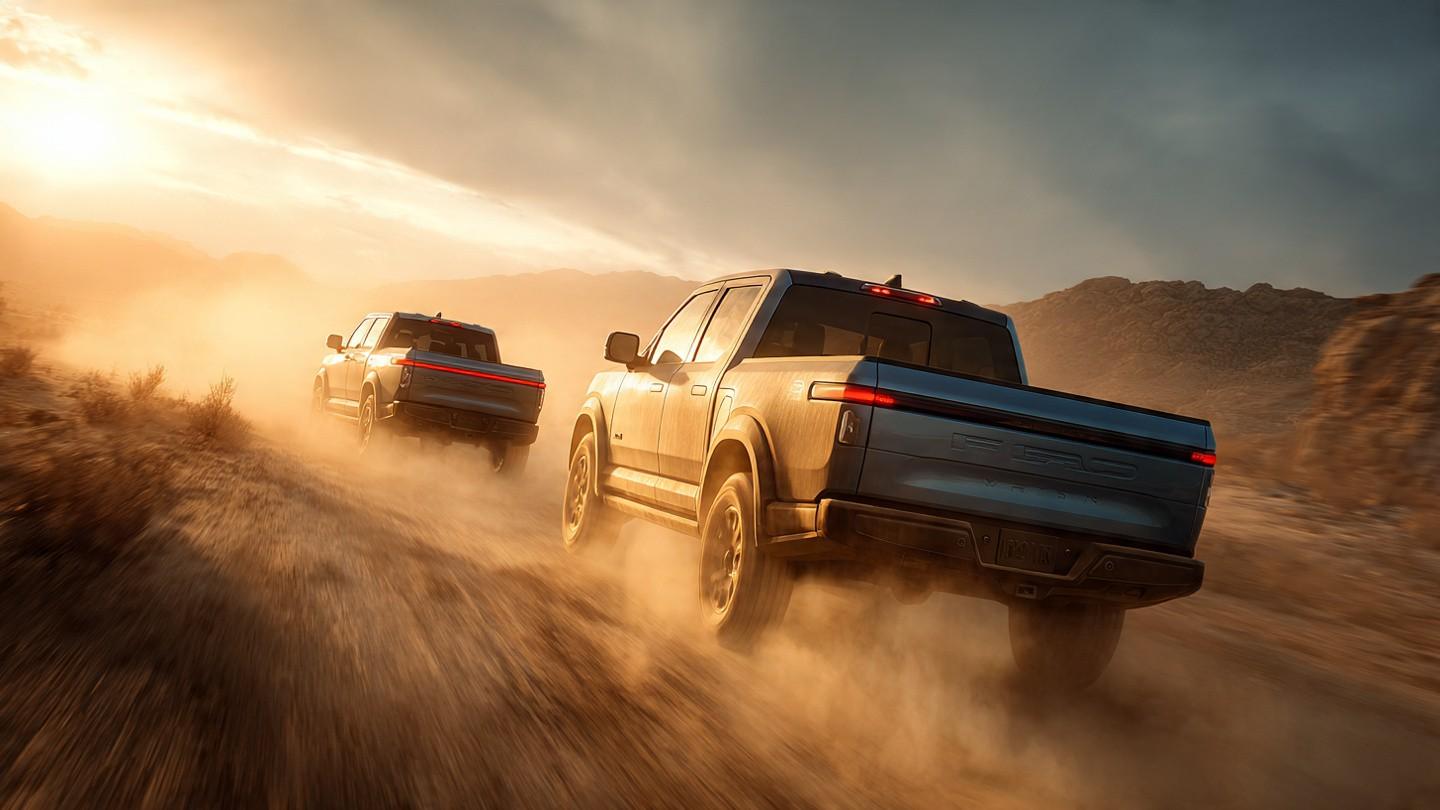
Most buyers comparing these two vehicles are asking the wrong question. They want to know which one has more range. The real question is which one is designed for the life you actually live because the 2026 Rivian R1S and the 2026 Ford F-150 Lightning are not competing to be the same vehicle. They’re solving different problems with electricity, and the gap between what they’re built for is wider than any spec sheet reveals.
The R1S is a three-row electric SUV with genuine off-road hardware underneath it. The Lightning is an electric full-size truck built around real-world work capacity and the appeal of the most popular vehicle platform in American history. Both cost between $60,000 and $100,000 depending on trim, both carry impressive EPA range numbers, and both have received strong safety ratings. This comparison covers range, capability, interior, practicality, and safety to answer the question that actually matters: which one do you need?
Range and Charging: The Numbers That Shape Your Week
The 2026 Rivian R1S Dual-Motor comes in at an EPA-estimated 320 miles of range, according to fueleconomy.gov. The R1S Quad-Motor drops that figure to around 270 miles but adds serious off-pavement performance. The 2026 Ford F-150 Lightning with the Extended Range battery earns an EPA estimate of 320 miles; the Standard Range version comes in around 240 miles. Those numbers look like parity. Real-world driving especially in cold weather or with cargo loads will compress both figures by 15–25%, a reality that matters more for the Lightning if you’re routinely towing.
Towing on an EV is range’s natural enemy, and it punishes the Lightning more directly. Ford rates the Lightning’s towing capacity at up to 10,000 pounds on certain configurations, which is legitimately useful truck-tier capability. But towing even a mid-size trailer say, 6,000 pounds can cut real-world range by 40–50%, per data widely consistent across EV towing tests. The Rivian R1S isn’t rated for heavy towing; its 7,700-pound max reflects its SUV-body priorities. If the trailer matters, the Lightning wins that dimension but factor in the range penalty when planning routes.
Both vehicles support DC fast charging, but the Rivian’s 200 kW peak charging rate and the Lightning’s 150 kW peak rate create a meaningful difference on long road trips. The Rivian can add roughly 140 miles in about 25 minutes at a compatible charger; the Lightning takes closer to 40 minutes for a comparable charge. For most daily drivers, this is irrelevant. For road-trippers, it compounds over time.
Capability On and Off Pavement
The Rivian R1S was designed to go places where trucks fear to tread, and it delivers. Standard air suspension adjustable to 14.9 inches of ground clearance, front and rear locking differentials, and the Quad-Motor’s torque vectoring capability make the R1S one of the most capable off-road electric vehicles in production. It wades through 3.9 feet of water and attacks trail grades that would strand most crossovers. The air compressor for re-inflating tires after airing down for rock crawling is built-in. Rivian thought about the use case from first principles.
The F-150 Lightning is a different machine. It sits on a standard Lightning platform with up to 8.4 inches of ground clearance respectable for a truck but not adventure-spec. It’s excellent on unpaved ranch roads, capable in mud and snow with the right tires, and genuinely impressive for job-site and farm work. What it is not is a technical off-road vehicle. Take it where a gas F-150 would confidently go and the Lightning handles it well. Point it at a boulder field and you’re in the wrong vehicle.
The Lightning’s payload advantage is real, though. It can carry up to 2,000 pounds in the bed, which the R1S an SUV, not a truck simply cannot match. If you haul material, equipment, or work cargo regularly, the Lightning’s bed is doing something the R1S cannot replicate.

2026 R1S vs. F-150 Lightning: Head-to-Head
| Category | 2026 Rivian R1S (Dual Motor) | 2026 Ford F-150 Lightning (Ext. Range) | Best For |
|---|---|---|---|
| Base MSRP | ~$75,900 | ~$64,995 | Lightning (value entry) |
| EPA Range | ~320 miles | ~320 miles | Even |
| Max Towing | 7,700 lbs | 10,000 lbs | Lightning |
| Max Payload | N/A (SUV) | 2,000 lbs | Lightning |
| Ground Clearance | Up to 14.9 in (air susp.) | 8.4 in | R1S |
| Seating | 7 passengers | 5 passengers | R1S |
| DC Fast Charge Rate | 200 kW | 150 kW | R1S |
| IIHS Safety Rating | Good (Top Safety Pick) | Acceptable (some moderate) | R1S |
| Frunk Storage | 11.1 cu ft | 14.1 cu ft | Lightning |
| Best For | Adventure + family | Work + daily hauling | — |
MSRP figures approximate. Range per EPA fueleconomy.gov. Capability specs per manufacturer pages.
Interior and Daily Livability
To be fair to the Lightning: its cab is cavernous, the controls are immediately familiar to any F-150 owner, and the onboard generator system is genuinely hard to argue against on practical grounds. But the R1S cabin is designed around adventure durability and family utility. Seven-passenger seating with a usable third row genuinely usable, not the symbolic third row that crossovers often claim combined with Rivian’s gear tunnel storage under the load floor makes this SUV practical for large families. The infotainment is clean, software updates frequently over the air, and the overall fit and finish has improved significantly since the vehicle’s 2022 launch.
The Lightning’s interior is pure F-150 evolution: familiar, wide, practical, and now featuring the large 12-inch Pro Power Onboard display and available 9.6 kW of onboard generator power. That last feature essentially a generator in your truck bed has become one of the Lightning’s most-discussed real-world advantages. Power your job site, run appliances during a power outage, or charge another EV from your bed. Ford calls it Pro Power Onboard, and it’s genuinely useful in a way that few automotive features actually are.
To be fair, the R1S’s seven seats, off-road hardware, and faster charging rate represent a different kind of practical. It serves a family that camps aggressively, needs three-row capacity, and covers meaningful road-trip distance. The Lightning serves the contractor, the farmer, and the buyer who needs the F-150 experience but wants to electrify it.
Safety Ratings: Where the Rivian Holds an Edge
The IIHS rates the 2026 Rivian R1S with “Good” scores across most categories, earning it a Top Safety Pick designation, according to IIHS vehicle ratings. The F-150 Lightning’s ratings are more uneven a mix of “Good” and “Acceptable” results in certain tests. NHTSA has given both vehicles strong overall ratings, though the specific configurations tested vary. In our assessment, the safety gap here is real and should factor meaningfully into the decision for buyers with young families.
Who Should NOT Buy This
Skip the Rivian R1S if you regularly tow more than 7,000 pounds, haul heavy material in a bed, or need the practical truck functionality that comes with a pickup body. The R1S is an SUV built around exploration and family capacity it is not a work truck, and trying to use it as one will expose its limitations quickly.
The Lightning is wrong for buyers who need genuine off-road capability, three-row seating, or faster DC charging on frequent long-distance road trips. It’s also a harder sell for buyers who prioritize safety ratings above other factors. And if your budget is closer to $75,000, the R1S’s higher base price reflects genuinely more sophisticated engineering the Lightning’s value case weakens as you option it up.
The Verdict
The 2026 Rivian R1S wins this comparison for buyers who need a family vehicle that can also go places specifically families who adventure, travel long distances, or need seven seats and off-road capability. The faster charging, better safety ratings, and superior off-road hardware make it the more capable vehicle in objective terms.
The F-150 Lightning is the right call for buyers who need a working truck, regularly tow, or want the familiar F-150 platform electrified. Its lower base price, 10,000-pound tow rating, and Pro Power Onboard functionality are real advantages for buyers whose lives actually need them.
One honest gap in this comparison: real-world charging infrastructure varies significantly by region, and both vehicles depend on route planning outside major metro areas. Based on the data covered here, the R1S is the stronger total package but your charging network reality may shift the calculus if you live outside a major metro. Check charger availability along your common routes before committing to either vehicle.
References
Disclaimer: The information provided in this article is for educational and informational purposes only. It does not constitute professional advice. Readers should conduct their own research and consult with qualified professionals before making any decisions.