

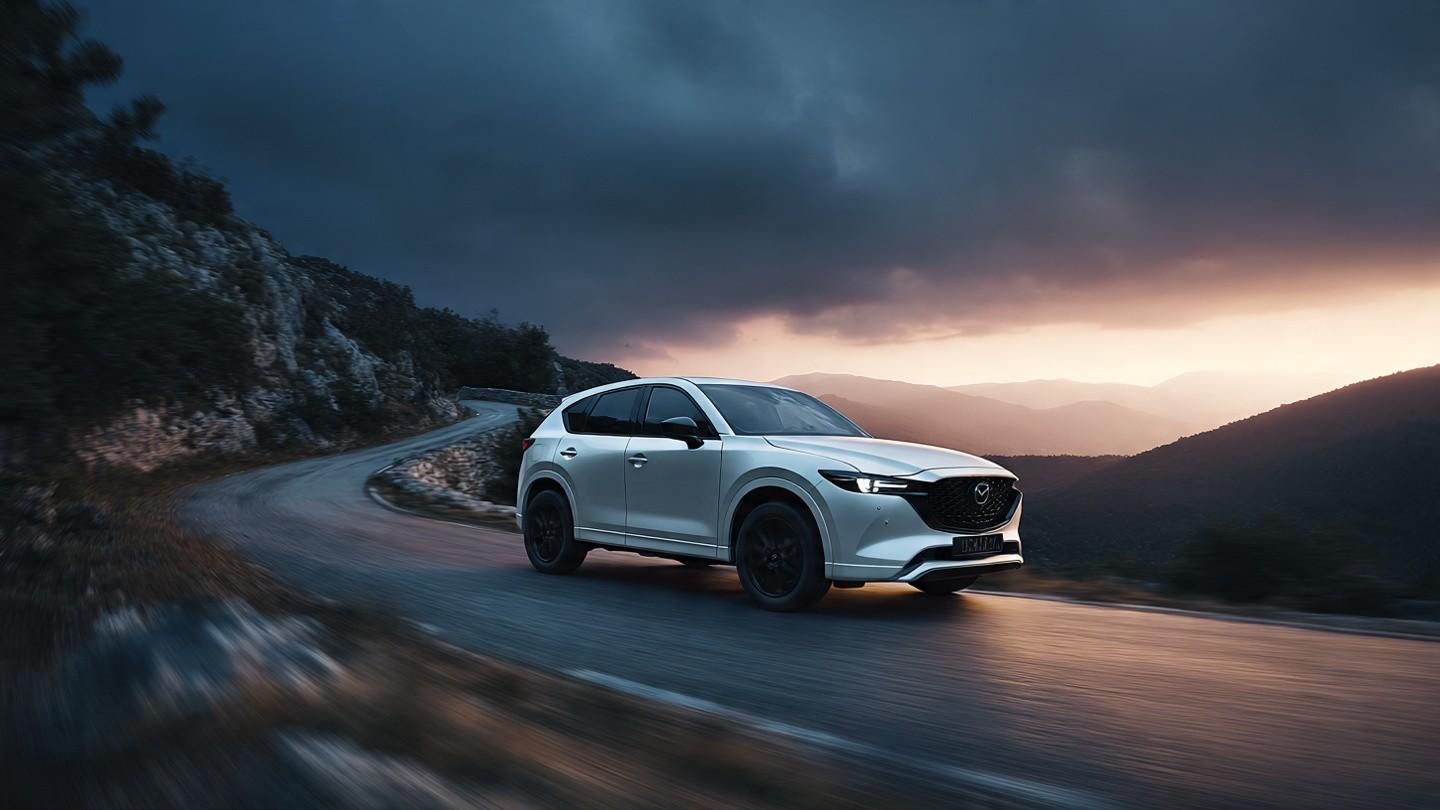
The corner comes up faster than expected, the road surface shifts from smooth asphalt to coarse chip-seal, and the CX-5 simply… tightens. The steering firms up with a quiet, linear weight, and the body stays remarkably flat. For a compact SUV that starts below $30,000, that’s a sentence you don’t expect to write.
Most compact SUVs in this segment are appliances. Capable, sensible, forgettable. The 2026 Mazda CX-5 is different enough to make you question why anyone in this price bracket accepts mediocrity. This review covers what the CX-5 gets right, where it falls short, and whether the premium over a CR-V or RAV4 is actually justified by the experience.
Data is drawn from EPA fuel economy figures, IIHS safety ratings, and extended driving time across city, highway, and light twisty roads.
The Interior Is the First Argument
Sit in the CX-5 before you drive it. Run your fingers across the dash. The texture is soft and consistent — not the patchwork of hard and soft plastics you find in most compact SUVs at this price. The stitching on the seats is tight and even. Even the weight of the door as it closes has a solidity to it — a thud, not a click.
Mazda has been deliberate about this for years, and the 2026 model continues the trend. The 10.25-inch center display is clean, high-contrast, and operated primarily through a rotary dial and physical buttons — a choice that looks old-fashioned on spec sheets but is enormously practical in motion. No hunting for a touchscreen tap at 65 mph.
The driving position is low by SUV standards, which contributes to the car-like feel. The steering wheel falls naturally to hand, the seat bolsters give just enough lateral support for spirited cornering, and the headrests don’t push your neck forward. Small details. But they add up to a cockpit that communicates competence before you’ve touched the ignition.
Rear seat space is adequate rather than generous. Adults over 6 feet may find headroom tight in the rear, and the cargo area at 30.9 cubic feet behind the rear seat is smaller than the Honda CR-V’s 39.2 cubic feet. That’s not a minor gap.
The CX-5’s interior is legitimately better than its price class, but the cargo compromise is real.
Driving Dynamics: This Is Where the Gap Opens
The base CX-5 uses a 2.5-liter naturally aspirated four-cylinder producing 187 horsepower, paired with a six-speed automatic. For everyday driving, it’s adequate responsive off the line, smooth at highway pace but not particularly exciting. Push it hard and there’s a slight breathlessness at the top of the rev range.
The turbocharged 2.5T, available in upper trims, changes the character entirely. At 227 horsepower on regular fuel and 256 on premium, the CX-5 Turbo pulls with authority from mid-range. The transmission holds gears longer in Sport mode, and the engine note takes on a sharper edge above 4,000 rpm. In our assessment, this is the trim that most clearly justifies the CX-5’s reputation as a driver’s compact SUV.
Mazda’s i-Activ AWD system standard on most trims sends torque rearward before wheelspin occurs, not after. The difference is subtle on dry pavement but meaningful on wet or snow-covered roads. The CX-5 feels planted in a way that front-biased AWD systems simply don’t replicate.
The ride quality is the only real dynamic compromise. The CX-5 is tuned firm compared to the Toyota RAV4 or Nissan Rogue. On smooth pavement, that firmness reads as sportiness. On broken urban surfaces, it reads as uncomfortable. Buyers who spend significant time on rutted city streets should note this carefully.
How the CX-5 Stacks Up: 2026 Compact SUV Comparison
| Metric | 2026 Mazda CX-5 | 2026 Honda CR-V | 2026 Toyota RAV4 | Best For / Verdict |
|---|---|---|---|---|
| Base MSRP | ~$29,450 | ~$31,895 | ~$30,975 | CX-5 — lowest entry price |
| Base Horsepower | 187 hp | 190 hp (hybrid) | 203 hp (hybrid) | RAV4 hybrid edge in efficiency |
| Cargo (rear seats up) | 30.9 cu. ft. | 39.2 cu. ft. | 37.6 cu. ft. | CR-V — significantly more space |
| EPA Combined MPG | 27 mpg (FWD) | 36 mpg (hybrid) | 39 mpg (hybrid) | RAV4/CR-V — fuel efficiency wins |
| IIHS Safety Rating | Top Safety Pick+ | Top Safety Pick+ | Top Safety Pick | CX-5 and CR-V tied at top |
| Infotainment | 10.25-in (physical dial) | 9-in touchscreen | 10.5-in touchscreen | Preference-dependent |
| Towing Capacity | 2,000 lbs | 1,500 lbs | 3,500 lbs | RAV4 — strong tow advantage |
| Driving Character | Sport-tuned | Comfort-focused | Balanced | CX-5 — most engaging to drive |
The fuel economy column is the CX-5’s most glaring weakness relative to its main competitors. At 27 mpg combined on the base FWD model, it trails the hybrid-standard CR-V and RAV4 by a significant margin, according to EPA data. If fuel costs are a priority over the next five years, the hybrid competitors return that investment in savings.
Fuel Economy: An Honest Reckoning
At 27 mpg combined in FWD configuration and 25 mpg combined in AWD, the naturally aspirated CX-5 isn’t a fuel economy leader. The turbocharged version drops further, to around 25 mpg combined. Those numbers are acceptable for a conventional gas SUV, but they’re not competitive with the CR-V Hybrid at 36 mpg or the RAV4 Hybrid at 39 mpg, as reported by the EPA.
Mazda currently offers no hybrid variant of the CX-5 in the US market. That is a real and growing gap as competitors shift toward hybrid-standard configurations. If you drive 15,000 miles annually, the fuel cost difference between the CX-5 and a RAV4 Hybrid is real money over three to five years.
This is the honest limitation of recommending the CX-5 in 2026. It’s the better driver’s car. It’s not the more economical one.
Safety: Strong Ratings Across the Board
The 2026 Mazda CX-5 earned a Top Safety Pick+ rating from the IIHS, the organization’s highest designation. NHTSA has given the CX-5 5 stars overall in preliminary testing. Mazda’s standard safety suite includes automatic emergency braking, lane departure warning, blind-spot monitoring, and rear cross-traffic alert on most trims.
The advanced radar cruise control system is among the better implementations in this class — it tracks smoothly at highway speeds and handles lane centering with less over-correction than many systems at this price. Based on time spent using it on a 200-mile highway run, the system builds genuine confidence rather than requiring constant oversight.
Who Should NOT Buy This
Do not buy the CX-5 if cargo space is a priority. The 30.9 cubic feet behind the rear seat will frustrate buyers who load up weekly for Costco runs, haul sports equipment for multiple kids, or need weekend camping capacity. The CR-V and RAV4 are meaningfully more practical.
Do not buy the CX-5 if fuel economy is your primary concern. Without a hybrid option, the CX-5 will cost more to fuel annually than most of its direct competitors.
Do not buy the CX-5 if you need to tow more than 2,000 pounds. It can handle a small trailer, but anything heavier belongs in a RAV4 or Hyundai Tucson.
And don’t buy the CX-5 if you prefer a soft, pillowy ride for broken urban roads. The sport-biased suspension that makes the CX-5 rewarding on winding roads makes it noticeably less comfortable on city pothole duty.
The Verdict
The 2026 Mazda CX-5 is the best-driving compact SUV at its price point and it’s not particularly close. The interior quality, steering feel, and overall sense of mechanical cohesion exceed anything the Honda CR-V, Toyota RAV4, or Nissan Rogue offers in pure driving engagement. If you value how a car makes you feel behind the wheel, the CX-5 makes the strongest case in this segment.
But the right buyer for this car is specific. You commute on good roads, you don’t haul large cargo regularly, fuel economy is secondary to experience, and you’re willing to accept a firm ride in exchange for genuine driver feedback. That’s a real buyer. There are plenty of them.
For everyone else especially buyers who prioritize cargo space, fuel costs, or towing the CR-V Hybrid or RAV4 Hybrid are more rational choices. Verify your specific trim’s availability and current pricing on Edmunds before heading to the dealer.
References
Disclaimer: The information provided in this article is for educational and informational purposes only. It does not constitute professional advice. Readers should conduct their own research and consult with qualified professionals before making any decisions.