

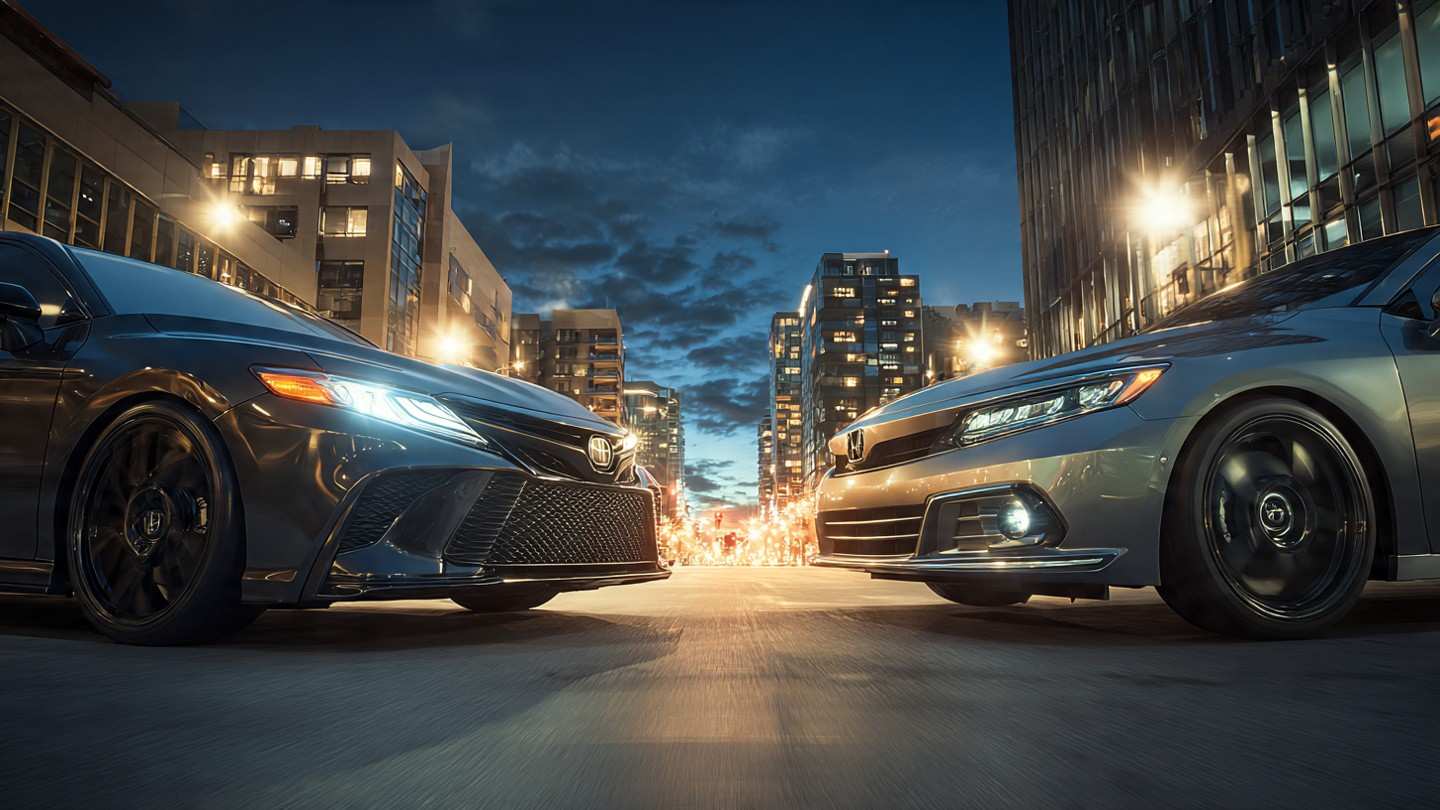
Merging onto a busy interstate, the 2026 Honda Accord Sport Hybrid doesn’t just accelerate it surges. The electric torque fills in immediately, the transmission holds without hunting, and you’re at highway speed before you’ve finished the thought. The Accord has always been quick for a family sedan. In hybrid form, it’s genuinely fast.
The 2026 Toyota Camry Hybrid, running the same exercise, responds differently. Smooth, composed, a little more deliberate in the way it builds speed. Not slow but the character is different. More reassuring than exciting.
These two sedans have been trading the midsize crown for decades. In 2026, both are hybrid-standard in their most popular configurations, both are legitimately good cars, and the decision between them has genuine texture. This comparison uses EPA fuel economy data, IIHS and NHTSA safety ratings, and real-world driving impressions to cut through the noise.
The Cabin: Two Very Different Interpretations of Premium
The Accord’s cabin leans sport. The Sport Hybrid trim brings a flat-bottom steering wheel, red stitching on the seats, and a 12.3-inch infotainment display that feels genuinely modern. The layout is driver-oriented controls cluster toward you, sight lines are wide, and the low roofline gives the interior a coupe-like intimacy. The soft surfaces on the dash and door panels are good quality for the price.
Step into the Camry and the atmosphere shifts. The 2026 Camry’s interior prioritizes serenity over engagement. The dash is wider and more horizontal in its design, the color tones are calmer, and the seat tuning is softer. The 12.3-inch infotainment screen in XSE and XLE trims is equally modern, but the interface’s menu logic is more intuitive out of the box than Honda’s system. Toyota’s cabin is quieter at highway speeds measurably so. Wind and tire noise are suppressed to a degree that makes long commutes noticeably less fatiguing.
Rear seat space favors the Accord. At 40.4 inches of rear legroom versus the Camry’s 38.0 inches, it’s a genuine advantage for families or anyone regularly carrying adult passengers.
The Accord is the sportier, more energetic cabin; the Camry is the quieter, more relaxed one. Neither is wrong, but they’re serving different drivers.
Powertrain and Efficiency: The Hybrid Gap Has Closed
Both vehicles now offer hybrid powertrains as the primary configuration. The 2026 Camry Hybrid produces 225 combined horsepower and returns 51 mpg city / 53 mpg highway / 52 mpg combined in FWD configuration, according to EPA data. The AWD version drops slightly to 44 mpg combined still excellent.
The 2026 Honda Accord Hybrid Sport produces 204 combined horsepower and returns 44 mpg city / 37 mpg highway / 41 mpg combined. The Camry wins on pure efficiency, and it’s not close the Camry returns roughly 11 more miles per gallon in combined driving. Over 15,000 annual miles at $3.50 per gallon, that gap translates to roughly $250–$300 in annual fuel savings.
The Accord makes up some ground in performance. Its hybrid system which can operate in pure EV mode, engine-only mode, or a parallel configuration depending on the conditions produces a more immediate torque response in acceleration. The 0–60 time for the Accord Hybrid Sport is approximately 6.5 seconds; the Camry Hybrid sits closer to 7.2 seconds. Neither is a sports car, but the gap is perceptible.
Head-to-Head: The Numbers That Matter
| Metric | 2026 Toyota Camry Hybrid | 2026 Honda Accord Hybrid Sport | Best For / Verdict |
|---|---|---|---|
| Base MSRP | ~$29,995 | ~$31,895 | Camry — lower entry price |
| Combined MPG | 52 mpg (FWD) | 41 mpg | Camry — clear efficiency leader |
| Combined Horsepower | 225 hp | 204 hp | Camry — more power in this config |
| Rear Legroom | 38.0 in. | 40.4 in. | Accord — more generous |
| Trunk Volume | 15.1 cu. ft. | 16.7 cu. ft. | Accord — slightly more cargo room |
| IIHS Safety Rating | Top Safety Pick+ | Top Safety Pick+ | Tie |
| NHTSA Overall | 5-star | 5-star | Tie |
| 0–60 mph (est.) | ~7.2 sec | ~6.5 sec | Accord — quicker |
| AWD Available? | Yes | No | Camry — unique in segment |
One item in that table stands out: the Camry offers AWD, the Accord does not. For buyers in snow-belt states the Midwest, Northeast, Mountain West that’s a real consideration, not a spec sheet curiosity. The Accord has no AWD option at all, which removes it from consideration for drivers who prioritize all-season traction.
On the Road: Character Over Spec Sheets
The Camry’s steering is light deliberately so. It’s tuned for effortless urban maneuvering and fatigue-free highway cruising, not for feedback or engagement. Run your hands along the wheel at speed and the car communicates very little about what’s happening at the tire contact patches. That’s a feature for many buyers, a frustration for others.
The Accord’s steering has weight. Not heavy, but present there’s resistance that builds progressively through a corner, and the car responds to input with a directness that makes it feel several classes above its price. After driving both vehicles back to back, my read is that the Accord’s chassis cohesion is the most underrated quality in this segment.
Ride quality is close, but the Camry absorbs rough pavement more willingly. Its suspension tuning prioritizes float, which suits long highway stints. The Accord, while not harsh, communicates more of the road through the seat and wheel again, that’s a feature for engaged drivers and a minor complaint for buyers who want serene isolation.
In our assessment, the Camry is the better commuter sedan for pure daily usefulness; the Accord is the better driver’s sedan for anyone who still finds driving interesting.
Safety: Both Are as Good as It Gets
The IIHS awarded both the 2026 Camry and the 2026 Accord Top Safety Pick+ ratings. NHTSA gives both vehicles 5-star overall ratings. Automatic emergency braking, lane-keeping assist, adaptive cruise control, and blind-spot monitoring are standard on mainstream trims of both vehicles.
Based on data from the IIHS safety ratings database, the Accord’s headlights in upper Sport Hybrid trims score Good, while the Camry’s higher trims also achieve Good ratings. At the base trim level, both vehicles score Acceptable solid but not exceptional. Buyers who upgrade even one trim level get meaningfully better headlight performance in both vehicles.
At the safety level, these two cars are functionally equivalent. The differentiator is elsewhere.
Who Should NOT Buy This
The Camry is not for buyers who enjoy driving. It’s comfortable, efficient, and supremely competent but it asks nothing of the driver, which means the driver gets nothing back. If the experience of driving matters to you even on a Tuesday commute, the Accord is more engaging.
The Camry is also not the right choice for buyers who regularly carry three or four adults. At 38.0 inches of rear legroom, the back seat is adequate but not spacious. The Accord’s 40.4 inches is noticeably more livable.
The Accord is not the right choice for buyers in northern states who need AWD. There is no AWD Accord. Full stop. It’s also not for buyers who prioritize fuel economy above all the Camry’s 52 mpg combined simply doesn’t have competition from this platform.
The Verdict
The 2026 Toyota Camry Hybrid wins this comparison for the majority of buyers and the fuel economy margin is the deciding factor. At 52 mpg combined, lower starting MSRP, optional AWD, and a quieter cabin, the Camry delivers more practical value per dollar for daily commuters who rack up miles. Add the AWD option for anyone in a snow state and the case gets even stronger.
The 2026 Honda Accord Hybrid Sport wins for a specific, real buyer: someone who finds the Camry’s competent serenity unsatisfying and wants a sedan with genuine road feel, quicker acceleration, and better rear passenger space. It costs a bit more and uses more fuel, but it’s the more rewarding machine to operate.
For your next step, verify current pricing and AWD availability at your nearest dealer, and cross-reference both models’ current safety and reliability scores on the IIHS and Edmunds platforms before finalizing.
Do not buy the Accord if you need AWD, and do not buy the Camry if you expect the drive itself to be part of the reward.
References
Disclaimer: The information provided in this article is for educational and informational purposes only. It does not constitute professional advice. Readers should conduct their own research and consult with qualified professionals before making any decisions.