

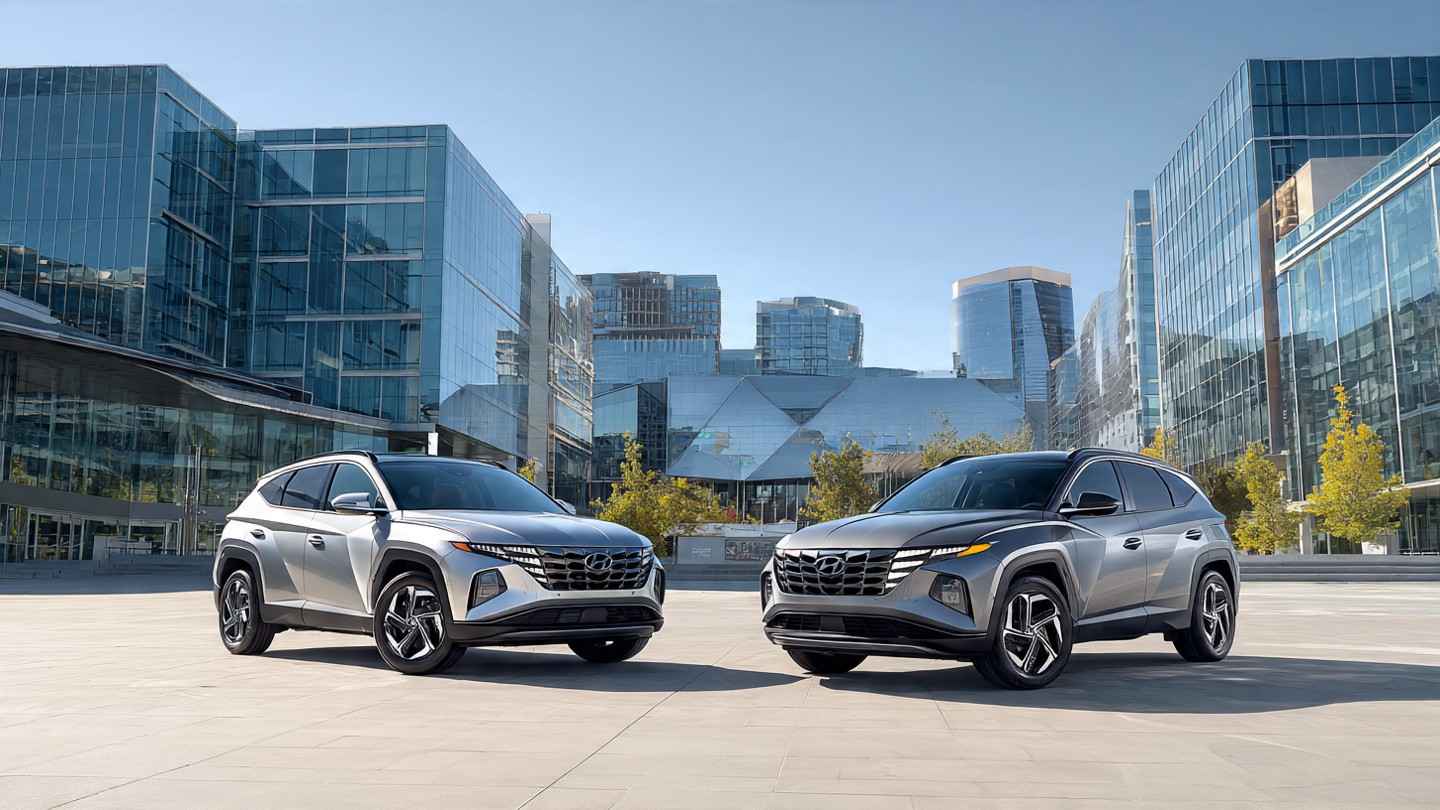
The 2026 Kia Sportage EX Hybrid and the 2026 Hyundai Tucson Hybrid SEL share a platform. They share engines. They share most of their underpinning architecture. And yet, behind the wheel on back-to-back drives, they feel like they were tuned by people with genuinely different opinions about what a compact SUV should be.
That’s the interesting tension in this comparison. Because when two vehicles are this closely related and still diverge meaningfully in character, it matters which divergence you prefer.
This is a direct comparison of the 2026 Tucson Hybrid and Sportage Hybrid the hybrid-powered configurations that now represent the best value in each lineup, covering driving dynamics, interior quality, practicality, fuel economy, and safety. Data comes from EPA fuel economy figures, IIHS safety ratings, and NHTSA crash test results.
Design and First Impressions: Different Personalities, Same DNA
Step into the Sportage and you notice the panoramic curved display immediately — it’s a single continuous arc of glass housing both the 12.3-inch instrument cluster and the 12.3-inch infotainment screen. The effect is striking. The Sportage’s interior reads young and assertive, with a level of visual flair that’s unusual in this price bracket.
The Tucson’s interior is more reserved. The horizontal dash design with a freestanding center console has a cleaner, more European restraint to it. The digital instrument cluster and 10.25-inch infotainment screen are functional and well-organized, but the cabin doesn’t announce itself the way the Sportage’s does. Soft-touch materials appear on the dash and upper door panels a quality that’s appropriate for the price without trying to masquerade as something more expensive.
Rear seat space slightly favors the Tucson at 41.3 inches of rear legroom versus the Sportage’s 41.3 inches — essentially identical. Cargo volume with seats up is 31.9 cubic feet in the Tucson Hybrid versus 39.6 cubic feet in the Sportage Hybrid. That cargo gap is real and worth paying attention to.
If the cabin’s first impression matters to your buying decision, these two will sort buyers quickly. The Sportage impresses; the Tucson reassures.
Powertrain: Shared Engine, Different Tune
Both the 2026 Tucson Hybrid and 2026 Sportage Hybrid use a turbocharged 1.6-liter four-cylinder paired with a 44.2 kWh hybrid battery and a six-speed automatic. Combined output is 227 horsepower in both applications.
The EPA rates the 2026 Tucson Hybrid at 38 mpg city / 38 mpg highway / 38 mpg combined in FWD. The Sportage Hybrid comes in at 38 mpg city / 35 mpg highway / 36 mpg combined FWD. The Tucson Hybrid’s unusually flat combined figure is a genuine achievement in this class.
Where they diverge is in throttle response and shift behavior. The Sportage has a slightly sharper initial response off the line — the tune is more aggressive, the transitions between EV-only and hybrid modes less seamlessly managed. The Tucson is smoother, more predictable. In mixed urban driving, the Tucson’s hybrid system integration is more polished than that of the other vehicle.
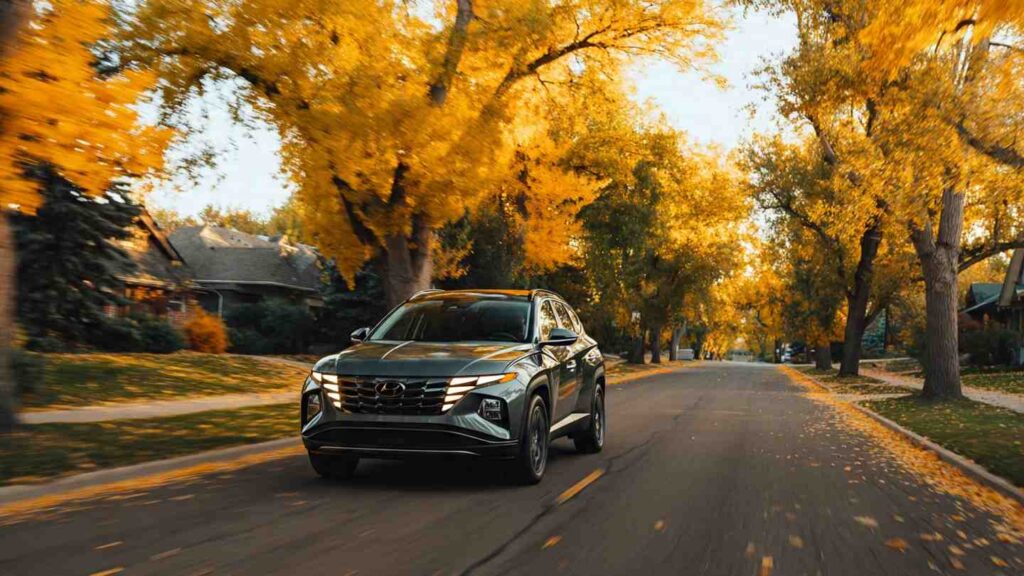
Head-to-Head: 2026 Tucson Hybrid vs. 2026 Sportage Hybrid
| Metric | 2026 Hyundai Tucson Hybrid SEL | 2026 Kia Sportage EX Hybrid | Best For / Verdict |
|---|---|---|---|
| Starting MSRP (trim) | ~$33,400 | ~$33,995 | Tucson — marginally lower |
| EPA Combined MPG | 38 mpg (FWD) | 36 mpg (FWD) | Tucson — 2 mpg edge |
| Combined Horsepower | 227 hp | 227 hp | Tie — same powertrain |
| Cargo Volume (seats up) | 31.9 cu. ft. | 39.6 cu. ft. | Sportage — significantly more |
| Rear Legroom | 41.3 in. | 41.3 in. | Tie |
| Infotainment Screen | 10.25-inch | 12.3-inch panoramic | Sportage — larger, more dramatic |
| IIHS Safety Rating | Top Safety Pick+ | Top Safety Pick+ | Tie |
| NHTSA Overall | 5-star | 5-star | Tie |
| Plug-In Hybrid Option | Yes (PHEV) | Yes (PHEV) | Tie — both offer PHEV |
The cargo volume difference in that table is the most significant spec gap between these two vehicles. The Sportage’s 39.6 cubic feet of cargo space beats the Tucson by nearly eight cubic feet enough to matter if you’re loading groceries for a family, moving a piece of furniture, or packing for a weekend away.
On the Road: Where the Shared Platform Diverges
The Tucson Hybrid’s ride is tuned toward comfort. It absorbs bumps with a softness that makes it feel larger than it is a floating quality that’s particularly noticeable on broken urban pavement. The steering is light and easy to manage, and the overall driving experience is calm, predictable, and unstressful.
The Sportage Hybrid’s suspension is firmer. Not harsh, but more engaged it communicates the road surface more actively through the seat and steering wheel. The steering has slightly more weight and the body responds to input with less float. This isn’t a dramatic difference, but spend an hour in each and you’ll notice the Sportage asks slightly more of the driver.
Both vehicles run nearly silently at low speeds in EV mode, and both suppress wind and tire noise well at highway speeds. The Tucson is marginally quieter in the cabin at 70 mph the difference is small but detectable.
In our assessment, the Tucson Hybrid is the better daily commuter for buyers who value smoothness. The Sportage Hybrid is the more interesting drive for buyers who want their car to feel like a car, not an appliance.
Safety: A Genuine Tie
Both the 2026 Hyundai Tucson and 2026 Kia Sportage hold Top Safety Pick+ ratings from the IIHS the organization’s highest designation. NHTSA awarded both vehicles 5-star overall ratings. Forward collision warning, automatic emergency braking, lane keeping assist, blind-spot collision warning, and rear cross-traffic alert are standard on mainstream trim levels of both vehicles.
Based on time spent using both active safety systems in light urban traffic, the automatic emergency braking responses were timely and well-calibrated in both vehicles neither triggered unnecessarily nor felt hesitant in genuine near-miss scenarios.
The safety parity between these two vehicles is not a coincidence. They share the same platform, and much of the same safety hardware. Buyers do not need to sacrifice safety for price in this comparison.
Who Should NOT Buy This
The Tucson Hybrid is not the right choice for buyers who need cargo space. The 31.9 cubic feet of cargo volume is genuinely constrained relative to its competitors including its own platform sibling. If you haul regularly, the Sportage’s additional 7.7 cubic feet will be noticeable within the first week.
The Tucson is also not for buyers who want a visually striking interior. The cabin does its job well, but it lacks the wow factor that the Sportage’s panoramic curved display delivers.
The Sportage Hybrid is not the right choice for buyers who prioritize fuel economy as the primary metric. The Tucson’s 38 mpg combined versus the Sportage’s 36 mpg is a modest gap, but it’s consistent and real. Over time, those two miles per gallon add up. The Sportage is also not for buyers who want the smoothest possible transition between EV and hybrid modes the Tucson handles that more seamlessly.
The Verdict
The 2026 Hyundai Tucson Hybrid wins for most daily commuters. It’s slightly more fuel-efficient, slightly less expensive to start, and its hybrid powertrain integration is smoother and more refined. The quieter cabin and more comfortable ride make it the better choice for buyers who want competent, low-stress daily transportation.
The 2026 Kia Sportage Hybrid wins for buyers who prioritize cargo space, want a more visually expressive interior, or prefer a slightly more engaging driving character. At very similar pricing, the Sportage’s additional 7.7 cubic feet of cargo volume alone may be enough to justify the choice for family buyers.
Both vehicles are genuinely excellent. But the right one depends on what you load in the back versus what you want to feel at the wheel. Check both vehicles’ PHEV variants too if you have home charging capability, the plug-in hybrid versions of each add an all-electric range of roughly 30–33 miles and change the fuel cost equation considerably.
Do not buy the Tucson Hybrid if cargo space is something you’ll argue with regularly. Do not buy the Sportage Hybrid if maximum fuel efficiency is your top priority.
References
Disclaimer: The information provided in this article is for educational and informational purposes only. It does not constitute professional advice. Readers should conduct their own research and consult with qualified professionals before making any decisions.