


The average trade-in undervaluation lands somewhere between $1,500 and $3,000 compared to private-party value, according to Kelley Blue Book data. That gap isn’t random; it is where most buyers quietly lose money during the transition to a new vehicle. You’re not just handing over keys when you visit a dealership. You’re selling an asset—often your second most expensive one—inside a transaction designed to blur the numbers. While the monthly payment might look fine on paper, the five-year cost often tells a much different story.
This is how you close that gap in 2026. We’ll break down what your car is actually worth, how dealers price trade-ins, when trading in makes financial sense, and the exact moves that keep more cash in your pocket. We’re pulling from KBB valuations, Edmunds True Cost to Own data, and Federal Reserve credit trends to ground this in real numbers. By understanding the mechanics of the “back-end” of the deal, you can ensure your equity remains intact.
The $2,000 Gap Most Buyers Accept Without Realizing
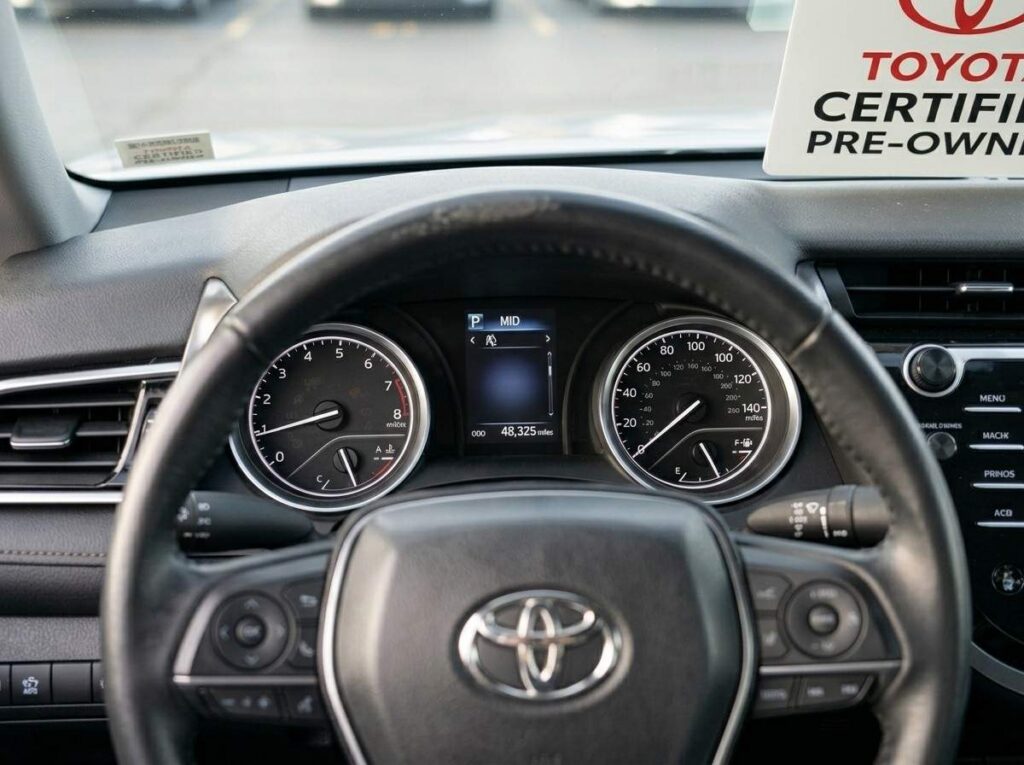
Let’s put numbers on it to see the actual impact. Here’s how a typical 2022 Toyota Camry LE (about 45,000 miles) might break down in early 2026 using Kelley Blue Book estimates:
| Sale Method | Typical Value (USD) |
| Trade-in at dealership | $17,500 – $18,500 |
| Instant cash offer (online) | $18,500 – $19,500 |
| Private party sale | $20,000 – $21,500 |
That’s a $2,000–$3,000 spread that stays with the dealer if you aren’t careful. Here’s what that actually means for your wallet: if you roll that lost value into your next loan at 6.5% (close to current averages per Federal Reserve consumer credit data), you could pay another $350–$500 in interest on top of the loss. Small decisions lead to real money disappearing over the life of your next loan. Dealers aren’t always trying to trick you; they’re pricing in reconditioning costs, auction risk, and resale margin. But they’re also betting you won’t push back, and most people simply don’t.
Why Timing Your Trade-In Matters More Than You Think
Ever noticed how your car suddenly “loses value” the moment you bring it in for an appraisal? Part of that is natural depreciation, but part of it is simple market timing. According to Edmunds True Cost to Own data, the steepest depreciation hits in the first three years—often 40% to 50% of original MSRP. After that, the curve flattens, which means trading in at year three versus year five can change your loss profile significantly.
Seasonal demand is the part buyers miss most often. SUVs and AWD vehicles tend to bring higher trade values in fall and winter. Convertibles and sports cars trend higher in spring, while fuel-efficient sedans spike when gas prices rise. Identical vehicles can appraise $1,200 apart just based on the month you walk into the showroom. In our view, if you’re within six months of needing a new car, it’s worth checking your trade-in value twice—once early, once closer to purchase—instead of assuming the number holds steady.
The Loan Payoff Trap That Costs You Thousands
If you still owe money on your current car, this is where things get expensive fast. Let’s say you owe $22,000 on your loan, but your trade-in offer comes in at $18,000. That leaves you with $4,000 of negative equity. Here’s what typically happens: the dealer rolls that $4,000 into your next loan, meaning you’re financing a new car plus your old car’s leftover debt. According to the CFPB’s auto loan guidance, this is one of the most common ways buyers end up “upside down” on loans for years.
This debt compounds significantly over time. That $4,000 becomes closer to $4,700–$5,200 over a 60-month loan once interest is added. If negative equity is under $1,500, rolling it in may be manageable for some budgets. However, if it’s above $3,000, we strongly suggest waiting or paying down the loan first. Based on our analysis of the finance desk, buyers who pause and fix negative equity first come out significantly ahead—even if it delays the purchase by a few months.
How Dealers Actually Price Your Trade-In
The appraisal process often feels opaque on purpose. But the formula is simpler than it looks when you break it down. Dealers typically anchor your trade-in value to auction value (what they could get wholesale) and reconditioning costs like tires and brakes. They also factor in market demand in your region and a profit margin that usually targets a $1,000–$2,500 spread.
If your car could sell retail for $21,000, a dealer might aim to own it for $18,000 or less. That gap is where negotiation lives, and you can negotiate trade-in value if you separate it from the rest of the deal. When buyers focus on the monthly payment, the trade-in number becomes easy for a salesperson to manipulate. The smarter move is to negotiate your new car price first, lock it, and then introduce your trade as a separate transaction.
The One Move That Consistently Gets Higher Offers
Get at least two outside offers before you step into a dealership. CarMax, Carvana, and local dealers will give you baseline numbers that anchor the negotiation. Once a dealer knows you have a competing offer, the tone of the conversation usually changes. I’ve watched this play out hundreds of times where a buyer walks in with a $19,200 quote, and the dealership’s “best offer” jumps from $18,000 to $19,000 instantly.
Leverage is the only thing that changed in that scenario. Selling privately can still net you more money, but it takes time, risk, and effort for test drives and paperwork. You must decide how much your time is worth compared to the potential profit. If the dealership can match a solid online offer, the convenience often outweighs the extra few hundred dollars found on the private market.

When Trading In Actually Makes Financial Sense
Trading in isn’t always the losing move because of tax incentives. In many states, you only pay sales tax on the difference between your new car price and your trade-in value. For a new car priced at $35,000 with an $18,000 trade-in, the taxable amount drops to $17,000. At a 7% sales tax rate, that saves you about $1,260 compared to selling privately and paying tax on the full purchase price.
This tax credit effectively closes a large part of the valuation gap. Convenience also carries a value that is hard to quantify but easy to feel. You deal with one transaction, no waiting for a buyer, and no strangers visiting your home for test drives. If your trade-in offer is within about $1,500 of private-party value after tax savings, it’s often a reasonable deal for the average consumer.
The Condition Details That Move the Needle
Dealers will walk your car with a checklist, and every flaw gets priced in. But not all fixes are worth your investment before the trade. Tires below 4/32” tread can drop value by $300–$800, and a check engine light is often an automatic $500–$1,000 deduction. Major cosmetic damage, like dents or scratches over 3 inches, will also trigger a significant price drop.
Minor scratches and cosmetic wear consistent with the vehicle’s age usually don’t matter as much. Spending $400 on professional detailing and basic maintenance can sometimes return $800–$1,200 in higher trade value. However, don’t overdo it, because dealers price for resale rather than perfection. Focus on the high-visibility items that suggest the car has been well-maintained over its lifespan.
Conclusion: Who Should Trade In — and Who Shouldn’t
If your primary goal is maximum cash, a private sale still wins every time. That’s the cleanest way to capture full market value, especially for vehicles under five years old with strong demand. But if your trade-in offer is within about $1,500 of private-party value after factoring tax savings, the convenience can justify it. In our view, that’s the threshold where the math starts to balance out for most busy families.
Where buyers lose money is by rushing into the first number they are given. Accepting the first offer or rolling in negative equity without thinking through the long-term cost are the biggest mistakes. Trade-in values shift quickly with market conditions—interest rates, used inventory levels, and even fuel prices. While the numbers in this guide reflect typical 2026 conditions, your exact vehicle may land differently based on local supply.
Your next step is simple: pull your car’s value on Kelley Blue Book and check at least one instant offer online. Run those numbers through the Edmunds’ True Cost to Own calculator before you walk into the dealership. Walking in with clarity is where the real savings start.
References
Kelley Blue Book
Edmunds True Cost to Own
Consumer Financial Protection Bureau Auto Loans
Federal Reserve Consumer Credit Data
EPA Fuel Economy Data
Disclaimer Disclaimer: The information provided in this article is for educational and informational purposes only. It does not constitute professional advice. Readers should conduct their own research and consult with qualified professionals before making any decisions.