
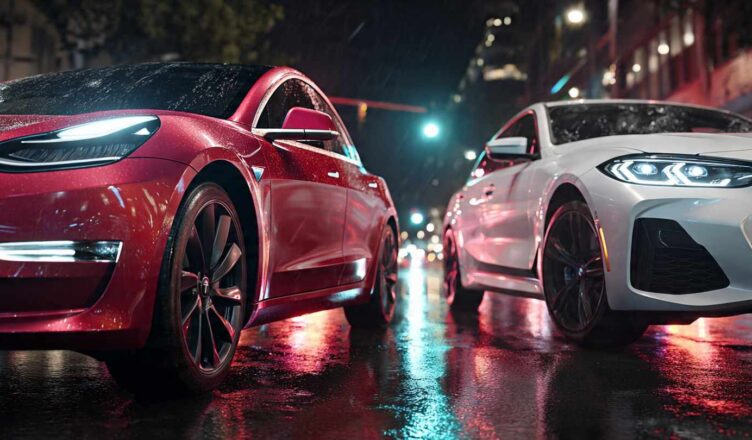
Pull onto a highway on-ramp in the 2026 Tesla Model 3 Long Range, and the acceleration is immediate: no pause, no buildup, just a sudden and silent compression against the seat back as the car moves from 40 to 70 mph in a way that feels disconnected from any mechanical process you can name. Then take the same corner in a BMW 330i xDrive, and there’s a different kind of feedback entirely: the steering loads slightly through the turn, the front tires communicate their grip through the wheel rim, and the chassis feels like it’s participating in the act of driving rather than executing a command.
These are not the same car. They’re not even the same idea of what a sedan should be.
The 2026 versions of both vehicles make this comparison sharper than it’s ever been. Tesla’s refreshed Model 3 now arrives with a redesigned interior, improved ride quality, and a revised suspension setup. BMW’s 3 Series remains the benchmark for driving dynamics in the segment, though its starting price has climbed and its infotainment system still generates mixed reactions. This comparison covers driving character, interior quality, real-world range versus fuel economy, safety ratings from IIHS and NHTSA, and a clear recommendation on who should buy which.
The Drive: Philosophy Made Physical
The BMW 3 Series communicates through pressure and resistance in ways the Tesla doesn’t. Take the 330i through a sweeping on-ramp: the steering builds load progressively, the rear stays settled, and there’s a tactile conversation between driver and road surface happening through the wheel. Sport mode in the 330i stiffens the dampers enough that you feel road texture through the seat pavement transitions, expansion joints, the slight roughness of worn asphalt and that information is useful. It tells you what the tires are doing.
The Model 3’s steering, by contrast, is artificially weighted. Tesla has tuned it to feel heavier than it physically needs to be, likely to simulate the connected feel of a conventional steering rack. It works at highway speeds — lane changes feel secure and the car tracks straight with almost no effort — but in slow technical driving, the weighting doesn’t behave the way a mechanical system does. It’s close. It’s not quite there.
Where the Tesla wins unambiguously is in straight-line performance. The Model 3 Long Range AWD hits 60 mph in approximately 4.2 seconds per Tesla’s published specs. The BMW 330i with the four-cylinder engine needs about 5.6 seconds for the same run. The M340i closes the gap considerably, but at a substantial price premium. For buyers who care about effortless passing power and daily-commute acceleration, the Model 3 wins and it isn’t subtle.
The BMW is the better driver’s car. The Tesla is the faster car. Based on seat time in both, I’d call it the clearest philosophical split in the mainstream sedan segment right now.
Interior and Technology: A Gap That Keeps Widening
This is where the comparison becomes almost unfair to the BMW depending on your priorities.
The Model 3’s interior is a study in reduction: a 15.4-inch landscape touchscreen handles nearly every vehicle function, the dashboard is flat and uninterrupted, and the materials in the 2026 refresh are genuinely improved over earlier versions. The acoustic glass is noticeably effective at highway speeds the cabin is quieter than the 3 Series at 75 mph, a reversal from earlier Model 3 generations.
The BMW interior has richer physical materials the leather on the M Sport steering wheel has a different weight and texture than anything Tesla offers but the iDrive 8 system can be frustrating. Navigating climate controls requires multiple screen interactions, and the curved display setup has drawn consistent criticism from long-term owners. The BMW feels more expensive when you first sit in it. It can also feel more complicated after two weeks of ownership.
One honest limitation of this comparison: real-world technology satisfaction depends heavily on individual workflows. Buyers deeply invested in Android Auto or CarPlay may find the BMW’s system (which supports both) preferable to Tesla’s closed software environment, which doesn’t support either.
Range, Efficiency, and the Running Cost Comparison
Here is where the two vehicles diverge most meaningfully in long-term cost.
| Spec | 2026 Tesla Model 3 Long Range AWD | 2026 BMW 330i xDrive | 2026 BMW M340i xDrive |
|---|---|---|---|
| Starting MSRP | ~$47,990 | ~$46,900 | ~$58,900 |
| EPA Range / MPG | 333 miles (EPA est.) | 29 mpg combined | 25 mpg combined |
| 0–60 mph | ~4.2 sec | ~5.6 sec | ~4.4 sec |
| IIHS Safety | Top Safety Pick+ | Top Safety Pick | Check by trim |
| Best For | EV commuters, tech adopters | Driving enthusiasts | Performance + refinement |
Pricing based on Edmunds data for the 2026 model year; figures are approximate.
The EPA rates the Model 3 Long Range at 333 miles of range, per fueleconomy.gov estimates. Real-world range in cold-weather states typically lands 15–20 percent below that figure, which is worth factoring in for buyers in the northern U.S. The 330i’s 29 mpg combined, also per EPA data, produces no range anxiety but translates to meaningful fuel costs at high annual mileage.
Both vehicles earned strong safety marks. The Model 3 received a Top Safety Pick+ designation from IIHS, according to IIHS ratings. The 330i received a Top Safety Pick. NHTSA awarded both 5-star overall ratings. For safety-focused buyers, either vehicle represents a solid choice.
Who Should NOT Buy This
Don’t buy the Tesla Model 3 if you regularly take long-distance road trips through rural stretches without Supercharger access. The network is denser in 2026 than it’s ever been, but gaps remain in the rural Midwest and parts of the South. If charging logistics would add stress to your travel, the BMW removes that variable entirely.
Don’t buy the Model 3 if you want a conventional ownership experience with scheduled dealer servicing, a physical key, traditional climate controls, and the ability to use CarPlay. Tesla’s ownership model is different, and for buyers accustomed to traditional car ownership, the adjustment curve can be steeper than they expect.
The BMW 3 Series is the wrong choice if you’re primarily a commuter putting on 20,000+ miles a year in a state with reasonable electricity costs. The running cost difference, electricity versus gasoline, compounds significantly over that kind of annual mileage, and the Model 3’s lower operating costs start to matter more than its higher entry price.
The Verdict
In my assessment, the 2026 Tesla Model 3 Long Range is the more practical daily vehicle for the majority of American sedan buyers it’s quicker, quieter, cheaper to fuel, and available with a federal tax credit that can reduce effective cost depending on buyer eligibility. That’s a substantial set of advantages that the BMW can’t fully offset.
But the BMW 3 Series remains the definitive choice for the buyer who genuinely loves the act of driving and wants a machine that communicates through every control surface. Based on the driving dynamics data and the chassis feedback alone, the 330i is simply more engaging to drive, and for the right buyer that matters more than charging convenience or acceleration figures.
The buyer who should not buy either: anyone who needs a spacious rear seat. Both vehicles are genuinely compromised for tall rear passengers the Tesla’s sloping roofline cuts headroom, and the BMW’s rear seat has never been generous. If three adults in the back is a regular scenario, consider the Model S or a 5 Series instead.
References
- IIHS Vehicle Safety Ratings
- NHTSA Safety Ratings
- EPA Fuel Economy Data
- Tesla Official Site
- BMW Official Site
- Edmunds — 2026 Sedan Comparisons
Disclaimer: The information provided in this article is for educational and informational purposes only. It does not constitute professional advice. Readers should conduct their own research and consult with qualified professionals before making any decisions.
