
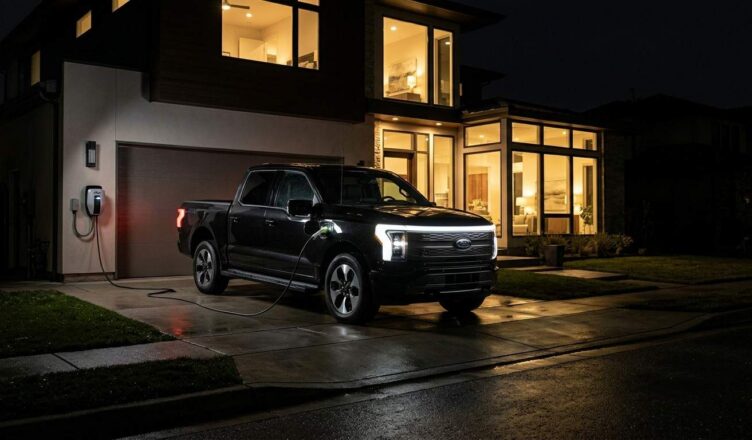
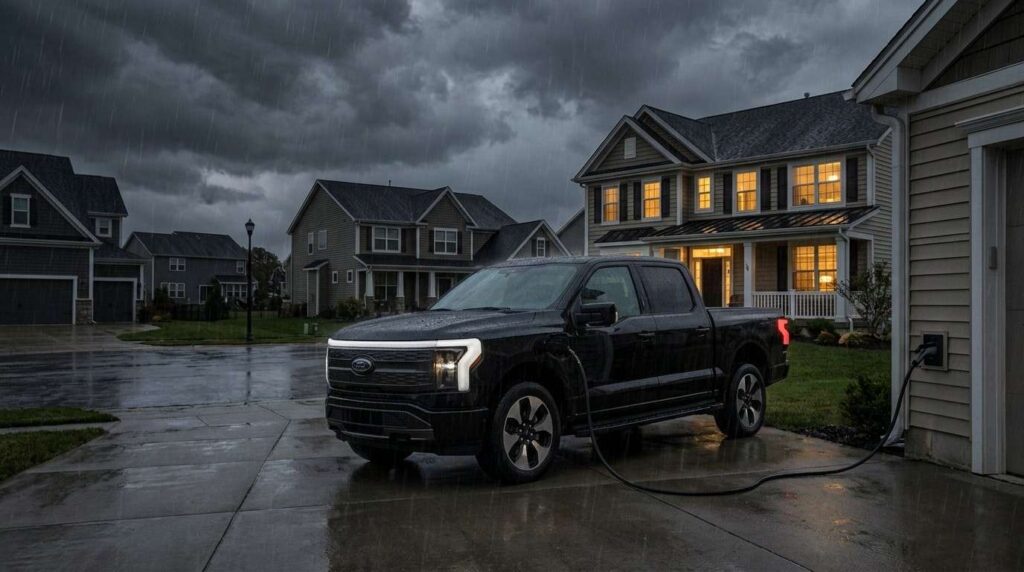
A Ford F-150 Lightning can power an average U.S. home for approximately three days during a total grid outage using its onboard battery alone. This is no longer a niche proof-of-concept; it is a functional technology being utilized in 2026 by homeowners to mitigate the impact of increasing weather-related blackouts.
Most consumers still view electric vehicles as one-way appliances: you draw power from the wall to propel the car. This article examines the shift toward bidirectional charging a system where the car becomes a high-capacity energy asset. By the end of this guide, you will understand the mechanics of Vehicle-to-Home (V2H) and Vehicle-to-Grid (V2G) systems, the specific hardware requirements for 2026 installations, and the financial metrics that determine if this technology is a sound investment for your household. The analysis below relies on data from the Department of Energy (DOE) and NREL grid integration studies.
The Mechanics: How Your Car Becomes a Power Plant
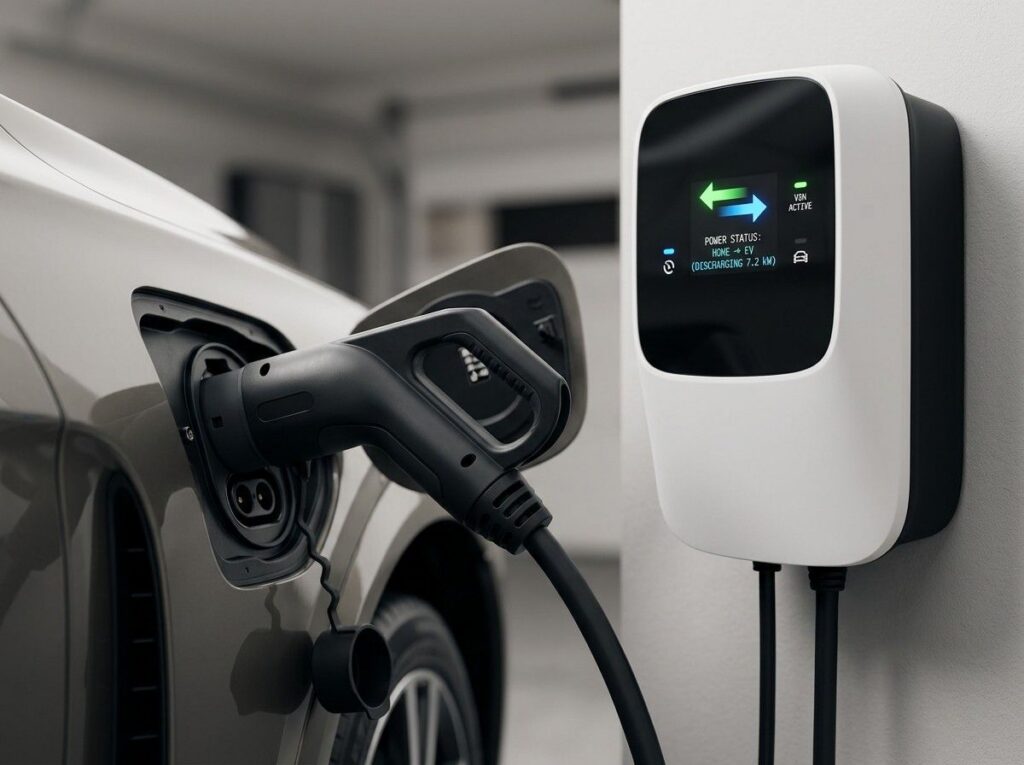
Bidirectional charging allows an EV to convert the Direct Current (DC) stored in its battery back into Alternating Current (AC) for use in a home or on the electrical grid. While standard “one-way” chargers only facilitate flow into the vehicle, bidirectional systems use specialized inverters to manage a two-way exchange.
Think of it less like a traditional fuel tank and more like a portable, high-output power bank on wheels.
The energy potential is significant. According to DOE EV resources, the average American household consumes roughly 30 kWh of electricity per day. Considering many modern EV batteries range from 70 kWh to over 130 kWh, a single vehicle can theoretically support a home’s essential loads such as refrigeration, lighting, and medical devices for several days without external power. This capability is categorized into three main types: Vehicle-to-Load (V2L) for small appliances, Vehicle-to-Home (V2H) for whole-house backup, and Vehicle-to-Grid (V2G) for selling power back to utilities.
The Hardware Gatekeeper: Inverters and Connectors
Implementing bidirectional charging is not as simple as buying a compatible car. It requires a sophisticated hardware chain that acts as a traffic controller for electricity. In 2026, the primary barrier for many owners is the cost of the home integration kit, which typically includes a power inverter, a dark-start battery, and an automatic transfer switch.
The physical connection also matters. While the industry is migrating toward the NACS (Tesla) standard, many bidirectional systems in the U.S. still utilize the CCS (Combined Charging System) or CHADEmo standards for power export. The NREL indicates that for V2H to function, your home’s electrical panel must be “islanded” from the main grid during an outage to prevent back-feeding, which could endanger utility line workers.
Estimated 2026 Installation Costs:
| Component | Estimated Cost (Equipment) | Estimated Cost (Installation) |
| Bidirectional Charger | $3,500 – $5,000 | Included |
| Home Integration Kit | $1,500 – $2,500 | $2,000 – $4,000 |
| Panel Upgrades | N/A | $1,500 – $3,000 |
| Total Investment | $5,000 | Up to $12,000+ |
These costs are often offset in part by the Federal EV Tax Credit, but the upfront capital remains the most significant hurdle for widespread adoption.
Financial Strategy: Time-of-Use Arbitrage and V2G
The most compelling economic case for bidirectional charging isn’t just emergency backup; it is “energy arbitrage.” This involves charging the vehicle when electricity is cheapest (usually overnight) and using that stored power to run your home during peak afternoon hours when utility rates spike.
Think of it as buying electricity at wholesale prices and consuming it at retail prices.
In 2026, many utilities in California and Texas have launched pilot programs that pay EV owners to export power during heatwaves. According to NREL grid studies, active participation in a V2G program can generate between $400 and $1,200 in annual credits for the owner. This transforms the vehicle from a depreciating asset into a source of passive income that can lower the total cost of ownership (TCO) over a five-year period.
Scenario: Annual Savings via Energy Arbitrage
| Utility Type | Off-Peak Rate | Peak Rate | Potential Annual Savings |
| Flat Rate | $0.16/kWh | $0.16/kWh | $0 |
| Standard TOU | $0.12/kWh | $0.38/kWh | $550 – $800 |
| Aggressive TOU | $0.08/kWh | $0.55/kWh | $900 – $1,300 |
Not All EVs Are Created Equal
As of 2026, only a specific selection of vehicles sold in the U.S. offer the software and hardware architecture required for full bidirectional flow. Buyers must distinguish between V2L (Vehicle-to-Load), which merely provides a 120V outlet for a laptop or coffee maker, and V2H, which integrates with the home’s main panel.
2026 Bidirectional Compatibility:
| Vehicle Model | Battery Size | Support Type | Capability |
| Ford F-150 Lightning | 98–131 kWh | V2H / V2G | Whole-home power |
| Nissan Leaf | 40–60 kWh | V2G (CHAdeMO) | Utility grid support |
| Hyundai Ioniq 5 | 77.4 kWh | V2L | Appliance power only |
| VW ID.Buzz (2026) | 91 kWh | V2H | Emergency home backup |
In my assessment, the F-150 Lightning remains the gold standard for this technology because its massive battery capacity can sustain a home longer than most dedicated residential storage batteries. However, smaller vehicles like the Nissan Leaf are often more effective for V2G grid services because their CHAdeMO ports were designed for two-way flow from the beginning.
The Tradeoff: Battery Health and Cycling
A common concern involves the impact of extra discharge cycles on the battery’s longevity. Every time you draw power for your home, you are technically adding “wear” to the lithium cells.
Think of battery health like a set of tires the more miles you drive, the thinner the tread becomes.
However, current research suggests the impact may be overstated for the average user. NREL data indicates that the shallow discharge cycles used for home backup or grid support are significantly less stressful on the battery than the high-heat environment of DC fast charging on a highway. Most 2026 EVs use sophisticated thermal management systems that keep the battery in an optimal temperature range during bidirectional flow, mitigating most of the “degradation tax.” Still, if you plan to cycle your battery daily for grid profit, you may see a 3–5% faster reduction in total range over a decade.
2026 Utility Pilots: California and Texas
The success of bidirectional charging depends on the regulatory environment. In 2026, the DOE Charging Station Locator shows an increase in utility-integrated bidirectional hubs. In California, Pacific Gas & Electric (PG&E) has launched a “Virtual Power Plant” program where thousands of EVs are used as a collective battery to prevent rolling blackouts. Similarly, in Texas, ERCOT has begun offering incentives for EV owners who allow their vehicles to support the grid during winter storms. For the owner, this means the value of the vehicle is directly tied to their local utility’s willingness to play ball.
Conclusion
What the data confirms:
Bidirectional charging is a functional reality in 2026. For homeowners in outage-prone regions or those with high time-of-use electricity rates, the technology can effectively pay for its own installation over four to six years through energy savings and grid credits. The Department of Energy (DOE) continues to fund V2X (Vehicle-to-Everything) research as a primary pillar of national grid resilience.
What remains variable:
The infrastructure for seamless home integration remains expensive and complex. Until the cost of bidirectional inverters drops further, the “value equation” favors high-end EV models and households with significant energy needs. Furthermore, the industry is still standardizing the communication protocols between cars and chargers, meaning some 2026 vehicles may require software updates to reach full capability.
If you are evaluating an EV for its energy potential, I recommend auditing your home’s peak energy usage and checking your utility’s TOU rate schedule. Use the Edmunds True Cost to Own calculator to factor in the installation costs versus potential energy savings.
References
- DOE Alternative Fuels Data Center – Electric Vehicles
- DOE Charging Station Locator
- NREL – Renewable Energy & Grid Integration
- EPA Fuel Economy Data
- IRS Guidance on Clean Vehicle Credits
Disclaimer: The information provided in this article is for educational and informational purposes only. It does not constitute professional advice. Readers should conduct their own research and consult with qualified professionals before making any decisions.
