
You plan a 900-mile drive, plug it into Google Maps, and see 13 hours. That number feels solid. Fixed. Predictable. It isn’t. On a recent run from Flagstaff to Denver, I watched a carefully planned itinerary slip by nearly three hours—and about $70 in extra fuel—without a single wrong turn. No breakdowns. No disasters. Just assumptions quietly stacking up.
By the end of this, you’ll know exactly where those hidden hours and dollars come from, how they show up in real 2026 routes across the U.S., and how to run your own numbers using tools like EPA Fuel Economy Data and Edmunds’ 2026 True Cost to Own. Because the gap between a “planned” road trip and a real one is where most people lose time.
Assumption #1: The Fastest Route Is the Cheapest Route
Most drivers follow the bold blue line on a navigation app because it promises the shortest time. However, speed costs money. Highway routes—especially interstates—tend to push higher speeds and heavier traffic bursts. According to EPA Fuel Economy Data, most gas vehicles hit peak efficiency between 45 and 60 mph; pushing past 70 mph can drop fuel economy by 10–20%.
Speed vs. Cost Comparison (2026 SUV Average)
| Speed (mph) | Estimated MPG | Fuel Cost per 100 Miles (at $4.00/gal) |
| 55 mph | 30 mpg | $13.33 |
| 65 mph | 27 mpg | $14.81 |
| 75 mph | 23 mpg | $17.39 |
Stretch that across a 1,000-mile trip, and you are looking at a $40 difference. In our assessment, taking a secondary highway often adds 45 minutes but can shave significant dollars off the trip by avoiding tolls and maintaining optimal engine efficiency.
Assumption #2: Fewer Stops Equal a Faster Trip
This feels obvious: stop less, arrive sooner. But long-haul driving in 2026 doesn’t work like that. Fatigue creeps in, reaction times slow, and you eventually start driving inefficiently with inconsistent speeds and hard braking. The 2026 AAA Winter Driving and Prep Guide notes that driver awareness is the primary factor in maintaining a steady, safe pace.
A 10-minute stop every three hours keeps your pace steadier, which often lands you closer to your original ETA than a nonstop “sprint” that ends in heavy fatigue. Additionally, running your tank low to avoid stopping can force you into expensive “highway oasis” stations where prices are significantly higher.
Assumption #3: Cruise Control Always Saves Fuel
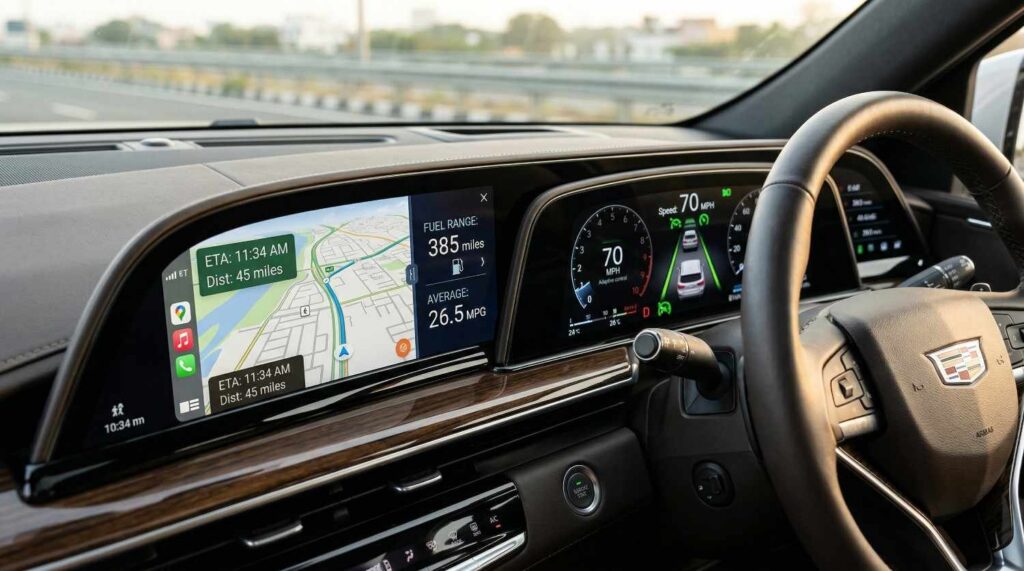
On flat terrain, adaptive cruise control systems improve efficiency. However, in hilly terrain—like I-70 through Colorado—these systems often chase speed targets aggressively, causing unnecessary throttle bursts on inclines. A key factor is that manual modulation often performs better in the mountains; letting your speed drop slightly on climbs and regaining it on descents burns less fuel. Modern vehicles are smart, but they are not always strategic about terrain-based momentum.
Assumption #4: Packing Everything Saves Money
Loading your vehicle with “just in case” gear adds physical weight that directly penalizes your efficiency. According to NHTSA Safety and Efficiency Guidance, every additional 100 pounds can reduce fuel economy by about 1–2%.
Aerodynamics play an even larger role. Roof boxes and bike racks can drop highway efficiency by 10–25%. We explicitly advise against using non-aerodynamic, soft-sided roof bags for long highway hauls; the “drag penalty” is often so high that it can cost you an extra $50 in fuel over a 500-mile trip.
Setup vs. Cost (2026 Midsize SUV)
| Setup | Estimated MPG | Cost per 500 Miles ($4.00/gal) |
| Empty Vehicle | 28 mpg | $71.43 |
| + 300 lbs Cargo | 26 mpg | $76.92 |
| + Roof Box | 23 mpg | $86.96 |
Assumption #5: Fuel Is the Only Cost That Matters
Fuel is the most visible expense, but it is not the only one. According to the 2026 AAA Driving Costs Study, the total cost of ownership includes maintenance, tire wear, and depreciation, which averages 83.89 cents per mile for medium SUVs.
Invisible Trip Costs (1,500-mile trip)
- Fuel: $220–$310
- Tire Wear (Pro-rated): $30–$50
- Maintenance (Oil/Fluids): $25–$45
- Depreciation: $120–$240
Using Edmunds’ 2026 True Cost to Own, you can see that these “invisible” costs often rival your fuel spend. If you are deciding whether to drive or fly in 2026, these are the numbers that matter.
2026 Technology: Electronic Stability and Fatigue
Modern 2026 vehicles feature advanced Electronic Stability Control (ESC) and driver monitoring. While these systems increase safety, they can also lead to over-reliance. According to 2026 IIHS Safety Rankings, vehicles like the 2026 Nissan Pathfinder offer superior occupant protection, but no safety system can offset the poor decision-making caused by a 14-hour driving day.
Conclusion: Rethinking the Strategy
If you are driving more than 500 miles in a day, the biggest gains come from moderating your speed and packing with aerodynamic intention. For larger SUVs and trucks, the difference between a “rushed” trip and an “efficient” one can exceed $100.
I’ll be honest about one limitation: these estimates don’t account for extreme winter weather, which can drop efficiency by another 20%. Before your next trip, run two versions of your route through EPA Fuel Economy Data and compare the real costs using the Edmunds’ True Cost to Own calculator. Not every road trip needs to be faster, but in 2026, they can all be smarter.
References
- 2026 AAA Winter Driving & Prep Guide
- EPA Fuel Economy Data & Trip Calculator (2026)
- 2026 IIHS Safety Rankings & Ratings
- 2026 AAA Driving Costs Study
- Edmunds’ 2026 True Cost to Own Data
- NHTSA Light-Duty Vehicle Safety Proposed Rulemaking (2024-2026)
Disclaimer: The information provided in this article is for educational and informational purposes only. It does not constitute professional advice. Readers should conduct their own research and consult with qualified professionals before making any decisions.
