

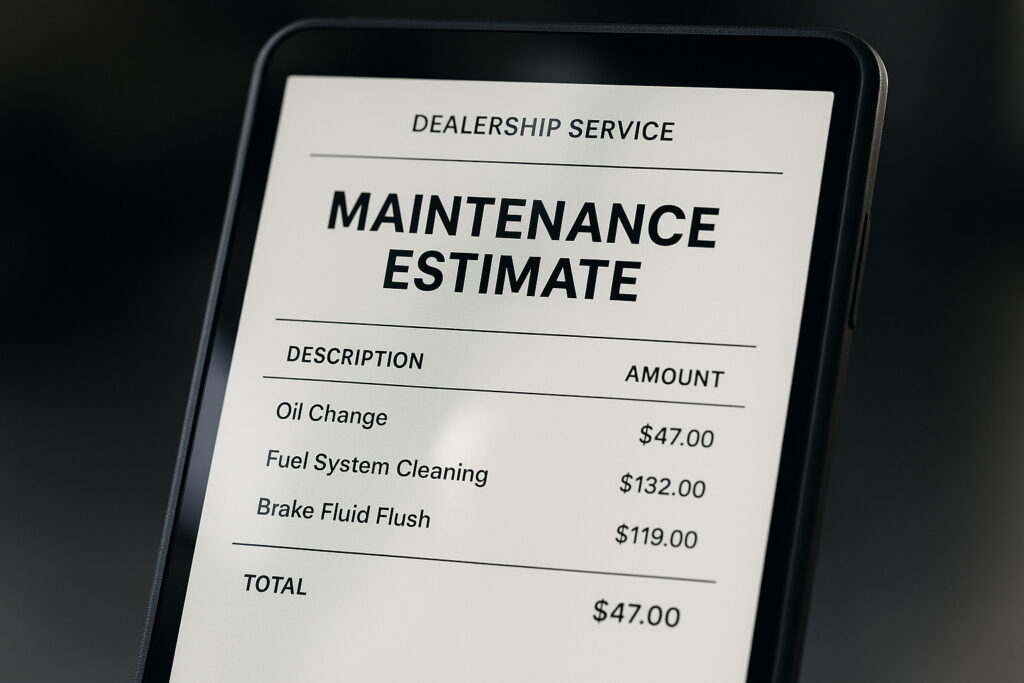
You’re sitting in the service lane, and the advisor slides over a sheet with three “recommended” services totaling $780. None of them were on your radar when you walked in for an oil change. This is where most owners overspend because dealers often bundle services, mark up labor, and push early intervals that pad the invoice.
According to AAA’s 2025 repair cost data, maintenance costs can vary by 30–60% between dealer and independent shops for the same work. In our assessment, understanding the difference between “factory required” and “dealer recommended” is the key to saving thousands over the life of your vehicle.
Here is what actually gets overpriced, why it happens, and how to maintain your car without overpaying for dealership overhead. We have analyzed the most common upsells to help you decide when to say yes and when to head for the exit.
1. Fuel System Cleaning Services
Skip this long enough and your engine may run rough, but overpay for it and you just wasted $150–300. Dealers love this one, often labeling it “fuel injection service” or “intake cleaning” on the upsell sheet.
Most modern engines already run detergent-rich fuel. According to manufacturer service schedules from Toyota and Honda, fuel system cleaning is not a routine maintenance item under normal driving conditions. If a car has a rough idle or hesitation, a technician should check for specific misfires or a dirty throttle body rather than selling a blanket cleaning.
What to do instead:
- Use Top Tier fuel: Stick to brands like Shell, Chevron, or Costco that meet high detergent standards.
- DIY Additive: Add a bottle of fuel system cleaner every 5,000–7,500 miles if you want cheap insurance for about $15.
- Symptom-Based Service: Only pay for a professional cleaning if your vehicle exhibits actual performance issues.
[IMAGE 1 — Featured image]
Placement: Use as featured image
AI Image Prompt: photorealistic image of a modern dealership service bay with a silver Toyota Camry on a lift, service advisor holding a tablet discussing repair estimate with customer, bright indoor lighting, clean workshop environment, editorial automotive photography, hyperrealistic, shot on Canon EOS R5, –ar 16:9
2. Brake Fluid Flush
If you ignore this, moisture builds up in the system; however, paying dealer pricing means you likely spend double. Brake fluid is hygroscopic, meaning it absorbs moisture over time, which can lead to internal corrosion in ABS components.
Most manufacturers recommend a brake fluid change every 2–3 years. The CarMD 2025 Vehicle Health Index indicates that fluid services are among the most commonly upsold items and are often performed earlier than necessary. Dealers frequently push this at the 1-year mark, which is unnecessary unless you drive in extremely humid conditions.
| Service | Dealer Price | Independent Shop Price | Typical Interval |
| Brake Fluid Flush | $150–220 | $80–130 | Every 2–3 years |
| Transmission Fluid | $220–400 | $140–260 | 60k–100k miles |
| Coolant Flush | $140–210 | $90–150 | 50k–100k miles |
3. Transmission Fluid Service
This service matters more than most owners realize. Automatic transmissions depend on fluid for lubrication and cooling; if it degrades, you may face slipping or a total rebuild costing $3,500–6,000.
Consumer Reports’ 2025 reliability data shows that transmission issues remain a major failure point past 100,000 miles when fluid is ignored. Some brands claim “lifetime fluid,” but in our experience, that usually refers to the warranty period, not the actual life of the car.
What to do instead:
- Ignore “Lifetime” Claims: Plan to service the fluid every 60,000 to 90,000 miles.
- Use OEM Specs: Ensure the shop uses the exact fluid specification required by your manufacturer.
- Go Independent: A reputable local shop can perform a standard drain-and-fill for significantly less than a dealer.
4. Cabin and Engine Air Filters
The price difference here is almost comical. Dealers often charge $60–120 for a filter replacement that takes five minutes. The physical part usually costs between $15 and $30 at an auto parts store.
We have seen owners pay $100 for a cabin filter located behind a glovebox that requires no tools to access. This is the easiest money you can save on your vehicle.
What to do instead:
- Check them yourself: Replace the engine filter every 15,000–30,000 miles and the cabin filter every 12,000–20,000 miles.
- Watch a tutorial: Most vehicles have accessible filters that a novice can change in minutes.
5. Nitrogen Tire Fills and “Premium” Add-ons
Dealers sometimes charge $50–100 for nitrogen-filled tires, claiming better pressure stability. In reality, regular air is already 78% nitrogen, and the benefits for daily drivers are negligible.
Similarly, “battery terminal protection packages” are often just a quick spray of anti-corrosive cleaner that you can do yourself for pennies. According to the J.D. Power 2025 Customer Service Index, these high-margin add-ons rarely improve long-term vehicle reliability.
[IMAGE 3 — CONTEXTUAL / LIFESTYLE]
Placement: Before the conclusion
Alt text: independent mechanic shop performing routine maintenance on a sedan
AI Image Prompt: photorealistic image of a local independent auto repair shop with a blue Honda Accord on a lift, mechanic draining transmission fluid, natural daylight through garage doors, realistic work environment, photorealistic, natural lighting, editorial style, wide angle, –ar 16:9
When Should You Use the Dealer?
Not every dealer visit is a waste of money. If your service involves proprietary software updates, complex warranty work, or advanced driver-assistance systems (ADAS) calibration, the dealer is usually the better choice. They have factory-specific scan tools that generic shops may lack. However, for routine “fluids and filters” maintenance, the independent shop is almost always the smarter financial move.
Conclusion
To keep ownership costs down, the pattern is simple: pay for what actually wears out and stick to the manufacturer’s manual. In our assessment, transmission and brake fluid services are vital to car longevity—just not at inflated dealer prices.
Service needs can vary based on your environment. If you frequently tow heavy loads or drive in extreme heat, your intervals may need to be shorter than the “normal” schedule. Always cross-check dealer quotes with the Edmunds True Cost to Own calculator to see if you are being overcharged. Taking ten minutes to compare quotes can save you hundreds of dollars on every single visit.
References
- AAA Repair Cost Data 2025
- CarMD Vehicle Health Index 2025
- Consumer Reports Cars 2025
- J.D. Power Customer Service Index 2025
- Edmunds True Cost to Own
Disclaimer: The information provided in this article is for educational and informational purposes only. It does not constitute professional advice. Readers should conduct their own research and consult with qualified professionals before making any decisions.
