
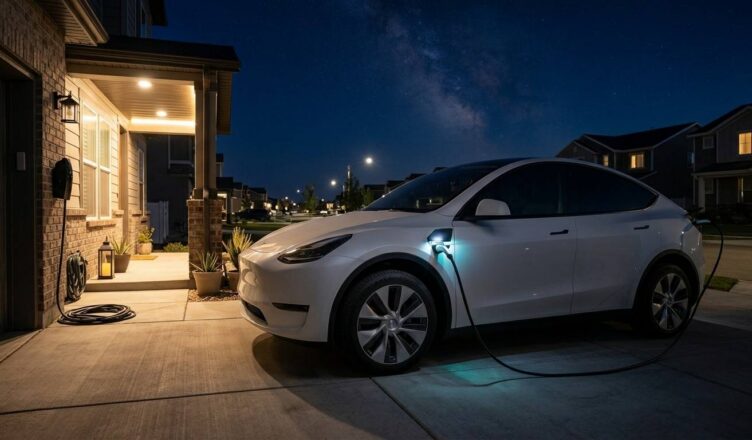
Charging the same EV at different times of day can change your cost per mile by more than 2x. In some utility territories, overnight electricity is priced under $0.10 per kWh, while peak evening rates can exceed $0.30.
That gap is the entire point of Time-of-Use (TOU) pricing—and if you own an EV, it’s one of the easiest ways to cut your “fuel” cost without changing anything about how you drive. This breakdown uses real-world rate structures and Department of Energy (DOE) data to show what actually happens when you shift your charging window. We’ll look at the engineering constraints on the grid, the real-world math of off-peak charging, and how to verify if your specific utility plan is actually saving you money.
Time-of-Use Rates Change Electricity Pricing by the Hour
Utilities divide the day into pricing windows to manage the “Duck Curve,” a phenomenon where solar production drops just as consumer demand spikes. For EV owners, this means charging at night can cost 50%–70% less per kWh than charging during peak hours.
Think of it like airline ticket pricing—the same seat costs a wildly different price depending on when you book it.
The technical reason is grid demand. According to the DOE’s Alternative Fuels Data Center, electricity demand spikes in the late afternoon when people return home and turn on high-draw appliances like air conditioners. Utilities price that period higher to discourage usage and reduce the need for expensive “peaker” plants. Which means for you, charging at 6 PM is the most expensive time to plug in. But waiting until 10 PM—or later—can cut your charging cost in half with zero downside while the car sits idle overnight.
Off-Peak Charging Is Where the Real Savings Happen
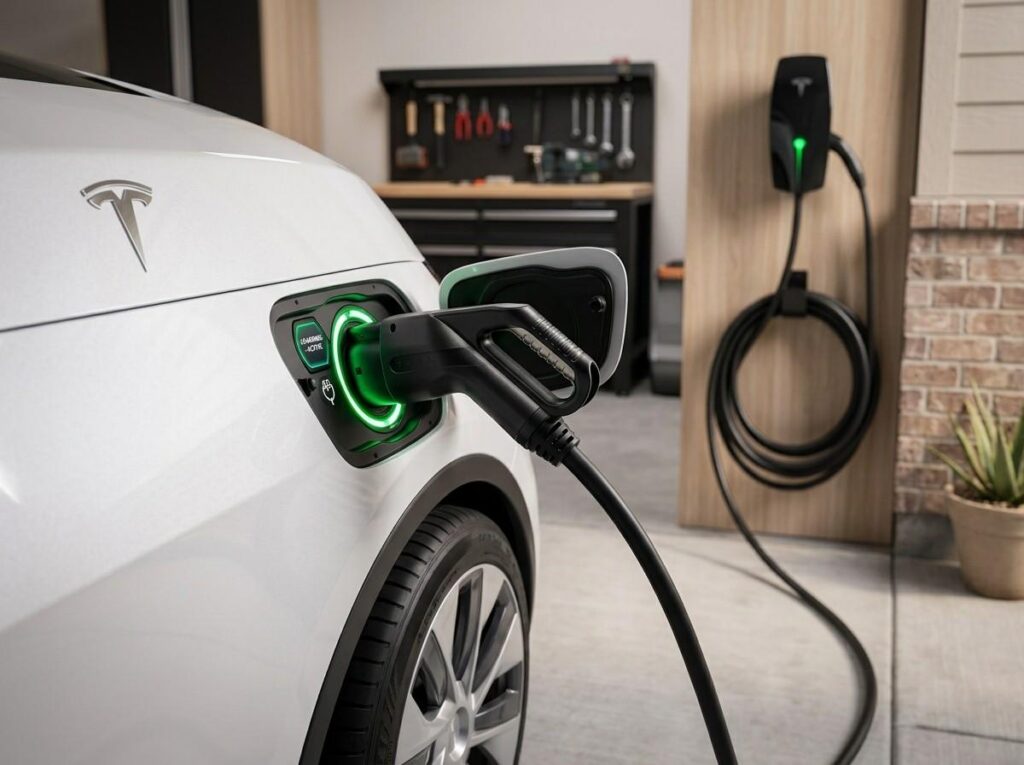
Off-peak rates often drop below $0.12/kWh, which translates to a “fuel” cost equivalent of roughly $1.00 per gallon. To put this in perspective, a high-efficiency vehicle like the Lucid Air can achieve over 4 miles per kWh, making its off-peak operating cost incredibly low.
The practical consequence is simple: if you plug in the moment you get home and charge immediately, you are paying the maximum premium for energy. By using a simple scheduled charging window, you capture these savings automatically.
Cost Comparison by Charging Window (1,000 miles/month):
| Charging Window | Typical Rate | Cost per Mile | Monthly Total |
|---|---|---|---|
| Off-Peak (Midnight–6 AM) | $0.10/kWh | $0.029 | $29 |
| Mid-Peak (Daytime) | $0.20/kWh | $0.057 | $57 |
| Peak (4 PM–9 PM) | $0.35/kWh | $0.100 | $100 |
Export to Sheets
Estimates based on 2025–2026 average TOU utility filings and a vehicle efficiency of 3.5 miles/kWh.
Annual Savings Add Up Faster Than Most Expect
Shifting your charging times can save between $500 and $800 per year for a typical driver covering 13,500 miles annually. This estimate is supported by NREL modeling of consumer behavior and grid pricing volatility.
Think of it like filling up a gas car at a local station versus a highway rest stop—it is the same fuel, but the price difference compounds every single week.
In my assessment, this is the most underused advantage of EV ownership. While buyers focus on the “sticker shock” of the vehicle, they often ignore the fact that electricity is a highly flexible commodity. For those who prioritize total cost of ownership, the RAV4 Prime or a Tesla Model 3 becomes significantly more attractive once these overnight rates are factored in. You can run your own specific mileage through the Edmunds True Cost to Own calculator to see the long-term impact.
Not Every Utility Plan Is Created Equal
Some TOU plans offer aggressive discounts for EVs, while others raise your daytime rates so much that they wipe out your charging savings. The difference is in the “spread” between peak and off-peak.
According to data from the Alternative Fuels Data Center, utility structures vary wildly by region. Some programs, like those in California, feature “super off-peak” windows that are specifically designed for EV owners. However, if you work from home and run the AC all day, a TOU plan might actually increase your total utility bill.
Which means for you, the “EV rate” isn’t always the “best rate.” To be fair, most utilities now provide a portal that analyzes your past 12 months of usage to tell you exactly which plan would have been cheapest. I’ll be honest: if your utility has a flat rate below $0.14/kWh, the hassle of a TOU plan might not be worth the marginal savings. But in high-cost states, it’s a non-negotiable step for saving money.
Charging Infrastructure Still Shapes the Reality
Home charging delivers the lowest cost, whereas public fast charging rarely follows these TOU windows and can cost 3x to 5x more. Public chargers must account for equipment maintenance and demand charges from the utility, which keeps their prices high.
Infrastructure Cost Reality:
| Charging Type | Est. Cost per kWh | Context |
|---|---|---|
| Home (Off-Peak) | $0.08–$0.12 | Lowest cost, slow speed |
| Home (Peak) | $0.30–$0.45 | High cost, avoid if possible |
| Public Level 2 | $0.20–$0.30 | Often found at workplaces/malls |
| DC Fast Charge | $0.40–$0.65 | Expensive, for road trips |
The practical consequence is that TOU savings are a “homeowner’s benefit.” If you rely entirely on public infrastructure because you live in an apartment, these grid-shifting savings are currently out of reach. According to the DOE Station Locator, we are seeing more public chargers, but their pricing remains decoupled from residential TOU benefits.
Conclusion
For drivers who charge at home, shifting to a Time-of-Use plan is the most effective way to lower the daily cost of EV ownership. Based on the data here, the math overwhelmingly favors overnight charging for anyone in a high-cost electricity market.
What the data confirms: TOU pricing is a highly effective tool for reducing fuel costs. The difference between peak and off-peak rates is large enough—often 2x to 4x—to materially change your monthly budget. Because most EV charging happens overnight, this is a passive way to save hundreds of dollars a year.
What remains variable: The overall benefit depends on your household’s total energy profile. If shifting your car’s load forces you into a plan that makes your 2 PM air conditioning usage unaffordable, the savings may vanish. Additionally, if you don’t have a Level 2 charger at home, you may not be able to replenish enough range during a narrow 6-hour “super off-peak” window.
Your best next step is to check fueleconomy.gov for your car’s specific efficiency, then compare it against your local utility’s EV-specific rate options.
References
- EPA Fuel Economy Data
- DOE Alternative Fuels Data Center
- DOE Charging Station Locator
- NREL – Electric Vehicle Infrastructure
- IRS EV Tax Credit Information
- Edmunds True Cost to Own
Disclaimer: The information provided in this article is for educational and informational purposes only. It does not constitute professional advice. Readers should conduct their own research and consult with qualified professionals before making any decisions.
