
You’re at 42,000 miles, and the shop says you need brake pads. You thought you had at least another year. That’s where most owners get caught off guard. Brake life isn’t a fixed number. It swings based on how you drive, where you drive, and what you’re driving. By the end of this, you’ll know what mileage ranges actually look like in the real world, what kills brakes early, and how to tell if you’re being sold work you don’t need.
Expect This Range — Not a Single Number
Skip this long enough and you’re into metal-on-metal grinding. That’s when a $300 job turns into $900 fast. Most modern brake pads last 30,000 to 70,000 miles. Rotors usually go longer, often 50,000 to 100,000 miles, depending on heat and wear patterns. That’s not guesswork—it lines up with manufacturer maintenance schedules and data from CarMD’s 2025 Vehicle Health Index.
Short version: there is no “normal.” If a car came into my bay at 35,000 miles needing pads, I wouldn’t blink. I’ve seen city-driven cars eat through pads in under 25,000 miles. Highway commuters? I’ve seen 80,000 miles on original pads.
Typical Brake Lifespan by Driving Style
| Driving Condition | Brake Pad Life (Miles) | Rotor Life (Miles) |
| City stop-and-go | 25,000–40,000 | 50,000–70,000 |
| Mixed driving | 30,000–60,000 | 60,000–90,000 |
| Mostly highway | 50,000–80,000 | 80,000–100,000+ |
| Aggressive driving | 20,000–35,000 | 40,000–60,000 |
Those ranges track with what AAA reports on wear-related maintenance costs and what most OEM service schedules recommend. And yes, some cars are harder on brakes than others.
Your Driving Habits Decide Everything
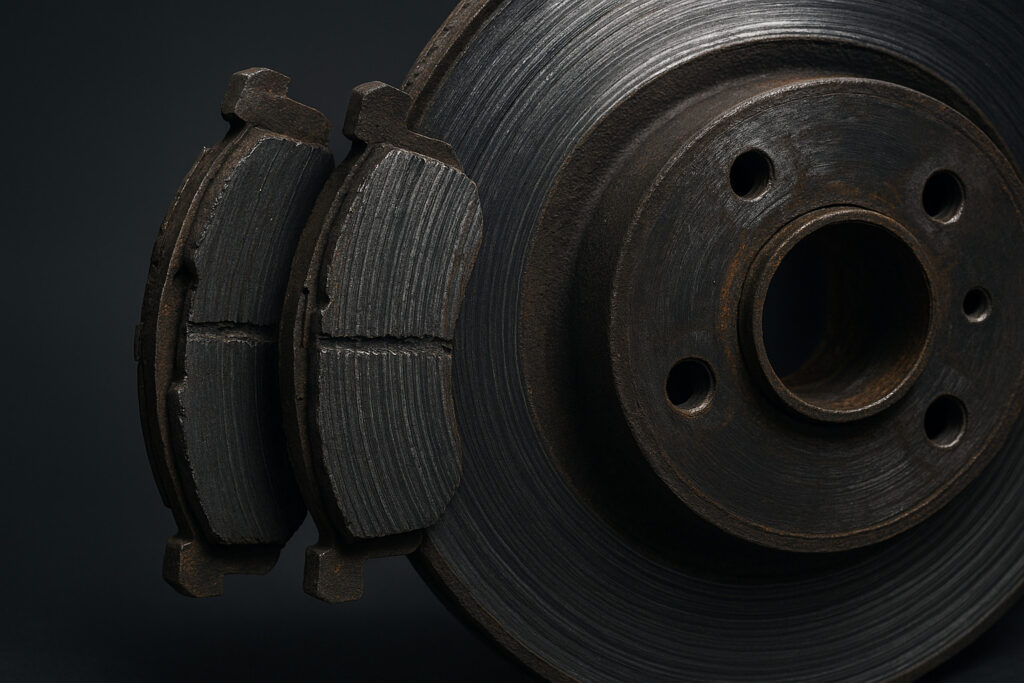
Ride the brakes long enough and they overheat. Overheated pads wear faster. Warped rotors follow. City driving is the worst-case scenario. Constant braking builds heat, and heat is what kills friction material. It’s not mileage—it’s cycles.
If a vehicle came into my bay with premature wear, the first thing I’d check is the driving pattern, not the parts. Hard braking makes it worse. So does riding downhill without engine braking. That one gets overlooked a lot.
Weight is another major factor. SUVs, trucks, and EVs are significantly heavier. More weight means more force is required to stop. According to Consumer Reports’ 2025 reliability data, heavier vehicles tend to show faster brake wear, especially in urban use. Short drives don’t help either; brakes never fully cool down, so heat simply stacks.
Cheap Pads Cost More Later
Go cheap on pads and you’ll pay twice. Not maybe. Usually. Entry-level organic pads are quiet and inexpensive, but they wear fast. Semi-metallic and ceramic pads cost more upfront but last longer and handle heat better.
According to RepairPal’s 2026 Brake Service Estimator, here’s how that math typically plays out:
- Basic pad replacement: $150–$300 per axle
- Premium pads: $250–$450 per axle
- Rotor replacement (if needed): add $300–$600
Skip replacing worn pads and you cut into the rotors. Now you’re doing both. I’ve seen owners try to stretch pads “just a little longer” and turn a $250 job into a $900 bill. It happens every week. In our assessment, ceramic pads hit the sweet spot for most drivers. They produce less dust, offer better longevity, and result in fewer surprises during inspections.
Rotors Don’t Always Need Replacement — But Often Do
Pads wear out. Rotors get damaged. In theory, rotors can be resurfaced—shaved down to remove grooves. In practice, most modern rotors are too thin to machine safely more than once. That’s why shops often recommend replacement alongside pads.
If a car came into my bay with vibration under braking, I’d check rotor thickness and runout immediately. Warped rotors don’t fix themselves. Typical rotor replacement runs $300–$600 per axle. And yes, that’s where a lot of brake jobs get expensive.
There’s a tradeoff here. Replacing rotors every other pad change saves money upfront. Replacing them every time reduces vibration risk and improves braking feel. I lean toward replacement if the car’s over 60,000 miles to prevent comeback work and future hassle.
Signs Your Brakes Are Done — Not Just “Getting Close”
Squeaking doesn’t always mean immediate replacement, but grinding does. That indicates the friction material is gone and you are damaging the rotors. Watch for these:
- Steering wheel vibration under braking: Typically a rotor thickness variation issue.
- High-pitched squeal: Often the mechanical wear indicator touching the rotor.
- Longer stopping distance: Can indicate pad wear or hydraulic fluid issues.
- Brake pedal pulsation: Usually caused by warped rotors.
According to NHTSA Safety Guidance, reduced braking performance is one of the most common contributors to avoidable crashes. This isn’t cosmetic wear. If you feel it, the service is likely already overdue.
How to Make Brakes Last Longer
You don’t need to baby the car. Just avoid abusing the hardware. Coast more. Anticipate stops. Use engine braking when traveling downhill. These small habits can significantly extend component life.
Space matters, too. Following too closely forces frequent, hard braking. That habit alone can cut pad life in half. In our assessment, most premature brake jobs come down to habit, not hardware. Same car, same parts—wildly different lifespans depending on the driver. However, if you live in a dense city or hilly area, your brake life will naturally be shorter.
What It Actually Costs Over Time
Brake maintenance isn’t optional, but it is predictable. According to AAA’s 2025 Driving Cost Estimates, brake service is one of the most common maintenance expenses after tires and oil changes. Over 100,000 miles, most drivers will replace pads 2–3 times and rotors 1–2 times.
Rough math for 100,000 miles:
- Pads (3x): $600–$1,200 total
- Rotors (2x): $600–$1,200 total
- Total Ownership Cost: $1,200 to $2,400.
If you want to sanity-check those numbers for your specific vehicle, the Edmunds True Cost to Own® calculator gives a detailed long-term breakdown.
Conclusion: When to Replace vs. When to Wait
If your brake pads are under 3mm thickness, replace them. No debate. If the total brake job estimate is under $600, do it and move on. That’s routine maintenance.
But if you’re staring at a $1,200+ brake quote on an older car, pause. If that repair is more than 40–50% of the car’s resale value, it’s time to question the bigger picture. In my experience, most owners wait too long, which is what drives total costs up.
There’s one limitation here. I can’t account for every driving condition—especially for performance cars and EVs, which behave differently under braking. Your numbers may shift. The next step is simple: check your last service record, look at your current mileage, and have a shop measure pad thickness. Not guess. Measure.
References
- AAA 2025 Your Driving Costs Report
- CarMD 2025 Vehicle Health Index
- Consumer Reports Car Reliability Rankings
- NHTSA Braking Safety Standards
- Edmunds True Cost to Own® Calculator
- RepairPal Brake Pad Replacement Cost Guide
Disclaimer
Disclaimer: The information provided in this article is for educational and informational purposes only. It does not constitute professional automotive or financial advice. Readers should conduct their own research and consult with qualified professionals before making any maintenance or repair decisions.
