
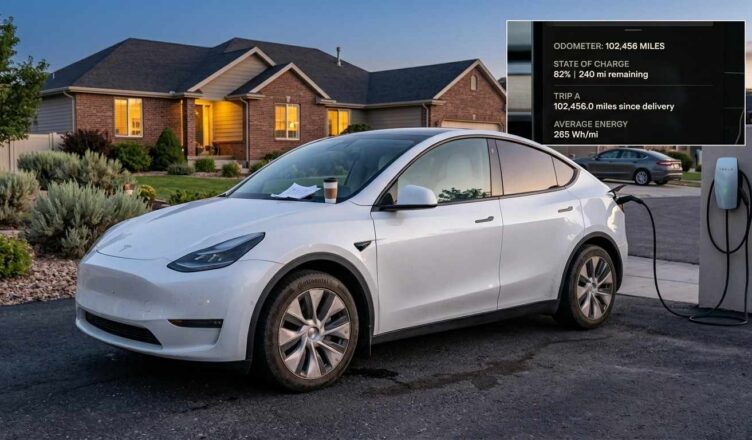
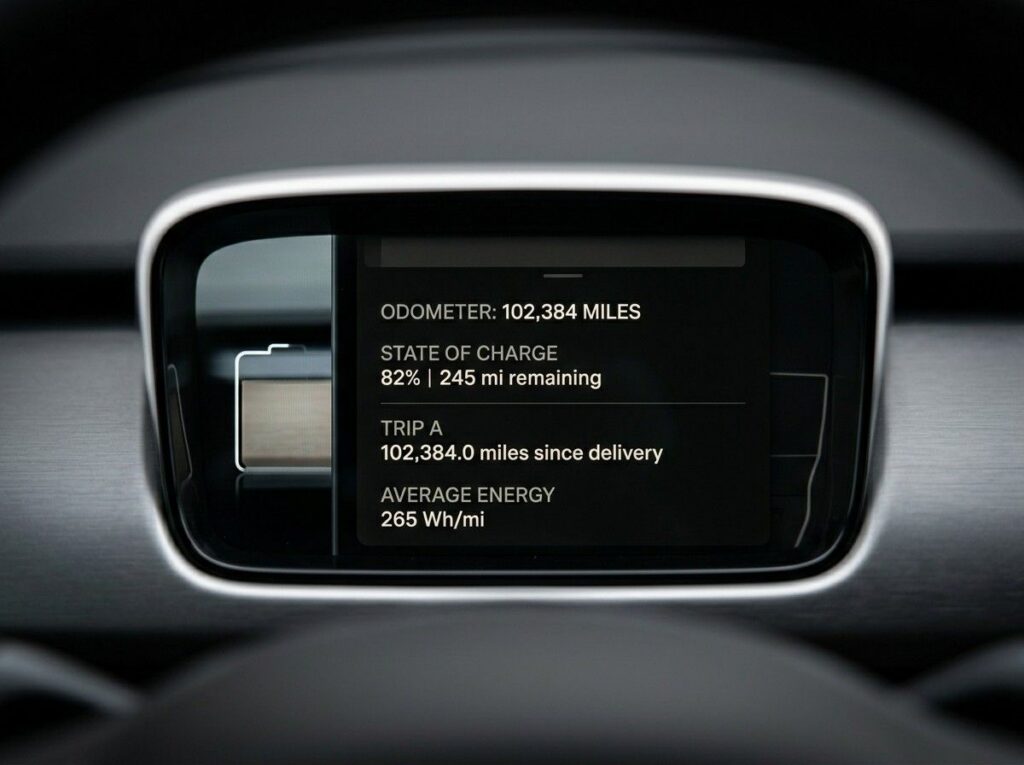
Most modern EV batteries retain between 85% and 90% of their original capacity after 100,000 miles. This is a consistent finding across massive telematics datasets and real-world owner reports in 2025–2026, contradicting early fears that EV batteries would need replacement as often as a set of tires.
While capacity loss is inevitable, the “degradation curve” is not linear. Most EVs experience a 3%–5% drop in the first year as the chemistry “settles,” followed by a much slower decline of roughly 1.5% to 2.3% per year thereafter.
The Reality of Range Loss: EPA vs. Odometer
For a vehicle that starts with a 300-mile EPA range, a 12% capacity loss at 100,000 miles results in a maximum theoretical range of 264 miles. However, “usable” range for a high-mileage owner is often lower because real-world highway driving already consumes 10%–20% more energy than EPA test cycles.
Expected Range After 100,000 Miles:
| Vehicle (2025/2026 Models) | New EPA Range | Est. Range at 100k Miles (90% SoH) | Real-World Highway Range (Adjusted) |
|---|---|---|---|
| Tesla Model 3 Long Range | 341 miles | ~307 miles | 250–270 miles |
| Hyundai Ioniq 6 RWD | 361 miles | ~325 miles | 270–290 miles |
| Ford Mustang Mach-E | 290 miles | ~261 miles | 210–230 miles |
| Chevrolet Equinox EV | 319 miles | ~287 miles | 230–250 miles |
Export to Sheets
Key Drivers of Accelerated Degradation
Data from Geotab and NREL indicates that how you charge matters as much as how much you drive. Vehicles that rely almost exclusively on DC fast charging (above 100 kW) see degradation rates roughly double those of vehicles charged primarily at home on Level 2 AC.
- Fast Charging: Frequent high-power sessions can push annual degradation to 3.0%, compared to 1.5% for AC charging.
- Heat Stress: EVs operating in hot climates (e.g., Arizona) degrade approximately 0.4% faster per year than those in moderate climates.
- State of Charge (SoC): Batteries age most rapidly when stored for long periods at 100% or below 10% charge.
Replacement Costs and the “Warranty Floor”
Full battery replacement is rare; current data suggests failure rates are well under 5% for the first decade of use. However, if a pack does fail out of warranty, costs remain a significant consideration. For 2025–2026, a full replacement for a long-range EV typically ranges from $12,000 to $20,000.
Fortunately, federal law requires manufacturers to provide a battery warranty for at least 8 years or 100,000 miles. Most brands, including Tesla, Rivian, and Hyundai, guarantee that the battery will retain at least 70% of its original capacity during this window.
Usability: Does 100k Miles Change Your Daily Life?
For the average American driver, who travels approximately 37 miles per day, a 10%–15% reduction in range is virtually unnoticeable in daily commuting. The friction only appears during long-distance travel, where a degraded battery might require one additional 20-minute charging stop on a 500-mile journey.
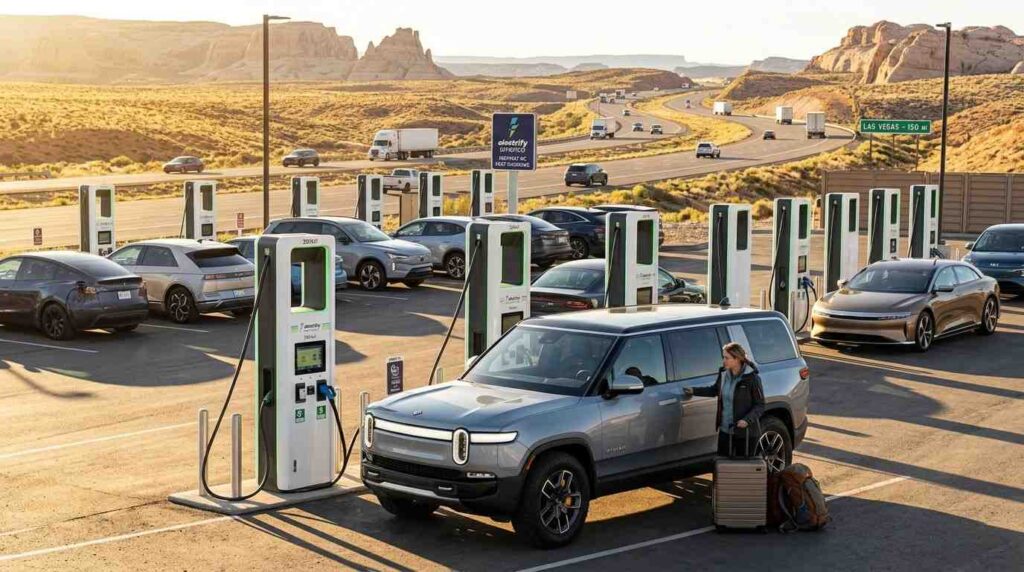
The density of the U.S. charging network—now exceeding 180,000 public ports—is growing faster than batteries are degrading. This infrastructure expansion effectively “offsets” small amounts of range loss by making charging stops more convenient and less frequent.
Conclusion
What the Data Confirms: Modern EV batteries are over-engineered for longevity. If you treat the battery reasonably well—favoring home charging and staying within the 20%–80% SoC range for daily use—you should expect at least 85% capacity at the 100,000-mile mark.
What Remains Variable: The long-term impact for “power users” who fast-charge daily or live in extreme heat is higher, potentially reaching 20% degradation by 100,000 miles. Additionally, while battery costs are falling, out-of-warranty replacements remain an expensive “black swan” event.
Before buying a high-mileage used EV, always verify the State of Health (SoH) through the vehicle’s onboard diagnostics or a third-party report. Use fueleconomy.gov to check the original range and the DOE Station Locator to ensure your local infrastructure can support a slightly smaller range buffer.
References
- What Is Normal EV Battery Degradation Rate? 2026 Guide | Recharged
- EV Battery Health Study: Fast Charging & Degradation | Geotab
- DOE Alternative Fuels Data Center: EV Infrastructure & Station Locator
- NREL: Empirical Analysis of EV Battery Performance
- EPA Fuel Economy Data & Real-World Range Testing
- Tesla Impact Report: Battery Lifespan & Degradation Data
Disclaimer The information provided in this article is for educational and informational purposes only. It does not constitute professional financial, tax, or legal advice. Battery degradation varies significantly based on individual use. Readers should conduct their own research and consult with qualified professionals before making purchase decisions.
