
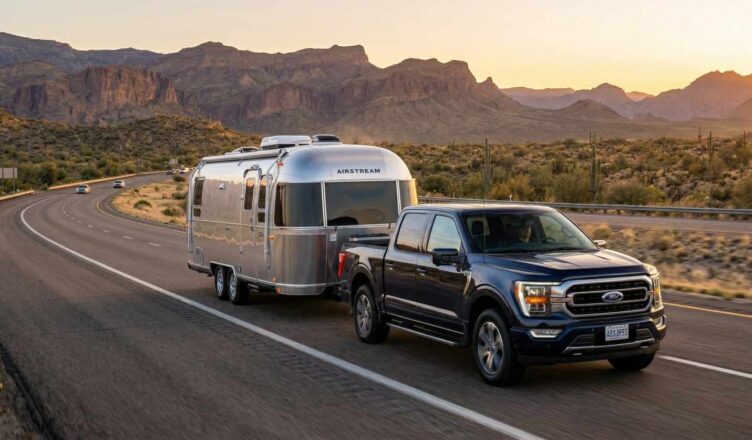
You’re easing onto a two-lane highway outside Moab, trailer mirrors full of polished aluminum reflecting red rock walls. Everything feels fine—until a crosswind hits. Suddenly, the truck feels lighter than it should. Steering gets busy. And you realize pretty quickly: towing an Airstream isn’t just about “can it pull it.” It’s about whether your vehicle can control it.
By the end of this, you’ll know what an Airstream actually demands from a tow vehicle—payload, stability, wheelbase, and cooling—not just the headline tow rating. We’ll look at real numbers from Airstream Official Specifications, compare common 2026 tow vehicles, and call out where buyers tend to get it wrong. We’ll also anchor this with data from the 2026 AAA Driving Costs Study and 2026 IIHS Safety Ratings.
The Tow Rating Is the Least Interesting Number
Most buyers start here, but it is a misleading metric. A 2026 Ford F-150 might advertise up to 13,500 pounds of towing capacity. On paper, that easily covers an Airstream Flying Cloud 25FB, which has a Gross Vehicle Weight Rating (GVWR) of 7,300 pounds.
The number that runs out first isn’t towing capacity—it’s payload. Payload includes everything in the truck: passengers, cargo, and the hitch weight of the trailer. Airstreams carry significant hitch weight, often 10–15% of the total trailer weight. That same 7,300-pound trailer puts between 800 and 1,000 pounds directly onto your truck’s rear axle. In our assessment, payload is what typically forces travelers into a larger truck than they initially planned.
Payload, Wheelbase, and Stability
Real-world towing separates vehicles by their ability to resist external forces. A short-wheelbase SUV might meet the weight requirements, but a tall, aerodynamic trailer like an Airstream introduces wind-related forces that aren’t on a spec sheet. Longer wheelbases help resist trailer sway and keep the vehicle’s front wheels planted during steering maneuvers.
Typical Requirements for a Mid-Size Airstream (2026)
| Spec Category | Recommended Minimum | Why It Matters |
| Tow Rating | 8,000 lbs | Safety margin above trailer weight |
| Payload | 1,800–2,200 lbs | Accounts for tongue weight + gear |
| Wheelbase | 140+ inches | Anchors the trailer against crosswinds |
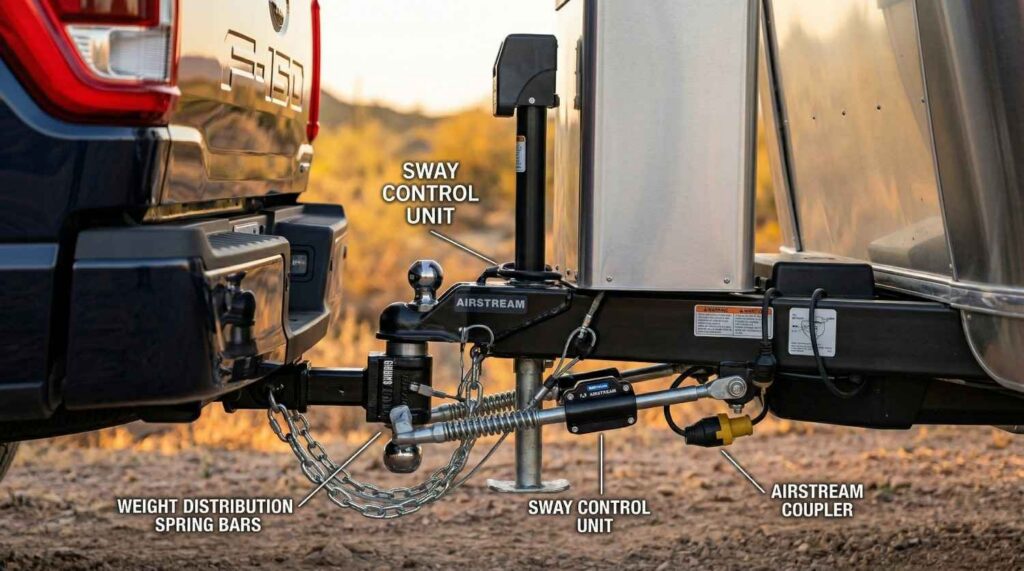
| Hitch Type | Weight Distribution | Reduces rear-end sag and sway |
2026 Vehicles: Capability vs. Reality
Let’s look at how specific 2026 models handle these demands. We explicitly advise against using unibody mid-size SUVs for Airstreams over 20 feet, regardless of their tow rating, because their suspension components lack the lateral stiffness to manage the “pendulum effect” of a heavy aluminum trailer at highway speeds.
| Vehicle (2026) | Max Tow Rating | Max Payload | Wheelbase |
| Ford F-150 (3.5L) | 13,500 lbs | 2,440 lbs | 145–157 in |
| Ram 1500 (Hurricane) | 11,550 lbs | 2,300 lbs | 144–153 in |
| Toyota Sequoia | 9,520 lbs | 1,730 lbs | 122 in |
| Ford Expedition Max | 9,300 lbs | 1,750 lbs | 131 in |
While full-size SUVs like the Sequoia or Expedition can tow Airstreams, they require more driver attention in crosswinds due to their shorter wheelbases compared to pickups.
The Cost Side: Fuel and Maintenance
Fuel economy drops sharply when towing. According to EPA Fuel Economy Data, a truck that gets 20 mpg highway may fall to 9–12 mpg when pulling a trailer. Additionally, the 2026 AAA Driving Costs Study notes that large pickups cost an average of 98.54 cents per mile to operate, largely due to higher insurance and maintenance demands.
Towing increases the heat in your transmission and wear on your brakes. For those considering long-term ownership, Edmunds’ 2026 True Cost to Own tool shows that maintenance costs for towing-capable vehicles can exceed $1,500 annually after the third year.
Managing Driver Fatigue
Towing is mentally exhausting. You are managing longer stopping distances and wider turns while making constant micro-corrections for wind turbulence. According to NHTSA Safety Guidance, driver fatigue is a significant factor in road trip safety. A vehicle that is “underworked” by the trailer—meaning it has a large margin of payload and wheelbase—drastically reduces this workload for the driver.
Conclusion: Confidence Over Capacity
If your goal is relaxed, long-distance travel through windy desert crossings or mountain descents, you want a vehicle that is not maxed out by the trailer. A half-ton pickup with a payload rating above 1,800 lbs, such as a properly configured 2026 Ford F-150, is the cleanest answer for most Airstream owners.
Before committing, verify your specific vehicle’s payload on its door jamb sticker and check safety ratings through the 2026 IIHS Safety Rankings. In our assessment, building in a 15–20% safety margin across all ratings is the best way to ensure your trip feels like a vacation rather than a job.
References
- 2026 Ford RV & Trailer Towing Guide
- 2026 Ford F-150 Towing & Payload Specs
- 2026 Ram 1500 Specifications & Payload
- 2026 IIHS Safety Rankings: Nissan & Industry Performance
- Airstream Official Site: Weight Distribution Hitch Guide
- 2026 AAA Driving Costs Study
- Edmunds’ 2026 True Cost to Own Data
- NHTSA Light-Duty Vehicle Safety Proposed Rulemaking (2024-2026)
- Airstream Flying Cloud 25FB Official Specifications
Disclaimer: The information provided in this article is for educational and informational purposes only. It does not constitute professional advice. Readers should conduct their own research and consult with qualified professionals before making any decisions.
