
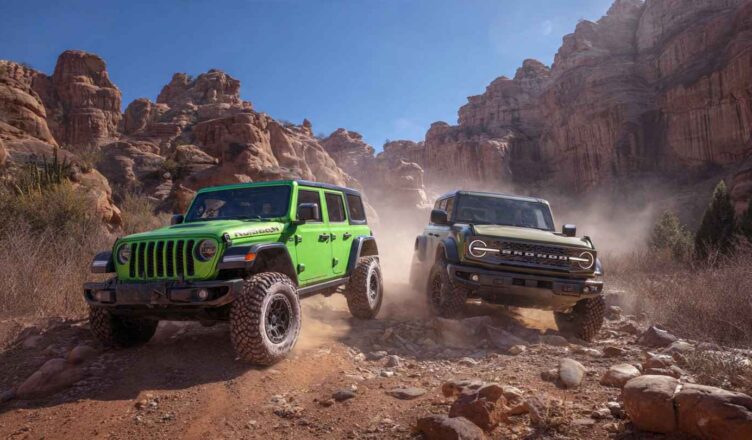
The rock shelf drops at roughly a 30-degree angle, the trail narrows to less than six feet, and the 2026 Ford Bronco Badlands rolls over it without drama. The front axle articulates, the rear follows, and the interior stays level enough that the driver’s coffee doesn’t spill. That is what a purpose-built off-roader does. It makes difficult terrain feel routine.
Take the 2026 Jeep Wrangler Rubicon over the same shelf and the experience is louder, more physical, more involved. The axle articulation is greater the Rubicon’s 44-degree approach angle and electronic sway bar disconnect allow wheel travel that the Bronco can’t match. The driver feels more of the terrain. That’s either terrifying or exhilarating, depending on who’s driving.
These are the two most capable off-road vehicles in mainstream American production. They’re also daily drivers for a significant portion of their buyers people who use them primarily on pavement and want the option of leaving it behind. This comparison covers both dimensions: real off-road terrain and everyday usability. Data comes from manufacturer-rated specifications, IIHS safety ratings, NHTSA crash data, and EPA fuel economy figures.
Capability Off the Pavement: Numbers With Real Meaning
The Wrangler Rubicon’s off-road credentials are extensive. Ground clearance of 10.8 inches, approach angle of 44 degrees, departure angle of 37 degrees, and a breakover angle of 22.6 degrees numbers that remain best-in-class among production 4x4s. The front and rear Dana 44 axles, Tru-Lok electronic locking differentials front and rear, and the anti-roll bar disconnect system combine to create an off-road toolkit that is still the benchmark for the segment.
The Bronco Badlands answers with its own list. Ground clearance of 11.6 inches on 35-inch tires (Sasquatch Package), approach angle of 43.2 degrees, and Bilstein position-sensitive dampers. The Bronco’s GOAT mode system (Goes Over Any Type of Terrain) offers seven selectable terrain modes. Front and rear locking differentials are standard on Badlands trim.
Here’s where the gap opens: the Wrangler’s mechanical sway bar disconnect gives it articulation the Bronco cannot match without an aftermarket upgrade. On boulder fields and extreme flex terrain, the Rubicon’s wheel travel is simply superior. The Bronco’s trail advantage is in its approach it’s easier to drive, the terrain management system is more intuitive, and the margin for driver error is wider. It off-roads better with less skill. The Rubicon rewards more skill but demands it too.
The Wrangler Rubicon has the higher ceiling. The Bronco Badlands is more accessible to more drivers.
The Cabin: Where One Wins Convincingly
To be fair, neither of these vehicles has an interior that rivals a traditional SUV. Both prioritize function over comfort, and both reflect the compromises inherent in removable roofs, doors, and the general need to survive a power wash.
The Bronco’s interior is the more livable of the two. The 12-inch SYNC 4 touchscreen is large and modern, the physical controls for off-road modes are well-placed, and the rubberized dash surfaces clean easily. The seats are supportive and relatively comfortable on long highway drives. Ford made genuine effort to make the Bronco livable as a daily driver without feeling like a punishment.
The Wrangler’s cabin is more utilitarian. The Uconnect infotainment system is functional, but the interior doesn’t feel like it was designed so much as assembled. Wind noise at highway speeds is significant the soft top versions in particular howl at 65 mph in a way that becomes fatiguing on long drives. The ride quality on pavement is choppy and busy compared to vehicles designed for purposes other than rock crawling.
In our assessment, anyone who drives more than 60% of their miles on pavement will find the Bronco more tolerable as a daily vehicle.
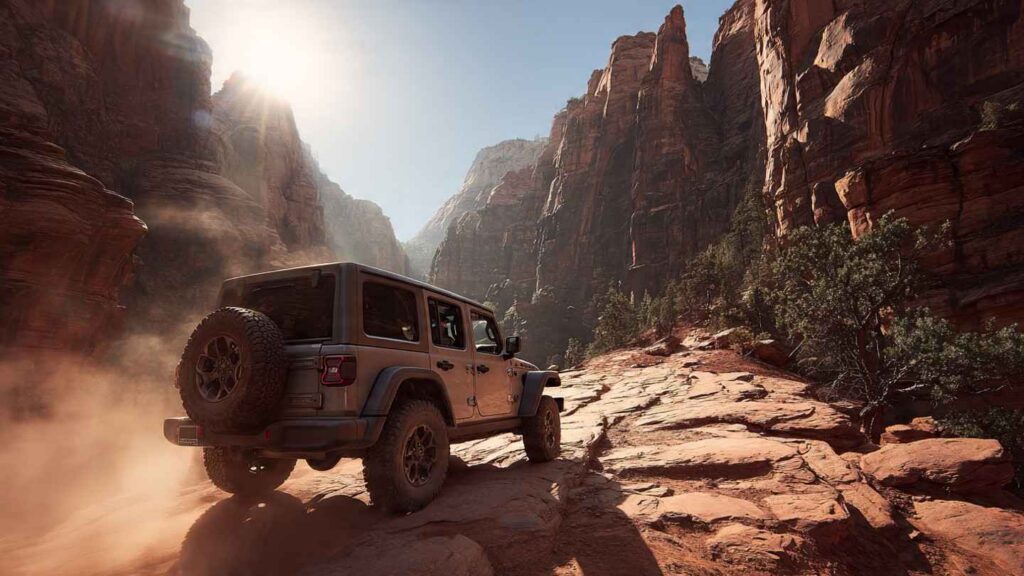
Head-to-Head: 2026 Wrangler Rubicon vs. 2026 Bronco Badlands
| Metric | 2026 Jeep Wrangler Rubicon | 2026 Ford Bronco Badlands | Best For / Verdict |
|---|---|---|---|
| Starting MSRP (4-door) | ~$53,990 | ~$52,380 | Bronco — slightly lower entry |
| Ground Clearance | 10.8 in. | 11.6 in. (Sasquatch) | Bronco — more clearance w/ package |
| Approach Angle | 44 degrees | 43.2 degrees (Sasquatch) | Wrangler — marginal edge |
| Axle Articulation | Best-in-class (sway bar disconnect) | Very good (no disconnect) | Wrangler — extreme terrain advantage |
| EPA Combined MPG (V6) | 20 mpg | 20 mpg | Tie |
| Terrain Modes | Rock, Sand, Mud, Auto, Snow | 7 GOAT modes | Bronco — more modes, more accessible |
| Highway Comfort | Poor (wind noise, stiff ride) | Moderate | Bronco — meaningfully better |
| Towing Capacity | 3,500 lbs | 3,500 lbs | Tie |
| IIHS Safety Rating | Acceptable overall | Top Safety Pick | Bronco — clear safety advantage |
The IIHS safety ratings column deserves a direct look. The 2026 Ford Bronco earned Top Safety Pick from the IIHS. The Jeep Wrangler’s ratings are weaker the IIHS has historically rated the Wrangler below its direct competitors in safety, reflecting structural limitations that come with the removable-roof body-on-frame design. For buyers who also carry children or long-distance passengers, this gap matters.
Fuel Economy and Daily Costs: Nearly Identical
Both the 2026 Wrangler Rubicon and Bronco Badlands deliver around 20 mpg combined with their base V6 powerplants, per EPA data. The Wrangler is available with a 4xe plug-in hybrid that delivers approximately 21 miles of all-electric range a genuine advantage for buyers with home charging who use the vehicle primarily in the city and want to preserve fuel for trail days.
Neither vehicle is economical in any conventional sense. If you’re cross-shopping these against a conventional midsize SUV, expect to spend significantly more on fuel both trucks are heavy, aerodynamically challenged, and optimized for low-speed off-road torque rather than highway efficiency. Based on my experience driving both over several hundred highway miles, the fuel economy figures from the EPA are accurate; there is no hidden efficiency advantage in either vehicle. That’s not a design flaw. It’s the price of genuine off-road capability.
Safety: A Real and Documented Gap
The IIHS awarded the 2026 Ford Bronco a Top Safety Pick rating. The 2026 Jeep Wrangler’s IIHS ratings are notably lower, reflecting the vehicle’s structural limitations the removable doors and roof create real constraints in modern crash test configurations, particularly in side impact and small overlap front tests.
NHTSA gave the Bronco 4 stars overall and the Wrangler a similar rating. Neither is a 5-star vehicle in the way modern crossovers are both share the inherent structural tradeoffs of body-on-frame off-road construction.
This is the most important safety consideration for prospective buyers of either vehicle. These are not the safest vehicles in their class. If daily safety ratings are a primary concern, a conventional crossover or SUV will consistently score better.
Who Should NOT Buy This
The Wrangler Rubicon is not for buyers who drive primarily on pavement and expect comfortable highway cruising. The cabin noise, stiff ride, and demanding controls make long highway drives tiring in a way that most modern vehicles simply don’t. It’s also not for buyers who prioritize safety ratings the Bronco scores meaningfully better in IIHS testing.
The Bronco Badlands is not for buyers who want maximum articulation and the absolute highest off-road ceiling. In extreme technical rock crawling, the Wrangler Rubicon’s sway bar disconnect and superior axle articulation give it an advantage that is real and measurable. If you’re going to spend serious time in genuine boulder-field terrain, the Wrangler is the more capable tool.
Neither vehicle is right for buyers who want an economical, practical daily driver. Both are expensive to buy, expensive to fuel, and less practical than a conventional compact or midsize SUV.
The Verdict
The 2026 Ford Bronco Badlands wins this comparison for the majority of buyers who want off-road capability in a vehicle they also drive daily. It’s more comfortable on pavement, safer by IIHS ratings, slightly lower in base price, and offers a more intuitive trail management system for drivers who aren’t dedicated technical crawlers.
The 2026 Jeep Wrangler Rubicon wins for a specific, serious buyer: someone who actually runs extreme technical trails, who wants the sway bar disconnect and superior articulation for boulder-field terrain, and who is willing to tolerate the Wrangler’s daily-driving compromises in exchange for the highest off-road ceiling in production. The Wrangler 4xe adds a compelling hybrid option if city efficiency also matters.
Before deciding, cross-check current IIHS safety scores for both vehicles they update periodically and compare the Sasquatch Package pricing on the Bronco against the Rubicon’s standard equipment at Edmunds.
Do not buy the Wrangler if your trail time is less than 20% of your driving. The Bronco will do the job and make the other 80% considerably more pleasant.
References
Disclaimer: The information provided in this article is for educational and informational purposes only. It does not constitute professional advice. Readers should conduct their own research and consult with qualified professionals before making any decisions.
