

You’re merging onto an interstate, trailer in tow, and the steering suddenly feels… vague. Not unsafe exactly, just off. That’s usually the moment first-time towers realize towing isn’t just “driving, but longer”. Most of the mistakes don’t show up in the driveway. They show up at 60 mph, in crosswinds, or halfway down a grade when your brakes start smelling like regret.
This guide walks through where new trailer owners slip up most often—weight calculations, hitch setup, braking, and real-world driving technique. We’ll lean on manufacturer specs, safety guidance from the 2026 NHTSA Trailer Safety Guide, and tools like Edmunds’ True Cost to Own for planning the bigger picture. By the end, you’ll know what actually matters when towing—not just what the brochure says.
The Weight Problem Most People Misunderstand
Ask a new owner what their trailer weighs, and you’ll usually hear the “dry weight”. That number is almost meaningless once you load water, gear, food, and propane. And it adds up fast. A trailer listed at 5,000 pounds dry can easily push 6,500 pounds loaded. According to the 2026 NHTSA Trailer Safety Guide, exceeding your vehicle’s towing capacity or mismanaging weight distribution is a primary contributor to trailer instability.
Key Towing Terminology
| Term | What It Means | Typical Range |
| GVWR (Trailer) | Max loaded trailer weight | 5,000–10,000 lbs |
| Tongue Weight | Weight on hitch (10–15% ideal) | 500–1,200 lbs |
| Payload (Truck) | Max weight in truck (people + cargo + tongue weight) | 1,200–2,500 lbs |
| Tow Rating | Max trailer weight vehicle can pull | 5,000–13,000 lbs |
The catch? Your truck’s payload often runs out before your tow rating does. That’s the number most people ignore. In my experience, payload—not horsepower—is what limits most setups.
Hitch Setup Isn’t Optional Fine-Tuning
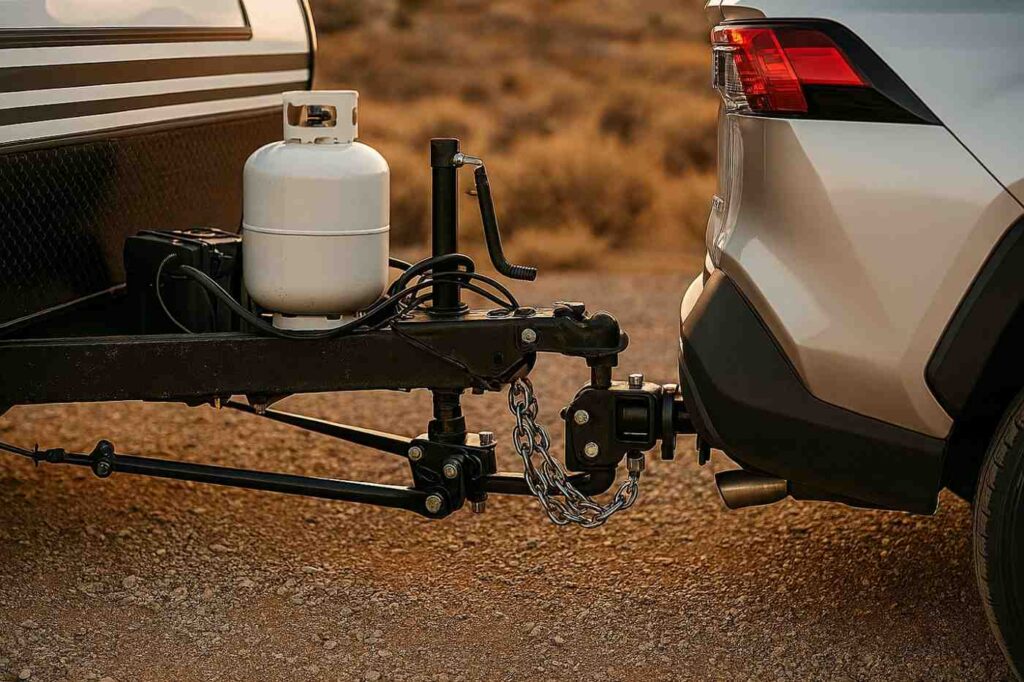
You can tow without a weight distribution hitch, but you probably shouldn’t. Without it, the rear of your vehicle squats, the front lifts slightly, and steering precision drops. A proper weight distribution hitch uses spring bars to redistribute load across all axles. It’s not just about comfort—it’s about control.
Crosswinds, passing trucks, or even abrupt steering inputs can trigger trailer sway. Some modern hitches include built-in sway control, which applies resistance to lateral movement. I’ll be blunt: if your trailer is over about 5,000 pounds, skipping sway control is a bad bet. Even experienced drivers get caught out here.
Braking and Transmission Heat: The Hidden Killers
You don’t notice bad braking—until you really do. Travel trailers have their own electric brakes, controlled through a brake controller in your vehicle. If you’re relying solely on your truck’s brakes, stopping distances stretch dramatically. According to safety data from the 2026 NHTSA Trailer Safety Guide, improperly configured trailer brakes can significantly increase stopping distance under load.
Brake controllers need calibration. Too aggressive, and the trailer jerks; too soft, and it doesn’t help enough. You want smooth, proportional braking where the trailer and vehicle slow together. Test it in an empty parking lot. Then test it again.
A secondary concern is transmission heat. Towing uphill in 90°F weather puts immense strain on your drivetrain. We advise against towing heavy loads with vehicles that lack a dedicated external transmission cooler. Without one, your transmission fluid can oxidize, leading to catastrophic failure miles from the nearest service center.
Speed, Stability, and the Myth of “It Feels Fine”
At 45 mph, almost any setup feels stable. At 70 mph, physics starts asking harder questions. Many first-time towers assume highway speeds are fine if the vehicle “feels planted”. But trailer tires, wind resistance, and braking all scale differently at speed.
Most trailer tires are rated for a maximum of 65 mph. Push beyond that, and heat buildup becomes a real issue. Blowouts happen—often enough that it’s worth respecting. In our assessment, a comfortable towing speed sits closer to 60–65 mph for most setups, even if the speed limit says otherwise. Let the faster traffic go by.
Backing Up: The Skill Nobody Practices Enough
Backing a trailer is counterintuitive. Turn the wheel left, the trailer goes right. Small corrections win here; big steering inputs make things worse fast. You don’t need years of experience—you need repetition in an empty parking lot. Practice straight-line backing, then gentle turns. I still take a second look before backing into tight campsites. That doesn’t go away.
The Five-Minute Walkaround
Before every trip, perform a thorough check:
- Tire pressure: Check both the vehicle and the trailer tires.
- Hitch connection: Ensure it is locked and pinned.
- Safety chains: They must be crossed and secured.
- Electronics: Verify that brake lights and turn signals are working.
- Load distribution: Ensure weight is even inside the trailer.
The Real Ownership Costs
Towing changes your ownership costs more than most expect. Fuel economy drops sharply. A truck that gets 20 mpg highway might drop to 10–12 mpg when towing, according to 2026 estimates on fueleconomy.gov. Maintenance costs also increase due to accelerated wear on brakes, tires, and the transmission.
A key factor is the 5-year maintenance window. If you’re planning long trips, it’s worth running numbers through Edmunds’ True Cost to Own. It gives a more realistic picture than just fuel alone. A lightweight trailer behind a midsize truck behaves very differently than a 9,000-pound setup behind a half-ton.
Where First-Time Towers Actually Get It Right
Most beginners are cautious, which is their greatest asset. They leave more following distance and drive slower. Those habits matter more than any spec sheet. In my experience, the people who struggle most are the ones who assume towing is easy because the truck’s brochure says it can do it. It can, but that doesn’t mean the driver is ready.
Conclusion: Precision Over Confidence
If you’re methodical and realistic about your vehicle’s limits, towing is completely manageable. Start with weight calculations, invest in a quality hitch with sway control, and keep your speeds conservative.
We explicitly advise against using “no-name” generic weight distribution hitches that lack integrated sway control. While cheaper, these units often require separate friction bars that are prone to binding in tight turns. Before your first trip, check your vehicle’s safety ratings on the IIHS website, verify your setup against manufacturer specs, and spend an hour practicing in a controlled space. That hour matters more than any article.
References
- 2026 NHTSA Trailer Safety Guide
- EPA Fuel Economy Data (2026 Updates)
- Edmunds True Cost to Own (2026 Data)
- IIHS Vehicle Safety Ratings
- 2026 AAA Driving Costs Study
Disclaimer: The information provided in this article is for educational and informational purposes only. It does not constitute professional advice. Readers should conduct their own research and consult with qualified professionals before making any decisions.
