
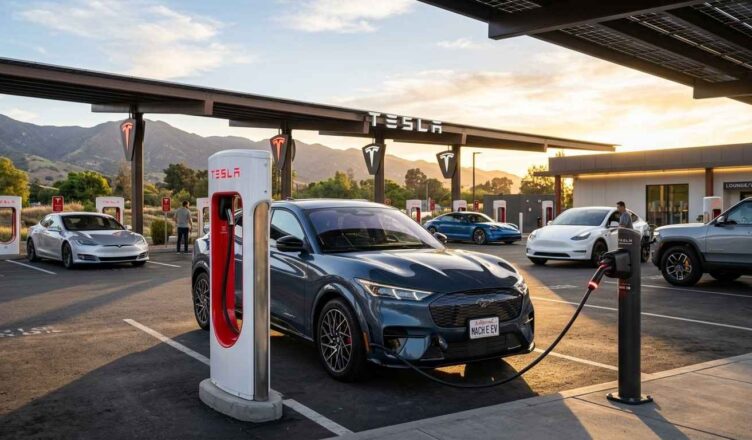
A Ford Mustang Mach-E owner pulling into a Tesla Supercharger in early 2025 likely didn’t expect the session to initiate. Now, with a simple adapter, it does—and that small technical handshake represents the most significant shift in American automotive infrastructure in decades.
The connector at the end of the cable determines where you can charge, how fast you can realistically return to the road, and the level of friction you encounter on long-distance trips. This guide breaks down the North American transition from CCS to NACS, what major automakers have committed to for 2026, and how this affects your next vehicle purchase. By grounding these technical differences in 2026 data from the U.S. Department of Energy (DOE) and NREL, we can see exactly where the “tracks” are being laid for the next decade of driving.
Why the NACS Shift Actually Matters to You
If your EV can access more chargers, your road trips become exponentially easier. CCS (Combined Charging System) has served as the default non-Tesla fast-charging standard in the U.S. for years. However, NACS (North American Charging Standard), originally Tesla’s proprietary plug, is physically smaller, lighter, and—crucially—connected to the most reliable fast-charging network in the country.
According to the 2026 DOE Alternative Fuels Data Center report, there are now 70,017 public DC fast-charging ports in the United States. Of those, Tesla’s Supercharger network accounts for 36,495 ports—a dominant 52.1% market share.
In our assessment, the reliability gap is the true driver of this shift. While third-party CCS networks have improved, Tesla’s vertical integration allows for a “plug and play” experience that avoids the broken screens and payment failures often associated with older CCS hardware.
Technical Differences and Infrastructure Reality
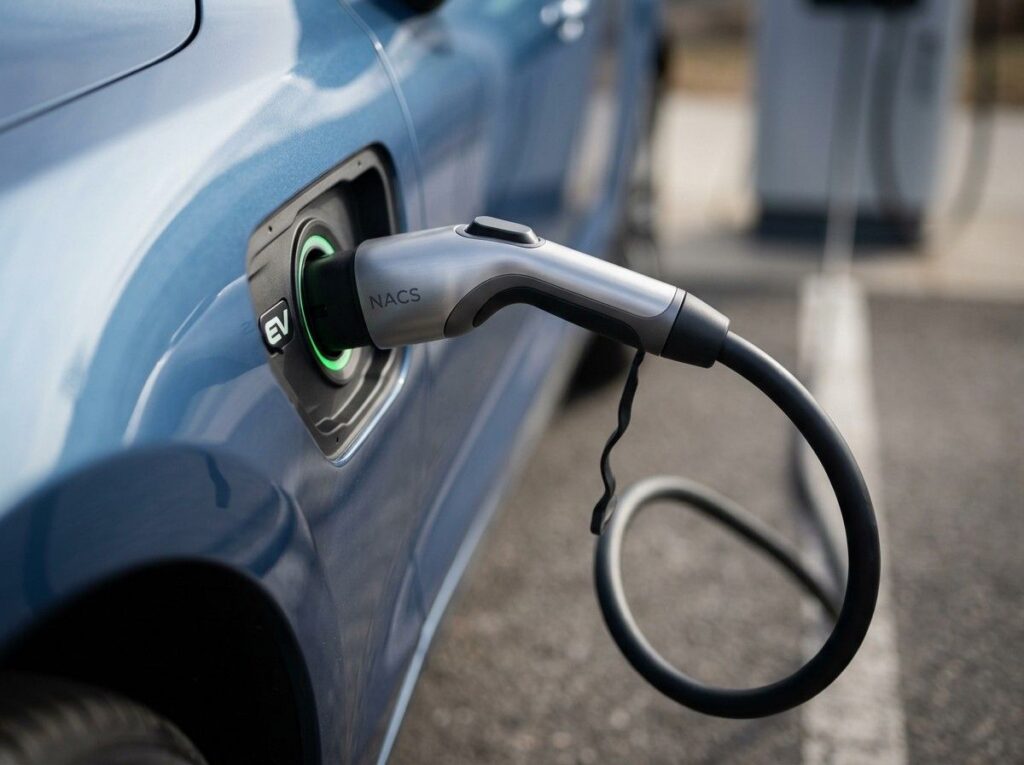
NACS is a “unified” design, meaning it uses the same pins for both AC home charging and DC fast charging. CCS is a “stacked” design that adds two large DC pins below a standard AC port, making the handle significantly bulkier and harder to maneuver for some users.
While CCS proponents often point to a theoretical 350 kW power ceiling, NACS (specifically V4 Superchargers) is quickly closing that gap. Here is how the two standards compare in the 2026 landscape:
| Feature (2026 Landscape) | NACS (North American Charging Standard) | CCS (Combined Charging System) |
| Connector Weight | ~2–3 lbs (Lightweight/Ergonomic) | ~5–8 lbs (Heavy/Bulky) |
| Current U.S. Port Count | 36,495+ Ports (52.1% share) | ~33,522 Ports (Combined others) |
| Max DC Charging Power | 250 kW+ (V4 supports higher) | Up to 350 kW (Theoretical) |
| Primary Network | Tesla Supercharger (High Uptime) | EA, EVgo, ChargePoint (Mixed) |
| Future Outlook | Adopted by 95% of U.S. Market | Legacy / Federally Funded (NEVI) |
Data from the 2026 NREL EV Efficiency Study indicates that while peak power is important, “charging curves”—how long a car can maintain high speeds—are the better metric for travelers. A NACS-connected Tesla or Hyundai often recovers 60–70% of its range faster than a CCS vehicle that peaks at 350 kW but throttles down quickly due to heat.
The Adapter Situation: Bridging the Gap
Automakers like Ford, GM, Rivian, and Hyundai have already begun providing or selling NACS adapters to their existing CCS customers. By 2026, most new models from these brands are shipping with NACS ports built directly into the fender.
However, adapters are not a perfect solution. They add a mechanical failure point and can be cumbersome to store. Furthermore, some older CCS vehicles may require software updates to communicate with Tesla’s “Magic Dock” or standard Superchargers. In our assessment, while adapters are a necessary bridge, they are a temporary friction point that will disappear as native NACS hardware becomes the standard by 2027.
Buying Advice: Which Connector Wins in 2026?
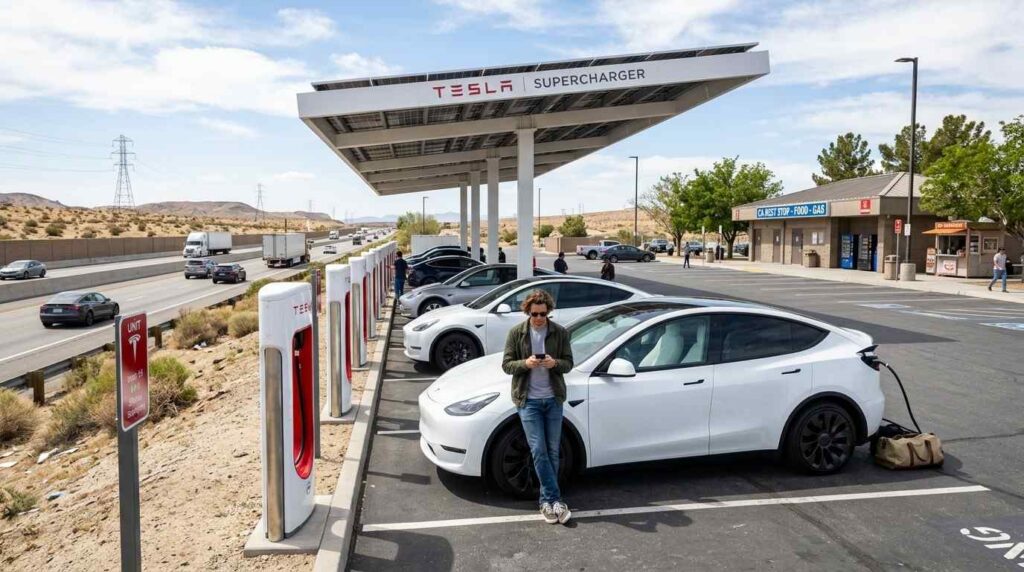
If you are buying a new EV in 2026, NACS is the definitive choice. Native access to the 36,000+ Tesla Supercharger ports provides a level of freedom that CCS-only vehicles currently struggle to match without an adapter.
That said, CCS is not “dead.” The federal government’s National Electric Vehicle Infrastructure (NEVI) program is currently investing billions into CCS-based highway corridors. According to 2026 DOE growth forecasts, another 19,500 fast-charging ports are expected to come online this year, many of which will be “dual-head” stations serving both standards.
For those looking at used EVs, a CCS-equipped car is still a viable option, provided you verify that an adapter is available for that specific model. Use tools like the Edmunds True Cost to Own calculator to see how the long-term value of a CCS vehicle might be impacted by this transition.
The Incentive Layer: Tax Credits and Savings
Charging choice is also a financial decision. The IRS Clean Vehicle Credit provides up to $7,500 for eligible new EVs, but your long-term savings depend on charging costs. Tesla’s Supercharging rates are frequently more stable than third-party CCS networks, which often implement “session fees” in addition to per-kWh costs.
Before you sign, check the DOE 2026 Station Locator for the fast chargers along your most common long-distance routes. If those routes are dominated by Tesla stalls, a NACS vehicle will save you hours of logistical planning every year.
Conclusion: A Unified Future
The transition from CCS to NACS is the “VHS vs. Betamax” moment for the electric era, and the winner is now clear. While the overlap period will involve adapters and some confusion at the pump, the result will be a unified, more reliable charging experience for all American drivers.
In our assessment, the move to NACS is the final piece of the puzzle for mass EV adoption. It removes the “charging anxiety” that has held back many prospective buyers. Your next step should be to verify the native port type on your shortlisted 2026 models and ensure you have a plan for home charging—the only standard that truly matters every single morning.
References
- DOE Alternative Fuels Data Center: 2026 Charging Report
- DOE Charging Station Locator (2026 Edition)
- IRS Clean Vehicle Tax Credit Requirements
- NREL EV Efficiency and Infrastructure Study (2026)
- Edmunds EV Range and Charging Test Database
- Tesla 2026 Supercharger Network Expansion Data
Disclaimer
The information provided in this article is for educational and informational purposes only and does not constitute professional automotive, engineering, or financial advice. Readers should conduct their own research and consult with qualified professionals before making any vehicle purchase or charging infrastructure decisions.
