
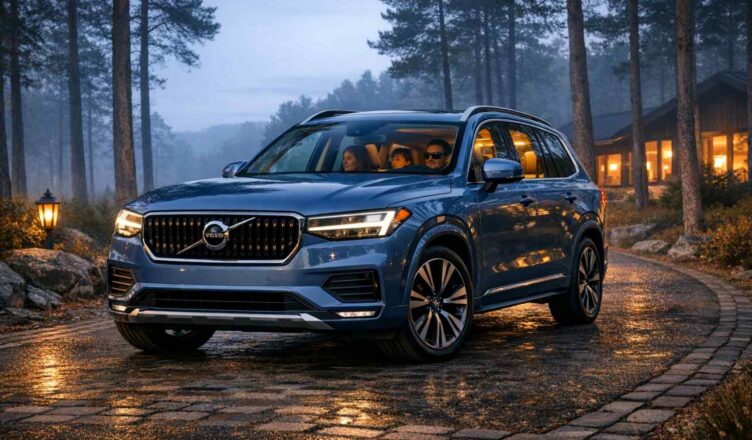
Somewhere on a curved I-90 interchange in Seattle, at 65 mph with rain on the windshield and three kids asleep in the back, the 2026 Volvo XC90 makes its argument most effectively. The ride is quiet enough that a conversation at normal volume carries over road noise. The seats hold you without clenching. The cabin feels removed from the weather in a way that goes beyond insulation into something closer to intention. It is, in that moment, an exceptionally good vehicle for the life it’s designed around.
The XC90 starts at approximately $58,000 for the B5 trim and climbs past $90,000 for the Recharge plug-in hybrid top spec. That’s a wide range, and the vehicle you get at $58,000 is meaningfully different from the one at $90,000. This review focuses on the 2026 XC90 B6 AWD the mid-tier gasoline powertrain alongside relevant notes on the Recharge PHEV variant, and compares the XC90 directly to its most credible competitors: the BMW X5, Mercedes GLE, and Audi Q7.
The Cabin: Where Volvo Still Leads the Segment
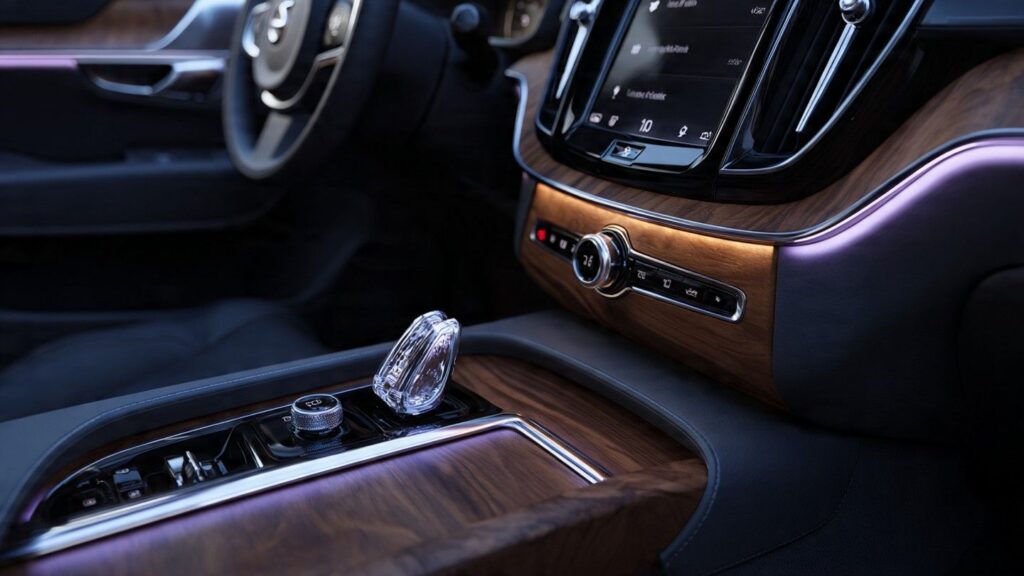
To be fair to the German alternatives the X5, GLE, and Q7 all have outstanding interiors. But the XC90’s cabin has a quality that’s harder to describe than to experience: restraint. There are no gratuitous chrome elements, no attempt at technology theater, no design detail that exists for its own sake. The open-pore wood trim is actual wood. The leather on the steering wheel has a texture and resistance that reminds you someone thought about the grip. The center console’s crystal gear shifter is the kind of material detail that Volvo uses exactly once, correctly, without overdoing it.
The 9-inch portrait infotainment display runs Volvo’s Google-based system Android Automotive embedded, which means native Google Maps, Google Assistant, and the same interface logic as a large Android tablet. For buyers already in the Google ecosystem, this is immediately familiar and genuinely useful. For buyers who want physical controls for everything, the system will require a learning curve. Climate controls live on a sliding panel at the bottom of the screen, which is a reasonable compromise but not as intuitive as a dedicated knob.
The XC90 is one of the quietest three-row SUVs in its class at highway speed a claim backed by consistent assessments from automotive testers who’ve measured cabin decibel levels. Wind noise, road noise, and tire roar are managed to a degree that contributes to the vehicle’s most significant experiential quality: it makes long drives feel shorter.
Powertrain: Capable, Not Exciting
The 2026 XC90 B6 AWD uses a mild-hybrid 2.0-liter four-cylinder with a supercharger, a turbocharger, and a 48V electric motor integrated into the drivetrain for a combined output of 295 horsepower. Yes Volvo stuffs both a supercharger and a turbocharger into a 2.0-liter four-cylinder, which is an engineering decision that works in practice even if it sounds excessive on paper.
Throttle response is immediate and the B6 pulls with authority from a stop. It doesn’t, however, feel like a luxury-tier powertrain in the way a BMW X5 xDrive40i’s inline-six does. The four-cylinder’s mechanical character is present under hard acceleration a slightly edgier quality than the smooth, seamless output of a six-cylinder competitor. For most buyers in this vehicle, this will never be a concern. If you care deeply about powertrain refinement and the mechanical experience of acceleration, the BMW X5 is the more satisfying machine.
The EPA rates the XC90 B6 AWD at approximately 21 mpg city and 27 mpg highway, per fueleconomy.gov. Based on the efficiency data, that’s competitive for the class the GLE 450 and X5 xDrive40i both land in a similar range.
2026 XC90 B6 vs. Segment Competitors
| Category | 2026 Volvo XC90 B6 | 2026 BMW X5 xDrive40i | 2026 Mercedes GLE 450 | Best For |
|---|---|---|---|---|
| Base MSRP | ~$58,000 | ~$67,100 | ~$65,400 | XC90 (value entry) |
| Engine | 2.0L mild-hybrid, 295 hp | 3.0L inline-6, 375 hp | 3.0L inline-6, 362 hp | BMW/Mercedes (refinement) |
| EPA Combined MPG | ~24 mpg | ~24 mpg | ~23 mpg | Even |
| Standard Seating | 7 | 5 (7 opt.) | 5 (7 opt.) | XC90 |
| IIHS Safety Rating | Top Safety Pick+ | Top Safety Pick | Top Safety Pick+ | XC90/GLE (edge) |
| Infotainment | Google Android Auto | BMW iDrive 8 | MBUX | Preference-dependent |
| PHEV Option | Yes (Recharge) | Yes (xDrive50e) | Yes (GLE 450e) | Even |
| Best For | Safety-focused families | Driver engagement | Interior refinement | — |
MSRP approximate as of 2026. MPG per EPA fueleconomy.gov. Safety via IIHS ratings.
Space and Practicality: Honest Answers
Climb into the XC90’s third row and measure the legroom with your knees first. It’s a two-person bench with 31.9 inches of legroom, suitable for children and adequate for adults on short trips but not the kind of three-row space a Kia Telluride or Toyota Highlander provides. The XC90 is a luxury vehicle first, a people-mover second. Buyers who need to comfortably seat seven adults regularly should look at the Telluride or Highlander at a significantly lower price point.
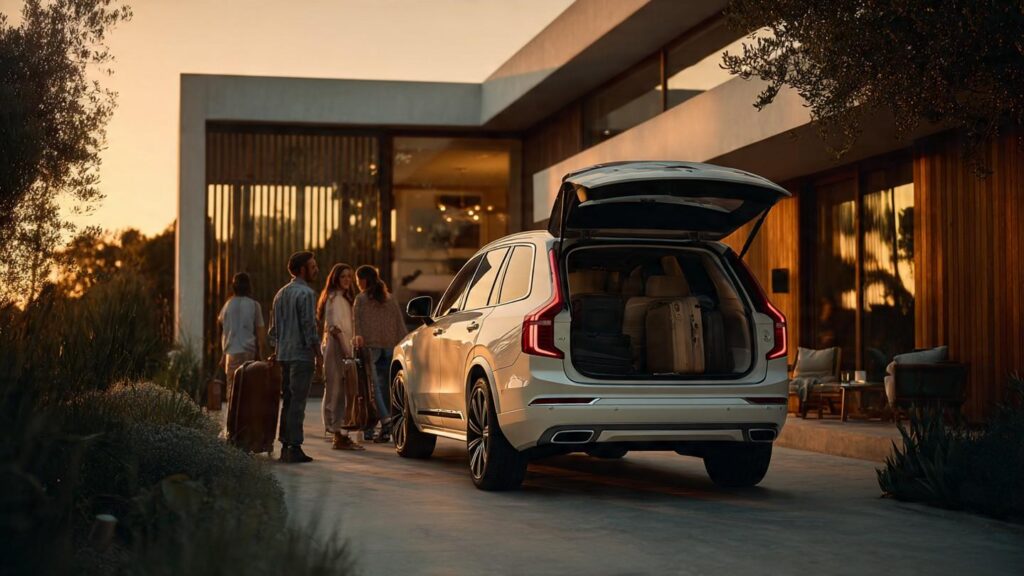
Cargo space behind the third row is 8.7 cubic feet among the smallest in the segment. Behind the second row, that expands to 35.4 cubic feet, and with all rows folded, the XC90 offers 85.7 cubic feet. The vehicle’s long hood and sloping rear contribute to the limited third-row cargo area, and it’s a genuine limitation for families who load gear when all seats are occupied.
In our assessment, the XC90 is best understood as a premium five-seat SUV with an occasional third row, not a genuine seven-seat family vehicle. That’s how most owners use it, and it performs excellently in that configuration.
Safety: The Reason Many Buyers Choose Volvo First
The IIHS gave the 2026 XC90 a Top Safety Pick+ designation, the agency’s highest rating, according to IIHS vehicle ratings. Volvo’s safety reputation has been built over decades and the XC90 consistently earns it. Standard on all 2026 trims: City Safety (Volvo’s automatic emergency braking with pedestrian, cyclist, and large animal detection), Run-off Road Mitigation, Oncoming Lane Mitigation, and the Pilot Assist semi-autonomous driving system. NHTSA also rates the XC90 at five stars overall.
Volvo’s technology choices here are notably conservative systems are calibrated to intervene clearly rather than subtly, which means more obvious brake inputs and more frequent alerts compared to some competitors. Some buyers find this reassuring. Others find it intrusive. It’s worth testing on a demo drive before committing.
Who Should NOT Buy This
The XC90 is the wrong vehicle for buyers who need genuine seven-seat capacity with adult-sized third-row legroom both the Kia Telluride and Toyota Highlander do that job better at significantly lower prices. It’s also wrong for buyers who prioritize powertrain refinement and driving engagement above quiet, composed cruising — the BMW X5 is the better choice for that profile.
Buyers working under $55,000 will find the XC90’s base trim levels underwhelming relative to the brand’s reputation. Many of the features that define the XC90 experience the Bowers & Wilkins audio, the panoramic roof, the advanced safety features arrive at higher trim levels. At the base price, you get a well-built, quiet SUV; at $75,000, you get the vehicle Volvo actually intended.
The Verdict
The 2026 Volvo XC90 B6 wins its segment for safety-focused buyers who prioritize cabin quiet, Scandinavian design integrity, and a genuinely livable interior for daily family use. Its competitive base price relative to BMW and Mercedes, combined with the industry-leading IIHS safety scores and the Google-integrated infotainment, make it the most practical luxury choice in this class for the buyer who isn’t primarily motivated by driving dynamics.
Do not buy it if three-row cargo or genuine seven-seat practicality is a hard requirement. If a luxury car’s driving style and powertrain refinement are its main draws, don’t purchase it. Both of those buyers will find more satisfaction elsewhere. Before purchasing, run your specific trim and options against the Edmunds True Cost to Own calculator the XC90’s optional equipment costs and dealer markup patterns can push an $58,000 base price significantly higher than expected.
References
Disclaimer: The information provided in this article is for educational and informational purposes only. It does not constitute professional advice. Readers should conduct their own research and consult with qualified professionals before making any decisions.
